

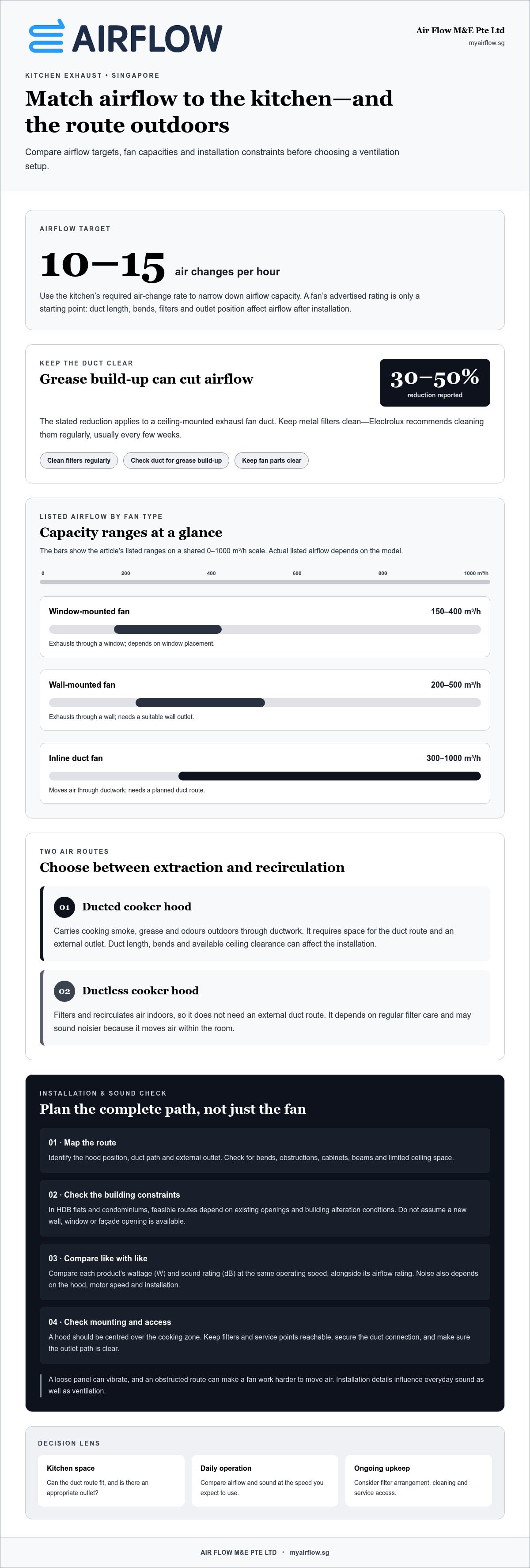
The quietest fan isn’t always the best fit. Choosing a high-efficiency kitchen exhaust fan in Singapore starts with matching airflow to the kitchen: exhaust fans should provide 10–15 air changes per hour. Duct route, mounting position and the noise level you can live with also shape the right setup.
It’s easy to focus on a fan’s advertised airflow and overlook what happens after installation. Ducting takes up space, while bends and grease build-up can affect airflow. A fan that sounds quiet in a showroom may also sound different during daily cooking.
This guide compares ducted and recirculating setups and explains how noise, installation, motor controls, fan size and filter access affect your choice. You’ll also learn how wall-mounted, window-mounted, ceiling-mounted and inline fans differ, then use a practical guide to narrow down a setup for your kitchen.
Key Takeaways
- Choose between ducted extraction and air recirculation based on whether your kitchen can accommodate ductwork and an external air outlet.
- Compare fan noise alongside airflow. Duct route, mounting position and operating speed all affect how a setup performs in daily use.
- Match the hood width to the hob, then compare mounting styles and filter access to find a setup that fits the kitchen and is practical to maintain.
- Use kitchen area and the desired rate of air changes to narrow down airflow capacity, then weigh motor controls against your ventilation needs.
- For commercial kitchen projects, hood installation, exhaust motor installation and custom-fitted ductwork can address the key parts of the ventilation setup.
Ducted cooker hoods and external ventilation
Ducted cooker hoods carry cooking smoke, grease and odours outdoors through ductwork. Ductless hoods filter and recirculate air indoors, so they do not need an external duct route. Ducted extraction removes odours directly, while recirculating models depend on regular filter care and may sound noisier because they move air within the room.
In Singapore, buyers can compare ventilating fan listings from appliance retailers and ventilation suppliers. Check the listed airflow, mounting type, filter arrangement and warranty terms; coverage varies by product and seller. Installation needs depend on the selected fan, available duct route and mounting position.
Grease build-up can reduce airflow in a ceiling-mounted exhaust fan duct by 30–50%. Clean metal filters regularly, usually every few weeks, as Electrolux recommends. Keeping filters and fan parts clear helps address grease accumulation before it restricts ventilation.
A custom ventilation system combines a hood, motor and duct route to suit the kitchen layout. A long duct run or limited ceiling space, for example, can affect which mounting option fits. Map the outlet location and duct path before selecting equipment.
| Option | Air route | Listed airflow | Key consideration |
|---|---|---|---|
| Ducted cooker hood | Exhausts air outside | Depends on model | Requires space for ductwork |
| Ductless cooker hood | Filters and recirculates air | Depends on model | Needs regular filter maintenance |
| Wall-mounted fan | Exhausts through a wall | 200–500 m³/h | Needs a suitable wall outlet |
| Window-mounted fan | Exhausts through a window | 150–400 m³/h | Depends on window placement |
| Inline duct fan | Moves air through ductwork | 300–1000 m³/h | Needs a planned duct route |
Choose a setup that suits the cooking area, outlet route, mounting space and filter-maintenance routine.
When choosing a high-efficiency kitchen exhaust fan in Singapore, compare the complete ventilation path, not just the fan. Duct length, bends, filter condition and outlet position all affect how effectively cooking air leaves the room. Product specifications are a starting point; the kitchen layout determines what will work in practice.
When comparing a ducted hood with a recirculating alternative, include the duct route in your decision rather than treating the hood as a stand-alone appliance. Ductwork takes up space, so consider the route and available clearance alongside the unit. Before choosing a model, identify where the hood would sit, where the duct could run and where air would exit the kitchen. Check that the planned route fits the layout. If it does not, reconsider the mounting position or compare a ductless option, taking its filter-maintenance needs into account. This clarifies the trade-off: external extraction needs a workable duct route, while recirculation avoids ducting but requires ongoing filter care.
Compare the complete installation: note the intended mounting position, space for ductwork, outlet location and filter arrangement. Use these details to assess a suitable configuration and how the planned route affects the installation. If there is little room for ductwork, weigh that constraint against the preference to carry air outdoors. If space is available, make sure the duct path and mounting position work together before choosing equipment. These checks help you avoid selecting a fan based only on its airflow rating or appearance. The final choice should reflect the kitchen’s space, ventilation route and filter-maintenance needs.
Cooker hood noise and installation considerations
Noise depends on the hood, motor speed and installation, not airflow alone. Ductless cooker hoods may run more noisily than ventilating hoods because they circulate air indoors. A fan may also sound different on a high setting than on a low one, so compare sound ratings at the speed you expect to use.
Before installation, map the hood position, duct route and external outlet. A short, direct route can limit bends and unnecessary restrictions. Check whether cabinets, beams or ceiling space obstruct the planned path. A hood centred over a hob, for example, may need a different route from a fan mounted beside a window.
In HDB flats and condominiums, the feasible route depends on existing openings and building alteration conditions. Plan around permitted openings rather than assuming a new wall, window or façade opening is available. Requirements can differ by property and installation location.
Fan models do not share one electricity-consumption or noise figure. Compare each product’s wattage (W) and sound rating (dB) at the same operating speed, then consider those readings alongside its airflow rating. A higher setting can change both power use and sound, so compare the specifications for the setting you expect to use.
Mounting and duct details also affect the sound in the kitchen. A loose panel can vibrate, while an obstructed route can make the fan work harder to move air. During installation, check that the hood is firmly mounted, the duct connection is secure and the outlet path is clear.
- Hood position: Centre the hood over the cooking zone so rising smoke and odours reach the intake.
- Duct route: Trace the path from hood to outlet, noting bends, obstructions and available ceiling space.
- Motor setting: Compare low and high operating speeds against the airflow and sound ratings in the product listing.
- Access: Keep filters and service points reachable for cleaning and routine inspection.
Before choosing, record each option’s airflow, wattage, sound rating, mounting position and duct route. A ductless hood, for instance, avoids an external duct route, while a ventilating hood needs a suitable outlet. The right balance depends on the cooking area, building layout and acceptable operating sound.
For a commercial kitchen, installation planning can account for hood position, exhaust motor and duct routing as one system. Explore commercial kitchen exhaust options when planning a ventilation setup for a commercial space.
Another key distinction is whether a hood recirculates air or sends it through a duct. Ductless recycling cooker hoods filter and return air to the kitchen without ducting. That makes ducting less relevant to the layout decision, though hood position and operating sound still matter. Inclined cooker hoods provide more headroom above the cooktop than designs without an angled form, which may be useful when assessing the space directly over the cooking area.
Include upkeep in your decision: recycling cooker hoods need frequent maintenance and regular cleaning to keep working effectively. Consider whether that routine suits your kitchen, alongside the hood’s fit and sound.
DC motor and variable-air-volume features
A DC motor uses electronic controls to regulate fan speed, offering more adjustment than a basic on-off switch. A cook might select a lower setting for simmering and increase extraction during frying. Consider whether the available settings provide practical control while maintaining the airflow needed for the task.
Variable air volume, or VAV, means airflow changes with demand. In a kitchen, this may mean selecting different fan speeds rather than running one fixed output. It does not necessarily mean automatic sensing. Read the control description to see whether adjustment is manual or sensor-driven.
Motor type alone does not determine ventilation performance. Airflow also depends on fan design, duct route, filter condition and outlet. A powerful motor paired with a restricted duct may not deliver the intended airflow. Compare motor and control features as part of the complete system, not in isolation.
Compare fan controls systematically. Check whether the fan offers distinct speed settings, variable control or only on-and-off operation. Then relate each mode to a cooking task: lower heat may need less extraction, while smoky searing calls for stronger airflow at the hood.
- Control range: Identify the available speed settings or adjustment method.
- Cooking demand: Match lower settings with light cooking and higher settings with smoke or heavier cooking.
- Air path: Consider duct restrictions and filter condition alongside motor capability.
- Sound: Compare operating noise at the setting you expect to use most.
Control quality matters when cooking demands change. A fixed-speed fan runs at the selected output until it is switched off or adjusted. Variable-speed control lets the user adapt extraction as cooking changes. Simmering soup and stir-frying, for example, create different ventilation demands, so one setting may not suit both.
For a planned ventilation system, define the operating needs before selecting a motor. Note the cooking equipment, expected use, hood position and route to the outlet. These details help determine whether adjustable airflow is useful or a simpler control will suit the kitchen.
Finally, check that the motor control matches the fan and installation design. The controls should operate the intended motor, and the hood and duct should support the required airflow. Clear product specifications help distinguish useful control features from labels that do not explain how the fan behaves during cooking.
Fan sizes and mounting filters
Start with the hob width. Electrolux recommends a cooker hood at least as wide as the hob in Singapore. Common hood widths are 60cm and 90cm. For example, a 60cm hob needs a hood at least 60cm wide. A wider hood can capture rising smoke beyond the cooking zone, but available cabinet and wall space also matter.
Choose a fan type to suit the kitchen layout and cooking pattern. A compact kitchen with light cooking may need a different setup from an open-plan space used for frequent frying. Check where the fan can be mounted, where air can exit and whether the hood covers the active burners. Match the stated airflow to the kitchen’s ventilation needs, not just the product’s dimensions.
Filters affect grease capture and cleaning access. Metal filters in many ducted cooker hoods catch grease before it reaches the duct. Electrolux recommends cleaning these filters regularly, usually every few weeks. A removable filter is easier to clean than one blocked by a cabinet edge or awkward hood surround.
Use these checks before choosing a size or filter arrangement:
- Measure the hob: Record its full width, then compare it with hood widths such as 60cm or 90cm.
- Check coverage: Confirm the hood reaches across the cooking zone, including the burners used most often.
- Inspect access: Make sure filters can be removed without shifting cabinets or surrounding fixtures.
- Match the layout: Compare wall, window or ceiling mounting with the available outlet and kitchen space.
For maintenance, clean kitchen exhaust fan grilles and blades every 3 months. Run the exhaust fan for 10–15 minutes after cooking to clear remaining airborne cooking pollutants. For ceiling-mounted kitchen exhaust fans, professional duct cleaning is recommended every 2–3 years. These steps address separate parts of the system: the grille and blades, the room air, and the duct interior.
Filter access matters when cooking produces frequent grease. If a filter is hard to remove, cleaning can be easy to postpone, allowing grease to collect on the filter and inside the duct. Plan for routine access before installation. Leave enough space around the hood to remove filters and reach fan components safely.
Kitchen exhaust fans are recommended for replacement after 8–12 years. Treat that range as a maintenance planning point, alongside changes in airflow, operating sound or visible wear. For a suitable fit, compare hob width, cooking habits, mounting position, outlet route and filter access together. A correctly sized hood still needs a clear ventilation path and regular cleaning.
What airflow capacity (CFM or m³/h) is suitable for a Singapore home kitchen?
Use kitchen size as your starting point. Kitchen exhaust fans should provide 10–15 air changes per hour. Air changes per hour (ACH) describe how often the fan can replace the room’s air in an hour. A larger kitchen needs more airflow to achieve the same rate. Cooking style and ventilation layout also affect the capacity that suits your space.
For a small HDB kitchen of 40–60 sq ft, the listed recommended airflow is 250–400 m³/h. For a standard HDB kitchen of 60–80 sq ft, use 400–550 m³/h as the listed range. A standard HDB kitchen is also listed with a recommended rating of 200–400 CFM. Compare products using the same unit, since a figure in CFM cannot be compared directly with one in m³/h without conversion.
| Kitchen or fan type | Listed airflow | How to use the range |
|---|---|---|
| Small HDB kitchen, 40–60 sq ft | 250–400 m³/h | Compare with the room size and cooking use |
| Standard HDB kitchen, 60–80 sq ft | 400–550 m³/h | Use as a starting range for capacity |
| Open-concept kitchen | Above 800 m³/h | Consider the larger, connected space |
| Wall-mounted fan | 200–500 m³/h | Check wall position and outlet route |
| Window-mounted fan | 150–400 m³/h | Check that the window location works |
| Ceiling-mounted duct fan | 200–600 m³/h | Consider the ceiling duct path |
| Inline duct fan | 300–1000 m³/h | Match capacity to duct layout |
Open-concept kitchens need a different assessment because cooking air can spread into adjoining areas. The listed recommendation for a range hood is above 800 m³/h. That figure is for a range hood, not a universal fan specification. Consider the connected room volume and cooking activity when comparing options.
Start by measuring the kitchen and noting whether it opens into a living or dining area. Then compare the relevant airflow range with the fan’s mounting type and outlet route. Frequent frying or heavier cooking creates greater extraction demand than light cooking. Duct restrictions matter too: the fan’s listed capacity is only one part of the complete airflow path.
For a practical selection, match room size, cooking habits, mounting position and duct route before comparing ratings. If you’re planning ventilation for a commercial kitchen, discuss kitchen airflow planning for a setup suited to its layout and use.
Air Flow M&E Pte: Commercial Kitchen Hood Installation
Air Flow M&E Pte Ltd provides Commercial Kitchen Hood Installation for businesses planning new or upgraded kitchen ventilation. A hood is part of a wider system, so its position, exhaust motor and duct route need to suit the kitchen layout and cooking operations.
These services are suited to commercial kitchens needing a new hood, exhaust motor installation or ductwork fitted to the space. For changes to an existing setup, Commercial Kitchen Exhaust System Addition & Alteration (A&A) Services can address planned system modifications. Air Flow M&E focuses on commercial kitchen ventilation.
Contact Air Flow M&E Pte Ltd to discuss a commercial kitchen hood or exhaust system project.
Plan the next ventilation step with confidence
A suitable ventilation setup starts with the kitchen’s operating needs and the changes required to support them. For commercial kitchens, selecting a high-efficiency kitchen exhaust fan in Singapore is part of a wider system decision. The hood position, exhaust motor and ductwork need to work together for the intended layout.
Air Flow M&E Pte Ltd provides Commercial Kitchen Exhaust System Addition & Alteration (A&A) Services, Commercial Kitchen Hood Installation and Commercial Exhaust Motor Installation. These services support businesses planning a new hood or changes to an existing commercial exhaust system. Share the project requirements and kitchen layout with Air Flow M&E to begin a practical discussion about the next step.
Contact Air Flow M&E Pte Ltd to discuss a commercial kitchen ventilation project. A well-planned system gives your team a clear path toward dependable day-to-day operation.
Frequently Asked Questions
What types of high-efficiency kitchen exhaust fans are available in Singapore?
Singapore kitchens can use ducted cooker hoods, ductless recycling hoods or standalone exhaust fans. These categories describe different features: ducted and ductless refer to where extracted air goes, while wall, window, ceiling and inline describe how a fan is mounted. An inline fan, for example, moves air through ductwork, while a recycling hood filters air and returns it indoors. Compare the air route and mounting method together.
Which kitchen exhaust fan brands and models in Singapore have the highest airflow and energy efficiency?
No single brand or model suits every kitchen, so compare each product’s airflow and power consumption together. Check that ratings use the same units and operating setting, then compare airflow per watt to assess how much air the fan moves for its electrical input. Consider whether the rating suits your outlet and duct arrangement too. A high listed airflow alone does not establish energy efficiency or performance after installation.
What Singapore regulations or HDB and condo rules apply to installing kitchen exhaust fans and ducting?
Plan around existing openings and permitted routes. Do not assume a new wall, window or façade opening is available. Requirements can differ by property and installation location.
What are the electricity consumption and noise levels of popular kitchen exhaust fans in Singapore?
Electricity use and noise vary by model and operating speed. Compare each fan’s wattage and sound rating at the same speed, alongside its airflow rating.


