

Replacing an old exhaust hood isn’t always the first fix. To learn how to solve low suction in a commercial kitchen hood, start by cleaning and checking the filters, then assess airflow, fan and duct performance, cooking output, and hood mounting height. These checks help identify whether a targeted repair or system alteration is more practical than replacement.
Weak extraction can leave smoke, steam, and cooking odours lingering in the kitchen, so it’s natural to suspect the hood. But blocked filters, restricted ductwork, insufficient make-up air, or a mismatch between the hood and cooking equipment can also reduce performance. This guide outlines a practical diagnosis, from filter checks to airflow and installation factors. You’ll learn what to inspect, which signs need technical attention, and how to weigh repair against replacement. The aim is to restore effective extraction without assuming that more suction or a new hood is automatically the answer.
Key Takeaways
- Inspect and clean grease filters regularly; buildup can restrict airflow before a larger fault becomes apparent.
- Use changes in fan performance, belt condition, and airflow readings to help narrow down the cause of weak extraction.
- Match hood capacity to the cooking equipment and heat output, not just the motor’s advertised power.
- Check that the hood’s position lets it capture smoke and steam before they spread beyond the cooking surface.
- Note whether suction loss is gradual, sudden, or inconsistent; airflow changes around doors can help identify a pressure imbalance.
Cleaning grease filters and replacing charcoal filters
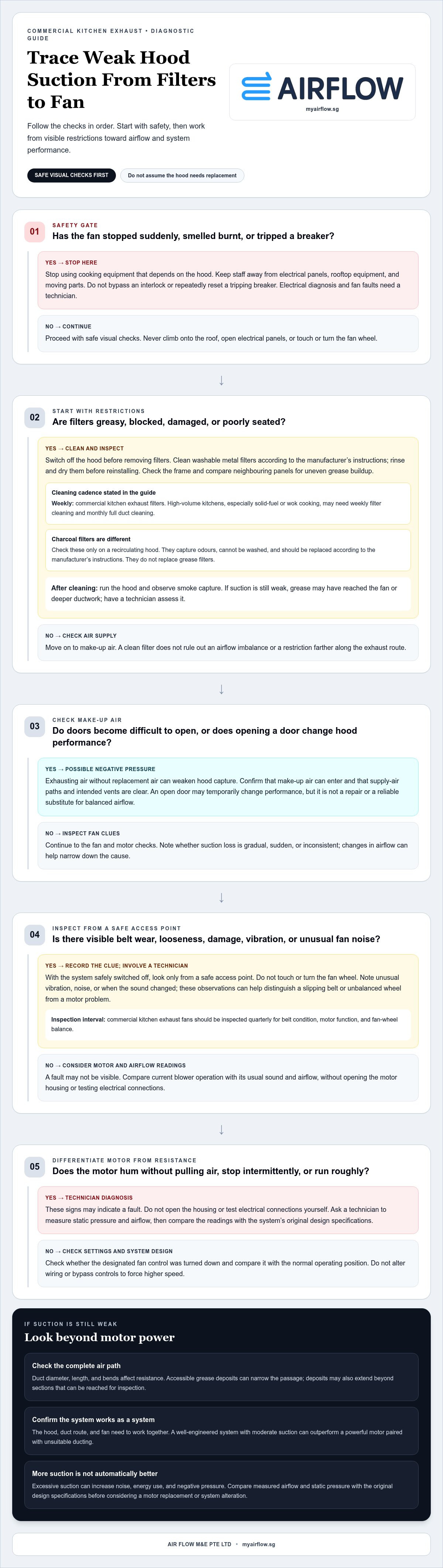
Check for grease on the filters, clean removable metal filters, and inspect accessible duct sections for deposits. Make-up air matters too: a commercial kitchen exhaust system needs replacement air to balance the air it removes. Without it, negative pressure can weaken hood capture.
-
Inspect Hood Filters for Grease Buildup
Switch off the hood before removing filters. Inspect each panel for sticky residue, blocked openings, or visible damage. Grease on a filter restricts the path for smoke and can reduce suction even while the fan is running. Compare neighbouring panels, since one heavily soiled filter can create uneven capture across the cooking line. Check the filter frame as well, where grease can collect around the edges.
-
Clean Grease Filters and Ductwork
Remove washable metal filters and clean them using the hood manufacturer’s instructions. Commercial kitchen exhaust filters should be cleaned weekly. High-volume kitchens, especially those using solid fuel or wok cooking, may need weekly filter cleaning and monthly full duct cleaning. Rinse away detergent and let filters dry before reinstalling them. A wet or poorly seated filter can obstruct airflow rather than restore it.
Inspect accessible ductwork for grease deposits, which can narrow the passage and create a serious fire hazard. The National Environment Agency says workers can clean the fan and accessible duct sections with a scrub pad or cotton cloth soaked in soapy water. Don’t treat a quick wipe of visible surfaces as full duct cleaning; deposits may extend beyond accessible sections.
-
Check Charcoal Filters Separately
Check for charcoal filters only if the hood uses a recirculating configuration. Unlike metal grease filters, charcoal filters capture odours and cannot be cleaned by washing. Replace them according to the hood manufacturer’s instructions, especially if odours persist after the grease filters are clean. Don’t install a charcoal filter in place of a grease filter: they serve different functions, and the grease filter protects the fan from oily deposits.
-
Check Make-Up Air and Fan Components
Confirm that make-up air can enter the kitchen while the exhaust fan runs. Exhausting air without replacement air can create negative pressure, making doors difficult to open and reducing the hood’s ability to capture smoke. Keep supply-air paths and intended vents clear. Opening a door may temporarily change hood performance, but it isn’t a repair or a reliable substitute for balanced airflow.
After cleaning and reinstalling the filters, run the hood and observe smoke capture over the cooking surface. If suction remains weak, grease may have reached the fan or deeper ductwork. Don’t reach into moving equipment. A technician can assess the fan and airflow if cleaning accessible areas hasn’t resolved the problem.
How Can You Diagnose the Exact Cause of Lost Suction?
Start with safe visual checks, then distinguish electrical, mechanical, and airflow faults. Never climb onto the roof or open electrical panels. Exhaust fan faults and rooftop equipment need a technician.
-
Review Troubleshooting Safety Risks
Stop using cooking equipment that depends on the hood if exhaust operation has failed. Smoke and grease-laden air can build up when ventilation stops working. Don’t bypass an interlock or repeatedly reset a tripping breaker. Keep staff away from exposed moving parts, electrical panels, and rooftop equipment while noting what changed.
If the fan stops suddenly, smells burnt, or trips a breaker, leave electrical diagnosis to a technician. Don’t treat an open door as a repair. It may temporarily change airflow, but it doesn’t restore safe exhaust operation.
-
Inspect the Exhaust Fan and Motor
With the system safely switched off, look for visible belt wear, looseness, or damage from a safe access point. Check whether the fan wheel appears obstructed or coated with grease, but don’t touch or turn it. Commercial kitchen exhaust fans should be inspected quarterly for belt condition, motor function, and fan-wheel balance.
Note unusual vibration, noise, or changes in the fan’s sound during operation. These clues can help distinguish a slipping belt or unbalanced wheel from a motor problem. Record when the sound changed so the technician has useful context.
-
Troubleshoot the Blower and Motor
Compare the blower’s current operation with its usual sound and airflow. A motor that hums without pulling air, stops intermittently, or runs roughly may indicate a fault. Don’t open its housing or test electrical connections yourself. Electrical faults require a technician with the appropriate equipment and expertise.
Ask for measured static pressure and airflow, then compare the readings with the system’s original design specifications. This can help distinguish motor failure from resistance elsewhere in the exhaust route. Replacing a motor without checking the connected fan and ductwork may leave the underlying airflow problem unresolved.
-
Check Fan Speed Settings and Airflow Design
Check whether the designated fan control has been accidentally turned down, and compare it with the normal operating position. Don’t alter wiring or bypass controls to force higher speed. More motor power won’t correct poor airflow design, and excessive suction can increase noise, energy use, and negative pressure.
Consider whether the hood, duct route, and fan were designed to work together. Duct diameter, length, and bends affect resistance, while the fan must move air through the installed route. A well-engineered system with moderate suction can outperform a powerful motor paired with unsuitable ducting.
-
Record Symptoms and Arrange a Measured Diagnosis
Note whether suction weakened gradually, dropped suddenly, or varies during service. Record changes in noise, vibration, cooking load, and fan settings. These details give a technician a clearer starting point than simply reporting that the hood feels weak.
For persistent loss, arrange a professional assessment of airflow velocity, static pressure, fan condition, and system design. If the findings point to motor or airflow-system work, review commercial exhaust system solutions as a possible next step.
Matching hood airflow to cooktop type and heat output
Match hood airflow to the cooking equipment, heat output, and capture area. A powerful motor alone won’t compensate for poor hood design or unsuitable placement. To solve low suction in a commercial kitchen hood, start with the cooking load, not just the motor rating.
- Identify the equipment and cooking workload. Gas hobs may require more extraction than electric or induction cooktops because their heat and combustion products increase ventilation demand. Wok cooking and high-heat frying also produce concentrated smoke and airborne grease. Record which appliances operate together, how intensely they’re used, and whether cooking takes place across the full surface.
- Use an airflow benchmark that reflects real resistance. For most kitchens, 700–1,200 m³/h under IEC conditions is often suitable for a gas hob, depending on kitchen size and cooking habits. IEC airflow measurements include resistance, giving a more realistic benchmark than unrestricted airflow. Unrestricted figures measure maximum motor movement without resistance from filters, ductwork, or installation conditions, so they’re usually higher.
- Compare the airflow rating with the cooking style. Wok cooking or high-heat frying may call for 900–1,500 CFM, plus strong static pressure. Everyday electric cooking has a different demand; a market rule of thumb suggests about 300–400 or more CFM, or 10 CFM per inch of cooktop width. Treat these figures as starting points, not interchangeable ratings. Check the units and test conditions before comparing equipment.
- Check capture across the entire cooking surface. The hood should cover the cooking area so smoke and steam reach the filters instead of spilling into the kitchen. Smoke escaping from an outer burner or equipment corner may indicate a coverage mismatch. High suction doesn’t guarantee faster odour removal: extraction primarily removes smoke, steam, and airborne particles.
- Arrange professional airflow testing if the system’s rating and observed capture don’t align. A technician can measure airflow and static pressure, then compare the readings with the original design specifications. This helps identify inadequate airflow, resistance in the installed system, or a mismatch with cooking output. Measurements also clarify how to solve low suction in commercial kitchen hood systems without relying on guesswork.
- Use test results before changing fan speed. Increasing suction can raise noise and energy use, and may contribute to negative pressure. Review the hood, duct route, and cooking load together. A well-engineered setup with moderate suction can outperform a high-power model with poor design, because effective capture depends on the whole ventilation arrangement.
Mounting height above the cooking surface
Check the hood’s position before changing fan settings or assuming a motor fault. Height, coverage, seals, and cooking volume all affect how effectively it captures smoke.
- Measure vertically from the cooking surface to the hood’s lower edge. As a reference, most range hoods are designed for mounting 24 to 30 inches above the cooking surface, though some allow up to 36 inches. Use the hood’s installation specifications to assess the actual unit. Don’t apply a general range without considering its design and the equipment beneath it.
- Compare the measured height with the hood’s stated installation range. A hood mounted too high gives rising smoke more room to spread before capture. Strong airflow alone may not correct that escape path. If the hood is above its specified position, record the measurement and assess the installation geometry before changing fan speed or replacing parts.
- Check whether the hood covers the full cooking surface. Smoke from a wok burner or a busy edge burner may escape if the hood is too narrow or poorly positioned. Note where cooking happens most often, including the outer burners and equipment corners. Hood size and placement should suit the cooking line, not just the centre of the appliance.
- Inspect the hood perimeter and duct connections for visible gaps. Air entering through a loose joint or open edge can weaken the intended capture pattern. Check the baffle filters too: each should sit properly in its frame, without a visible gap around the edge. Don’t remove panels or adjust mechanical fittings while the system is running.
- Relate hood height to cooking volume and heat output. A line used for wok cooking creates a different smoke pattern from a lightly used electric cooktop. Observe capture during normal cooking instead of judging suction with every appliance off. Note which station releases visible smoke beyond the hood. That example can help distinguish poor coverage from an electrical or motor issue.
- Use the inspection findings to decide what needs correction. If the hood’s height, coverage, or seals differ from the installation specifications, an adjustment may matter more than a stronger motor. If the placement is correct but capture remains poor, assess airflow and duct resistance too. This sequence can prevent an unnecessary replacement based on height alone.
Diagnosing gradual, sudden, or inconsistent suction loss
Record when suction changes and what happens around the hood. The pattern can help distinguish grease buildup, an air-supply imbalance, and a sudden equipment fault.
- Track gradual changes across operating shifts. Note when smoke capture began weakening, which cooking stations were active, and whether filter cleaning changed performance. A slow decline may point to accumulating resistance in filters or ductwork, while a sudden drop suggests a different fault. Keep the observations together so a technician can compare symptoms with airflow readings.
- Record sudden changes and stop dependent cooking if exhaust operation fails. Note whether the fan stopped, became unusually noisy, or lost suction after a breaker tripped. Don’t repeatedly reset a tripping breaker or bypass an interlock. These actions don’t identify the fault and can expose staff to electrical or smoke hazards.
- Watch for signs of negative pressure during normal hood operation. Doors that become difficult to open, slam shut, or whistle around their edges can indicate an airflow imbalance. Note whether hood performance improves when a back door is open. That change points toward a possible air-supply or pressure issue, but doesn’t establish the diagnosis.
- Compare exhaust volume with replacement air. A commercial kitchen exhaust system needs make-up air to balance the air it removes. If the supply-air system is restricted, poorly balanced, or not operating as intended, the hood may struggle to capture smoke and particles. Note whether supply vents or dampers appear blocked, but don’t alter mechanical settings yourself.
- Separate airflow symptoms from installation factors. Record whether the hood performs differently at one cooking station, especially near an edge or beneath a different mounting height. Uneven capture may point to coverage or system-design issues rather than a uniform fan failure. Include the cooking activity, hood setting, and door condition in your notes.
- Arrange measured testing when the pattern remains unclear. A technician can measure static pressure and airflow velocity, then compare results with the system’s original design specifications. A pressure gauge or airflow sensor can also alert operators when suction drops below optimal performance. If findings point to changes in system layout or air balance, discuss commercial kitchen exhaust system alterations as a potential next step.
Air Flow M&E Pte: Commercial Kitchen Hood Installation
Air Flow M&E Pte Ltd can help when checks point to an undersized hood, an unsuitable exhaust motor, or ductwork that restricts airflow. Its commercial kitchen hood installation, commercial exhaust motor installation, and custom-fitted ductwork address key parts of the exhaust system. For an existing setup that needs changes, its Commercial Kitchen Exhaust System Addition & Alteration (A&A) Services can support system modifications.
Use your inspection notes to describe the symptoms, including when suction changed, which cooking areas are affected, and any airflow measurements available. This gives the project a practical starting point and helps focus attention on the relevant system components.
Contact Air Flow M&E Pte to discuss your commercial kitchen exhaust needs.
Plan the Next Improvement for Your Kitchen
Once you know how to solve low suction in a commercial kitchen hood, use the diagnosis to guide your next system decision. A clear record of operating issues can help plan improvements around your kitchen’s workflow, equipment changes, and future capacity needs. That turns an immediate performance concern into a more considered approach to ventilation.
Air Flow M&E Pte Ltd supports commercial projects through Commercial Kitchen Exhaust System Addition & Alteration (A&A) Services, Commercial Kitchen Hood Installation, and Commercial Exhaust Motor Installation. The right next step depends on what the system needs, whether that means a new hood, motor installation, or an alteration to the exhaust setup.
Discuss the findings from your kitchen with Air Flow M&E Pte Ltd and explore a practical path forward. A well-planned system decision can help you move ahead with greater confidence.
Frequently Asked Questions
Are there alternatives to repairing an old exhaust hood system?
Yes. Depending on the fault, you can replace a failed exhaust motor, alter the existing exhaust system, or install a new commercial hood. These options address different causes, so consider the hood’s condition, duct layout, cooking equipment, and measured airflow before choosing. Replacing the whole system may be unnecessary if the hood remains suitable and the issue is limited to a component or section of ductwork.
Could the Hood Itself Be the Problem?
Yes. A hood can struggle even with a working fan if its size or position doesn’t suit the cooking line. For example, smoke escaping from an outer burner may indicate inadequate coverage rather than a motor fault. Check whether the hood spans the active cooking surface, whether the filters sit properly, and whether visible damage affects its structure. Compare performance across cooking zones to identify where capture fails.
How Does Damaged or Leaky Ductwork Affect Suction?
Damaged joints or openings can let exhaust escape before it reaches the discharge point, reducing effective airflow at the hood. Grease marks near a duct joint may indicate leakage and need attention, since grease-laden ductwork presents a serious fire hazard. Don’t open duct sections or climb onto the roof to investigate. A technician can assess accessible signs and measure airflow to locate the restriction or loss.
What Maintenance Schedule Prevents Suction Loss?
Clean commercial kitchen exhaust filters weekly, and inspect exhaust fans quarterly for belt condition, motor function, and fan-wheel balance. Schedule professional exhaust cleaning every 1–3 months depending on kitchen volume; high-volume kitchens may need monthly cleaning. Adjust the routine to actual cooking activity, especially wok or solid-fuel use. Mechanical checks don’t replace cleaning, because grease can still accumulate in filters and ductwork.
How to inspect the exhaust fan, motor, belts, and impeller for faults?
Start with a safe visual check while the equipment is stopped. Look for a visibly worn or loose belt, grease on the impeller, or damage around the fan housing. Note unusual noise or vibration during normal operation, but don’t touch moving parts. Leave electrical panels and rooftop equipment to a technician. Commercial kitchen exhaust fans should receive quarterly checks for belts, motor function, and wheel balance.


