

Approximately 50% of commercial property fires in Singapore originate in the kitchen, with grease buildup in exhaust ducts acting as the primary fuel source. It's a stressful reality for F&B owners who want to focus on their menu without worrying about SFA inspections or neighbor complaints regarding smoke and odors. You know that a failing grade or a surprise NEA fine can disrupt your entire operation. Managing technical sizing and duct routing often feels like a hurdle that gets in the way of your daily business goals.
This guide simplifies the complexities of commercial kitchen exhaust duct installation Singapore requirements, specifically focusing on Electrostatic Precipitator (ESP) integration for 2026. You'll learn how to master the technical standards of SS 553:2026 to ensure a compliant, smoke-free kitchen that passes every inspection. We'll cover everything from precise CFM sizing and SCDF fire-rated ducting to pairing high-performance motors with multi-stage filtration for peak efficiency. This article provides a clear roadmap to a quiet, high-performance ventilation system that protects your investment and your reputation.
Key Takeaways
- Understand why ESPs are the benchmark for capturing sub-micron grease and smoke to ensure your facility meets strict SFA emission standards.
- Master the technical side of commercial kitchen exhaust duct installation Singapore by learning how to balance CFM requirements with the right exhaust motor for optimal airflow.
- Learn design strategies for custom transition pieces that reduce air turbulence and maximize the filtration efficiency of your ESP unit.
- Follow a step-by-step roadmap for regulatory compliance, covering everything from initial M&E site surveys to final authority sign-offs.
- Discover how specialized A&A services can integrate high-efficiency filtration into existing kitchen layouts with minimal disruption to your operations.
What is an Electrostatic Precipitator (ESP) in Commercial Kitchens?
An Electrostatic Precipitator (ESP) is a high-efficiency air filtration device designed specifically to handle the heavy grease, smoke, and oil mist generated by commercial cooking. Unlike traditional mechanical filters that rely on physical mesh to block debris, an ESP uses high-voltage electricity to charge and capture particles. It's the gold standard for modern air management, ensuring that your commercial kitchen exhaust duct installation Singapore project meets the rigorous "clean air" requirements set by local authorities. By integrating electrostatic precipitator technology, businesses can eliminate the thick blue smoke often associated with wok frying or charcoal grilling.
Operators typically choose between two main configurations based on their cooking volume and discharge location. Single-pass ESP units are suitable for standard operations, offering between 90% and 95% particulate removal efficiency. For kitchens in high-density areas or those with low-level discharge points, double-pass configurations are used. These systems utilize two stages of collector cells to achieve a removal efficiency of 98.7% or higher, capturing particles as small as 0.01 microns. This precision is what allows an F&B business to operate in a shopping mall or shophouse without triggering odor or smoke complaints from neighbors.
The Science of Smoke Removal
The process begins when contaminated air passes through an ionization zone. Here, high-voltage wires create a corona discharge that gives grease and smoke particles a strong electrical charge. As these charged particles move into the collection stage, they are attracted to oppositely charged or grounded plates. They stick to these plates until the unit is cleaned, preventing them from exiting the duct. Standard mechanical filters cannot pass SFA smoke tests because they lack the ability to trap these sub-micron aerosols. Collection efficiency is the measured percentage of particulate matter successfully removed from the air stream before it reaches the discharge point.
Why Singapore F&B Businesses Require ESPs
Singapore's unique urban density means restaurants often share walls with residential units or offices. Without an ESP, visible smoke and cooking smells quickly become a public nuisance, leading to NEA investigations. To secure and maintain an SFA license, your system must demonstrate a "no visible smoke" output. Beyond legal compliance, an ESP is a critical fire safety tool. It captures fine grease before it can settle and solidify within your kitchen ductwork. By keeping the internal surfaces of your ducts cleaner for longer, you significantly reduce the risk of a flash fire, which is the leading cause of property damage in the local F&B sector.
Technical Requirements for ESP Duct Installation in Singapore
Successful commercial kitchen exhaust duct installation Singapore projects rely on precise airflow calculations. You cannot simply "plug and play" an ESP unit into an existing duct run. The most critical metric is Cubic Feet per Minute (CFM). If your ESP capacity doesn't match the total volume of air pulled from your hoods, the system will fail to capture smoke effectively. This mismatch is a leading cause of failed SFA inspections during the licensing phase.
Adding an ESP introduces static pressure resistance into the ventilation system. This "pressure drop" often means your existing fan might struggle to pull air through the collector cells. In many A&A projects, a kitchen exhaust motor replacement is necessary to compensate for this added load. Choosing a motor with a higher static pressure rating ensures the system maintains a transport velocity of 6 m/s to 12 m/s, preventing grease from settling in horizontal duct sections.
Placement is equally vital for both performance and safety. The ESP should be installed at least 3 to 5 meters away from the kitchen hood. This distance allows hot air to cool slightly, protecting the sensitive internal electronics from heat damage. Simultaneously, the unit must be positioned for easy maintenance. You need at least 1 meter of clear side-access to slide out the heavy collector cells for regular degreasing. Failing to provide this clearance leads to neglected servicing and eventual system failure.
Sizing Your ESP for Optimum Airflow
Undersizing your ESP is a common mistake that leads to smoke bypass. When air moves too quickly through the unit, the "dwell time" is insufficient for the electrostatic charge to bond with grease particles. Conversely, an oversized unit leads to unnecessary energy costs and potential duct vibration issues. To find the right fit, calculate the total hood length and cooking intensity to determine the required CFM. Select an ESP rated for approximately 10% to 15% above that load to account for future filter loading and maintain efficiency.
Electrical and Safety Integration
Safety standards mandate that the ESP must be electrically interlocked with the exhaust fan. This ensures the air cleaner only operates when there is active airflow, preventing the dangerous buildup of ozone or heat within the duct. According to the NEA Code of Practice on Environmental Health requirements, discharge points must also maintain specific distances from fresh air intakes and neighboring windows to prevent cross-contamination.
Additionally, SCDF regulations require any duct sections housing air cleaners to be constructed with fire-rated materials if they penetrate fire compartments. For outdoor installations, ensure the unit has a waterproof housing and proper grounding to protect against Singapore's heavy rainfall. If you are unsure about your current system's capacity, our team can provide a professional site assessment to identify the best integration strategy for your kitchen layout.
Custom Ductwork and ESP Integration Strategy
Singapore's commercial spaces often feature low ceiling voids and complex structural layouts. Successfully executing a commercial kitchen exhaust duct installation Singapore project requires more than just buying an ESP unit; it demands custom-engineered ductwork. In shophouses and malls, you'll often find structural beams or existing M&E services blocking the most direct path. We design custom transition pieces that bypass these obstacles while maintaining the necessary airflow velocity for your system.
Transition pieces are critical because they manage how air enters the ESP inlet. If the air is too turbulent, the ionization process becomes uneven, leaving some grease particles uncharged. According to EPA technical guidance on electrostatic precipitators, maintaining uniform air distribution is essential for achieving peak collection efficiencies. We use high-grade galvanized or stainless steel for these sections. Choosing the correct material thickness prevents duct "popping" or noise during high-volume operation and ensures the system meets local fire safety standards.
A&A Works: Retrofitting ESPs into Existing Systems
Retrofitting an ESP into an older kitchen is a core part of our Addition & Alteration (A&A) services. A single-pass unit is heavy, but a double-pass system can weigh several hundred kilograms. We assess your ceiling's structural capacity to ensure mounting brackets can handle this load safely. Our team coordinates these modifications during off-peak hours to minimize your business downtime. We focus on precision fitting to ensure the new air cleaner integrates seamlessly with your legacy hood and motor without causing airflow bottlenecks.
Optimizing Airflow Distribution
To prevent "hot spots" where air moves too fast through specific cells, we install perforated plates at the ESP inlet. These plates break up air turbulence and ensure every part of the collector cell is utilized. Sharp duct bends immediately before or after the ESP should be avoided. They create backpressure and reduce filtration efficiency. Every junction is sealed with high-temperature, leak-proof gaskets to prevent grease leakage into your ceiling void. This level of detail ensures your commercial kitchen exhaust duct installation Singapore remains clean, quiet, and compliant for years.
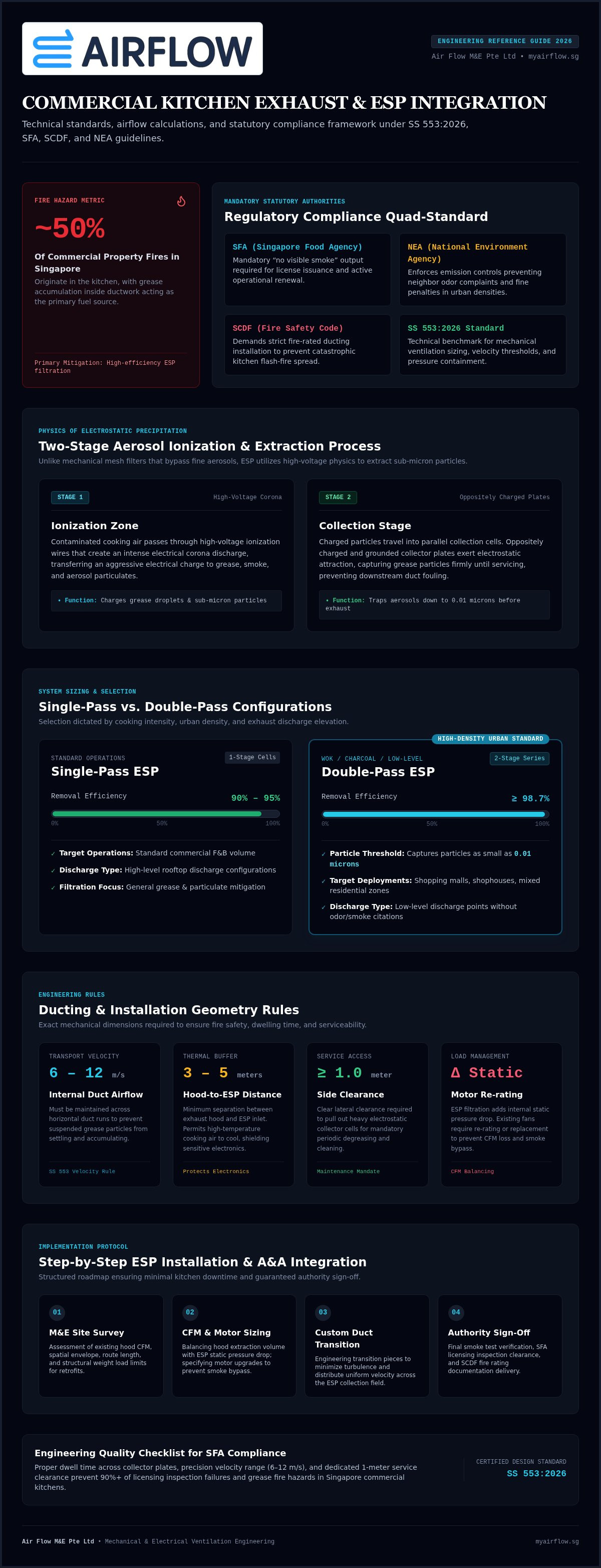
Step-by-Step ESP Installation Roadmap for F&B Operators
A successful commercial kitchen exhaust duct installation Singapore project begins with a detailed site survey. We don't just measure space; we calculate the total M&E load to ensure your existing Distribution Board (DB) can handle the ESP's electrical requirements. This initial phase identifies potential bottlenecks in duct routing, such as existing structural beams or shared services in tight ceiling voids. It's the most critical step for avoiding costly mid-project modifications.
Once the survey is complete, we move to the submission of plans for BCA, SFA, or NEA approval where required. This documentation is essential for your licensing process. We then fabricate custom duct transitions and heavy-duty support frames in our workshop. These frames are precision-engineered to manage the significant weight of double-pass ESP units, ensuring they remain secure even during high-velocity airflow. Physical installation is followed by electrical interlocking to ensure the air cleaner and exhaust fan operate in sync.
Pre-Installation: Compliance and Planning
Before any physical work starts, you must coordinate with mall management or building owners for duct access. We help you prepare the necessary technical documentation for your SFA licensing inspections. This includes checking that your electrical setup is ready for the additional ESP load. Planning for these details early prevents delays in your kitchen's opening date and ensures your layout meets all environmental health and fire safety codes.
Post-Installation: Testing and Commissioning
The final stage involves rigorous performance verification. We conduct a smoke test to confirm that your system achieves the target removal efficiency, which reaches 99% for double-pass configurations. We also measure air velocity across the collector cells to ensure the dwell time is sufficient for effective particle charging. Noise levels are checked at the discharge point to prevent public nuisance complaints from nearby residents or businesses. Finally, we hand over a maintenance schedule and SFA-compliant servicing logs. If you need a reliable partner to manage your upcoming fit-out, contact our specialist team for a site survey.
Why Air Flow M&E is Your Trusted Partner for ESP A&A Works
Air Flow M&E specializes in Addition & Alteration (A&A) works, which is crucial for operators needing to upgrade legacy systems without a total overhaul. Our expertise in commercial kitchen exhaust duct installation Singapore ensures that new ESP units fit perfectly into your existing footprint. We don't believe in one-size-fits-all solutions. Instead, we fabricate custom-fitted ductwork that maneuvers around the unique structural constraints of Singapore shophouses and malls. This precision reduces air leakage and ensures your system operates at peak efficiency from day one.
We manage the entire lifecycle of your ventilation project. This includes everything from initial commercial kitchen hood installation to the final integration of high-efficiency air cleaners. Our team has a proven track record of helping diverse F&B concepts pass SFA and NEA inspections on the first attempt. By choosing a specialist who understands the mechanical and electrical nuances of Singapore's regulatory environment, you avoid the risk of costly rework or licensing delays.
The 'Safe Pair of Hands' Approach
We provide pragmatic solutions that balance technical performance with your specific budget constraints. Our approach is grounded in safety and long-term functionality, ensuring your kitchen remains smoke-free and compliant for years. You can expect direct, professional communication with no engineering fluff. We focus on the facts: static pressure, CFM requirements, and regulatory adherence. This transparency gives you the peace of mind to focus on your business while we handle the technical complexities.
Comprehensive Kitchen Ventilation Solutions
Efficiency is a priority in every A&A project we undertake. We pair high-performance exhaust motors with your ESP to minimize energy consumption and reduce operational costs. Whether you are launching a new concept or modifying a complex existing system, our engineering mindset ensures a disciplined, methodical execution. We understand the high-stakes nature of commercial operations and work to deliver a system that is both quiet and powerful. Get a professional ESP installation quote from Air Flow M&E today to secure your kitchen's future.
Future-Proof Your Singapore Kitchen Ventilation
Navigating the 2026 regulatory landscape requires more than just standard equipment. Successful commercial kitchen exhaust duct installation Singapore depends on the seamless integration of high-efficiency ESP units with precision-engineered ductwork. It's about matching your airflow capacity to your cooking intensity and ensuring fire-rated compliance to protect your business from costly NEA fines or neighbor complaints. Meticulous A&A works allow you to retrofit these essential systems even in the most restricted shophouse or mall ceiling voids where standard solutions often fail.
Air Flow M&E provides the technical authority and custom fabrication expertise needed to keep your operations running smoothly. As a specialist in commercial mechanical and electrical A&A works with a deep focus on SFA/NEA compliance, we ensure your ventilation system is a dependable asset rather than a regulatory risk. We handle the technical complexities so you can focus on delivering a great dining experience. Secure Your SFA Compliance with Professional ESP Installation today. We look forward to helping your F&B business maintain a clean, efficient, and smoke-free environment for years to come.
Frequently Asked Questions
Does my restaurant really need an ESP to get an SFA license?
SFA licensing requires that your kitchen doesn't discharge visible smoke or odors that cause a public nuisance. For most commercial F&B establishments, an ESP is the most reliable way to achieve this standard. Without one, you risk failing your pre-licensing inspection or receiving complaints that lead to enforcement action. It's a standard requirement for any kitchen using heavy cooking methods like frying or grilling.
What is the difference between a single-pass and a double-pass ESP?
The primary difference lies in the filtration efficiency and the number of collector cell stages. A single-pass unit uses one set of cells to capture approximately 90% to 95% of particles. A double-pass unit uses two stages to achieve 98.7% efficiency or higher. Double-pass systems are often necessary for kitchens with low-level discharge points or those located in high-density shopping malls.
How often should the ESP cells be cleaned in a commercial kitchen?
Most ESP cells require professional cleaning every 1 to 3 months depending on your cooking volume and menu. Heavy wok frying or charcoal grilling generates more grease, necessitating more frequent servicing to maintain the electrostatic charge. While SCDF mandates a full duct degreasing once every 12 months, your ESP cells must be washed much more often to prevent the unit from losing its filtration power.
Can I install an ESP if I have very limited ceiling space?
Limited ceiling space is a common challenge that we solve through specialized A&A services. We design custom-fitted ductwork and transitions that allow the ESP to be positioned in tight voids or alternative locations. If a horizontal installation isn't possible, we can explore vertical mounting or exterior placements. Our engineering team focuses on creating compact layouts that don't compromise your kitchen's operational space.
Will an ESP reduce the suction power of my kitchen hood?
An ESP creates static pressure resistance, which can reduce suction if your existing motor isn't powerful enough. To ensure your commercial kitchen exhaust duct installation Singapore remains effective, we calculate the pressure drop across the filter cells. You may require a high-performance exhaust motor replacement to compensate for this resistance. This ensures your hood continues to pull smoke away from the cooking line efficiently.
What happens if my ESP fails an NEA smoke inspection?
Failing an NEA smoke inspection typically results in a formal warning or a fine. You'll be required to rectify the system immediately to eliminate visible emissions. This usually involves a technical audit to check for undersized units, saturated collector cells, or improper airflow distribution. We specialize in modifying non-compliant systems to bring them back into alignment with Singapore's strict environmental health standards.
Can I get government grants for ESP installation in 2026?
F&B operators in 2026 should check for available productivity or energy-efficiency grants through Enterprise Singapore or NEA. These schemes often support the adoption of high-efficiency air cleaning systems that reduce environmental impact. While we don't manage grant applications, we provide the technical specifications and quotations required for your submission. It's a pragmatic way to offset the initial investment while ensuring your facility remains compliant.
How do I interlock my ESP with my existing exhaust fan?
Interlocking is achieved by connecting the ESP power pack to the exhaust fan's control circuit. This ensures the air cleaner only activates when the fan is pulling air through the duct. We use airflow sensors or electrical relays to automate this process. Proper interlocking is a critical safety requirement that prevents the buildup of ozone and reduces the risk of electrical faults within your ventilation system.


