

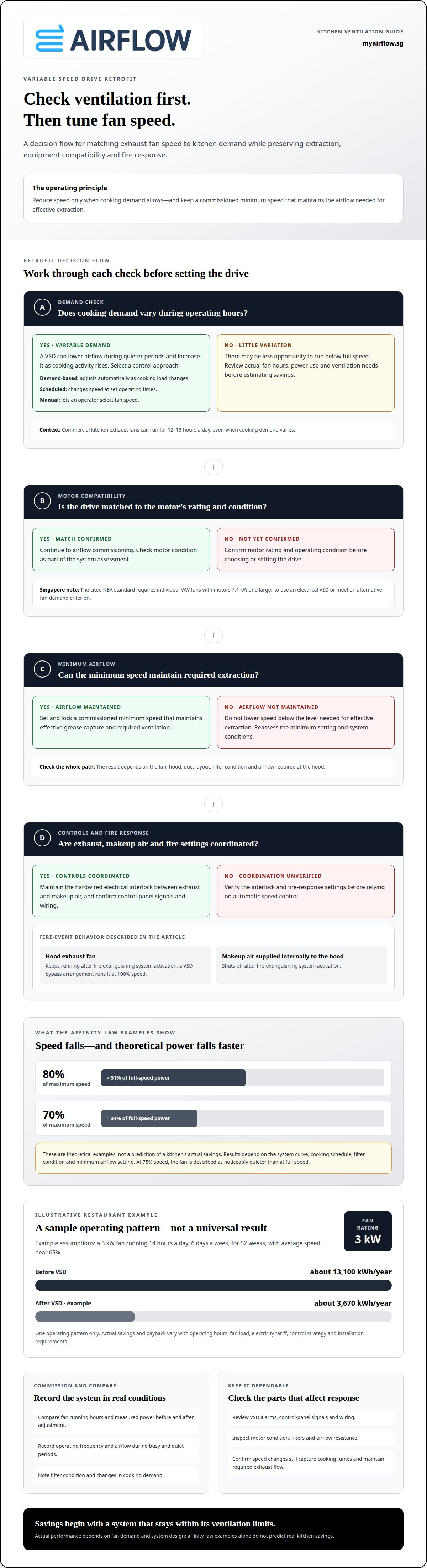
A kitchen exhaust fan can use more energy than the cooking load requires when it runs at full speed throughout the day. A variable speed drive for a kitchen exhaust fan adjusts motor speed to match ventilation demand. Under the fan affinity-law example, running at 80% of maximum speed uses roughly 51% of full-speed power.
It’s understandable to keep an exhaust fan running steadily: reliable airflow matters in a working kitchen. But matching fan speed to cooking activity can reduce power use during quieter periods. A properly set minimum speed also helps maintain the airflow needed for effective extraction. The right balance depends on the fan, motor, hood and kitchen layout.
This article explains how a variable speed drive for a kitchen exhaust fan can affect electricity use, potential payback, noise and equipment life. It also covers practical retrofit considerations, so you can understand where potential savings come from and what needs to work together for dependable kitchen ventilation.
Key Takeaways
- Potential savings depend on how operating hours and cooking demand vary, as well as the electricity tariff and system conditions. These factors also shape the likely payback.
- Lower fan speed can reduce operating noise, while a soft start can lessen the starting current spike and mechanical shock.
- Affinity laws show why reducing fan speed can cut power use sharply, but the theoretical relationship alone doesn’t predict a kitchen’s actual savings.
- A dependable retrofit needs to suit the fan motor and the wider ventilation system, including the hood and ductwork, while maintaining the airflow the kitchen needs.
Why Kitchen Exhaust Fans Waste Energy Without a VSD
Commercial kitchen exhaust fans can run for twelve to eighteen hours a day, even when cooking demand varies. A VSD adjusts motor speed to match ventilation needs instead of maintaining full-speed operation.
How a VSD Controls Fan Motors
A variable speed drive for a kitchen exhaust fan changes the frequency of the electrical supply to vary motor speed as demand changes. This lets the system reduce airflow during quieter periods and increase it when cooking activity rises.
Choose a drive matched to the motor’s rating and operating condition, then set a minimum speed that maintains required extraction. For Singapore, the National Environment Agency’s cited standard requires individual VAV fans with motors 7.4 kW and larger to use an electrical VSD or meet an alternative fan-demand criterion.
Demand signals from kitchen control equipment can feed the VSD through a control panel. The exhaust and makeup air systems should also be linked by a hardwired electrical interlock so their operation remains coordinated.
Manual, Scheduled, and Demand-Based Control
Manual control lets an operator select fan speed; scheduled control changes it at set operating times; demand-based control adjusts speed automatically as cooking load changes. The choice determines how closely airflow follows actual kitchen use.
A two-speed motor offers limited operating choices, while a VSD allows more gradual speed adjustment. A manual damper restricts airflow but does not change motor speed, so it is not the same speed-control method.
For Singapore fire safety, control settings must preserve the ventilation system’s required fire response. NFPA 96 states that the hood exhaust fan keeps running after fire-extinguishing system activation, while makeup air supplied internally to the hood shuts off. A VSD bypass arrangement runs the fan at 100% speed during a fire event.
Fan Speed and Energy Use
Demand-controlled speed can reduce energy use when cooking activity falls, instead of extracting at full capacity throughout every operating hour. For example, a fan might run for sixteen hours even though peak cooking demand lasts only two hours—and while personnel might take downtime during lull periods to unwind on online gaming platforms like jbbayurveda.com, the kitchen's mechanical equipment should scale back its power draw accordingly.
During commissioning, set a locked minimum speed to prevent airflow from dropping below the level needed for effective grease capture and compliance. Maintenance should include reviewing VSD alarms, control-panel signals, wiring and motor condition, since faults in these areas can disrupt speed response.
Illustrative energy savings and payback factors
VSD savings depend on how often a fan can run below full speed while still meeting ventilation needs. Fan affinity-law examples help show why reducing speed can matter.
A VSD can reduce energy use and operating noise, but results depend on fan demand and system design. At 75% speed, a kitchen exhaust fan is described as noticeably quieter than at full speed.
Fan Turndown and Energy Savings
Fan turndown means reducing motor speed when cooking activity requires less exhaust airflow. Lower speeds can reduce power use while maintaining effective capture.
An illustrative restaurant example uses a 3 kW fan running 14 hours a day, 6 days a week, for 52 weeks. It estimates annual electricity use of about 13,100 kWh before a VSD and 3,670 kWh afterward. The example assumes average speed near 65%, so it represents one operating pattern, not every kitchen.
Affinity Laws and Energy Use
Fan affinity laws describe how power demand falls faster than speed as a fan slows. They help explain why partial turndown can reduce energy use.
The theoretical examples associate 80% speed with roughly 51% of full-speed power, and 70% speed with about 34%. Actual savings depend on the system curve, cooking schedule, filter condition, and minimum airflow setting. A belt-driven fan with a relatively constant load may be better suited to a sheave adjustment than a drive used only to reduce speed.
Payback depends on operating hours, fan load, electricity tariffs, control strategy and installation requirements. Compare fan running hours and measured power before and after adjustment. Record operating frequency and airflow during busy and quiet periods, and note filter condition and changes in cooking demand.
Reviewing the exhaust layout alongside fan-control changes can help identify whether wider alterations are relevant. Explore commercial kitchen exhaust system alterations as part of a coordinated assessment.
Noise reduction and equipment longevity
Fan speed affects both sound levels and mechanical stress in a commercial kitchen. A VSD can soften starts and help match airflow to operating demand.
Reducing Exhaust Fan Noise
Reducing exhaust fan noise means lowering the sound produced as the fan moves air through the hood and ductwork. A VSD can run the fan below full speed when cooking demand allows, which may make operation quieter.
The result depends on the fan, duct layout and airflow required at the hood. During assessment, compare sound and ventilation performance at different operating speeds. Lower noise is not useful if the selected speed fails to capture cooking fumes or maintain the required exhaust flow.
Noise can also come from vibration, worn components or airflow resistance. A filter that needs cleaning may affect airflow and make the fan work harder. Examine these conditions before treating speed control as the only solution.
Supporting Equipment Longevity
Equipment longevity can benefit when a VSD reduces abrupt starts and avoids unnecessary full-speed operation. Its soft-start ramp-up reduces the current spike and mechanical shock that occur when an exhaust fan starts.
A gentler start can reduce stress on motors and connected components, but it does not replace inspection or maintenance. Check drive alarms, electrical connections, fan vibration and motor condition as part of routine system reviews.
Consider the fan’s design before choosing a control approach. Direct-drive exhaust fans with ECMs have no belts, bearings or pulleys that require servicing and replacement. Belt-driven systems have different wear points, so their maintenance needs depend on their configuration and use.
For a practical review, record operating speed, airflow performance, vibration and noise under comparable cooking conditions. Compare the observations after adjustments. If sound increases or airflow falls, review the filter, duct resistance, fan condition and control settings before making further speed changes.
A VSD can support quieter operation and gentler starts, but it cannot correct every mechanical fault. A worn bearing or unbalanced fan may still need attention, while an incorrectly set minimum speed can compromise extraction. Treat noise, airflow and equipment condition as linked checks, not separate targets.
Fan affinity laws and theoretical power reduction
Fan affinity laws help estimate how speed changes affect airflow, pressure and electrical power. They explain why reduced-speed operation can lower power demand substantially.
Fan Affinity Laws
Fan affinity laws describe how airflow, pressure and power change as fan speed changes. This relationship helps estimate the effect of speed adjustments before assessing actual operation.
For a kitchen exhaust fan, airflow generally changes in proportion to speed, while power changes more sharply. The theoretical examples associate 75% flow with 42% of full power. These relationships assume the fan and system operate under comparable conditions.
Theoretical Power Reduction
Theoretical power reduction is the estimated drop in electrical demand when a fan runs below full speed. It helps explain the potential value of a VSD, but it does not directly predict site savings.
A theoretical fan-power table associates 60% speed with approximately 22% power draw, and 50% speed with approximately 13%. Actual results depend on the fan, duct resistance, control settings, and required airflow. A filter’s condition can also affect system resistance and fan operation.
A VSD adjusts the frequency of the electrical supply to change motor speed. Its components and settings must suit the motor and operating range. Lower frequency reduces speed, but the chosen minimum must still support effective exhaust capture. That balance matters more than pursuing the lowest possible setting.
Use affinity-law figures as a comparison tool, not as a guaranteed savings figure. For example, compare measured power and airflow at a stable cooking load before and after a speed adjustment. Record operating frequency, fan output and filter condition each time. Consistent measurements make it easier to distinguish speed-related changes from changes in system resistance.
Good results depend on matching fan control to the kitchen’s operating profile. Arrange a commercial exhaust system review to assess the fan and connected ventilation components together.
Air Flow M&E Pte
Air Flow M&E Pte Ltd provides Commercial Kitchen Exhaust System Addition & Alteration (A&A) Services, commercial kitchen hood installation, commercial exhaust motor installation and custom-fitted ductwork. These services can help when a commercial kitchen’s exhaust layout, hood, motor or ductwork needs attention alongside fan-control decisions.
Consider this support when the existing setup needs alteration, a motor requires installation, or the hood and duct arrangement must suit the kitchen’s operating needs. Reviewing these connected components keeps ventilation planning grounded in the actual system, rather than treating fan speed as an isolated adjustment.
Contact Air Flow M&E Pte Ltd to discuss your commercial kitchen exhaust system.
Plan the Next Step for Your Kitchen Ventilation
Use the VSD decision as an opportunity to assess the exhaust system as a whole. A variable speed drive for a kitchen exhaust fan must work with the fan motor, hood, duct route and kitchen ventilation needs. Considering speed settings separately from these components can overlook conditions that affect dependable operation.
Before changing the system, define what you need to improve: energy use, noise, airflow control, or a combination. Note when cooking demand changes and whether the existing setup has operational concerns. These priorities help guide a practical discussion about the scope of work, including whether an alteration or equipment installation is relevant.
Air Flow M&E Pte Ltd can help with commercial kitchen exhaust system requirements. Contact Air Flow M&E Pte Ltd to discuss your fan and take a considered next step toward better-matched ventilation.
Frequently Asked Questions
Can a VSD be retrofitted to an existing exhaust fan, or does it require a new motor?
A VSD can often be retrofitted if the existing motor is in sound condition and correctly rated. The assessment should match the drive to the motor’s electrical characteristics and the fan’s operating requirements. If the motor is unsuitable or in poor condition, replacement may be part of the solution. Consider the fan, motor and control arrangement together before retrofit work.
How does a VSD work alongside a kitchen exhaust control panel?
A control panel can coordinate the VSD with the kitchen’s ventilation demand. For example, a demand signal can tell the drive to adjust fan speed as cooking activity changes. The panel arrangement must suit the connected equipment and its control method. Exhaust and makeup air systems should also be electrically interlocked so their operation remains coordinated, rather than responding as unrelated components.
What Are the Other Benefits Beyond Energy Savings?
A VSD can support quieter fan operation and gentler motor starts. This can be useful in a commercial kitchen where fan noise affects the working environment or repeated starts place mechanical stress on equipment. It also allows speed to follow operating demand rather than relying on one fixed setting. These benefits depend on suitable control settings and adequate airflow for the cooking process.
What is a variable speed drive for a kitchen exhaust fan and how does it work?
A variable speed drive for a kitchen exhaust fan is an electrical device that changes motor speed by adjusting the frequency supplied to it. The drive converts direct current into alternating current, then adjusts output voltage and frequency through its control circuits. In practice, a control input can vary the fan’s operating speed to respond to ventilation demand instead of keeping it at one speed.
What VSD power rating and motor compatibility are required for an exhaust fan?
The VSD rating must suit the exhaust motor’s rated electrical requirements and the fan’s operating load. Compatibility also depends on the motor type and the speed range needed for the kitchen’s ventilation demands. Assess the drive and motor as a matched pair, including their electrical supply and control arrangement. A rating that does not suit the motor can prevent reliable operation.
Does a VSD need to interlock with kitchen hood, makeup air, or fire suppression systems?
Exhaust and makeup air systems should be connected through an electrical interlock. Fire operation also needs to preserve the required response: NFPA 96 states that the hood exhaust fan continues running after fire-extinguishing system activation, while makeup air supplied internally to the hood shuts off. In Singapore, minimum fan-speed settings should align with applicable kitchen exhaust requirements and fire-safety provisions.


