

A more powerful fan may address an exhaust shortfall in a commercial kitchen, but only if the hood, ductwork and make-up air can support the increased airflow. Upgrading exhaust for increased kitchen capacity may also require changes beyond the fan. The right solution depends on the cooking load and how the complete system performs together.
If extraction can’t keep pace with service, smoke, heat and grease-laden air may escape the hood, while a poorly matched upgrade can add cost without fixing the cause. You’ll learn how to tell when a fan replacement is enough, how undersized exhaust can affect compliance and operating costs, and what to consider when planning an upgrade in Singapore.
Food court capacity planning requires considering several cooking loads across a shared exhaust system. Hood coverage, duct capacity and balanced make-up air all shape the scope of an upgrade. Understanding these factors helps you plan a practical solution around your kitchen’s needs.
Key Takeaways
- A more powerful fan can help when the hood and ductwork can handle the airflow. An assessment of the full system helps identify the actual bottleneck.
- Restricted or poorly matched ductwork can reduce exhaust performance, even after a fan upgrade. Find out which system components affect pressure and airflow.
- Installation costs depend on the scope of work, from replacing a fan to altering the hood or ductwork. Learn which project factors shape the estimate in Singapore.
- Food court capacity planning must account for different cooking loads and balanced make-up air. See how these considerations guide upgrade decisions across shared systems.
1. How does an undersized exhaust hood affect code compliance?
An undersized hood may not capture cooking fumes, heat and grease-laden air at the source. Escaping contaminants can contribute to grease buildup around the cooking line and leave staff working in a hotter, smokier kitchen. A stronger fan alone may not solve the problem if the hood misses equipment or the ductwork restricts airflow.
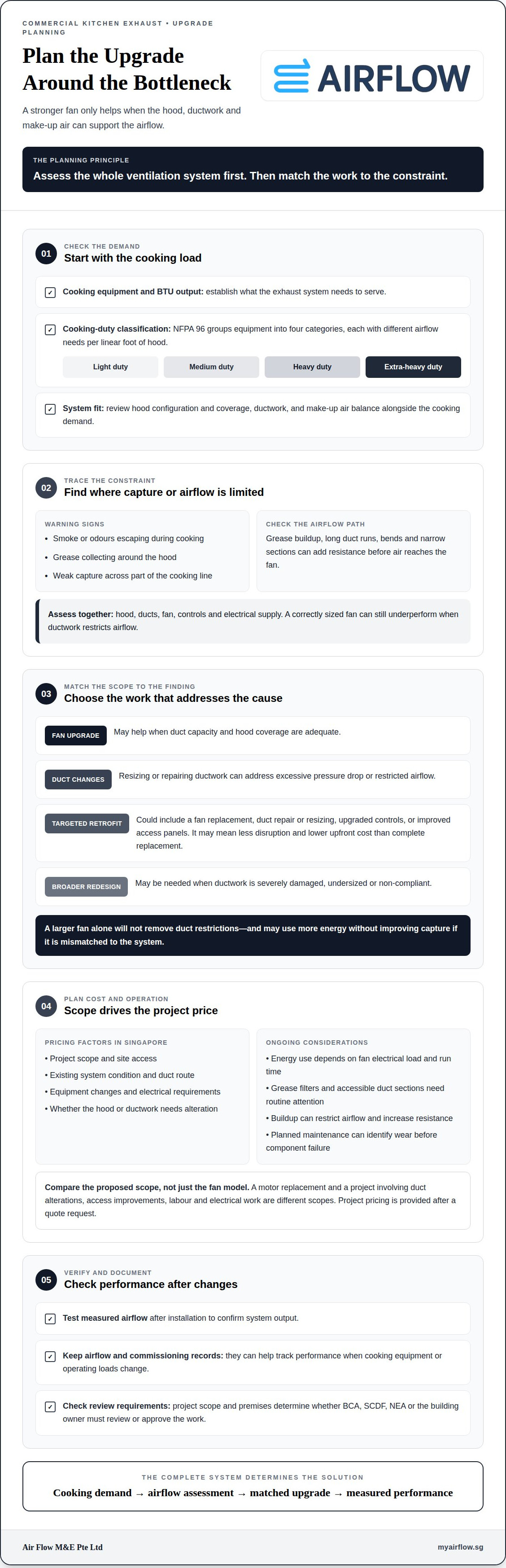
A ventilation professional assesses the system as a whole. The assessment considers cooking equipment and BTU output, cooking-duty classification, hood configuration, ductwork, and make-up air balance. NFPA 96 groups equipment into light, medium, heavy, and extra-heavy duty categories, each with different airflow needs per linear foot of hood. These factors help establish an airflow rate suited to the cooking load.
For operators upgrading exhaust for increased kitchen capacity, an assessment can reveal whether the limiting factor is the fan, hood coverage or air balance. There is no single standard capacity for a larger commercial kitchen. Required airflow depends on the equipment, cooking duty, hood configuration and make-up air.
There is no single approval answer for every upgrade. Project scope and premises determine whether BCA, SCDF, NEA, or the building owner must review or approve the work. Before upgrading exhaust for increased kitchen capacity, identify which building systems or fire-safety arrangements the proposed changes affect.
Airflow monitoring can help tenants track system performance after cooking equipment or operating loads change. If a landlord or building manager requests records, measured airflow and commissioning results provide useful documentation. A professional can compare readings with the project’s design criteria and identify pressure or capture problems.
Improved airflow can capture cooking emissions more effectively and reduce smoke escaping from the hood. An assessment may show that wider hood coverage or changes to duct resistance and make-up air are needed. Correct sizing matches the complete ventilation system to the kitchen’s cooking demand.
2. What are the long-term costs of running an undersized system?
Pressure drop can restrict exhaust airflow before it reaches the fan. Grease buildup, long duct runs, bends and narrow sections add resistance. A correctly sized fan may still underperform if existing ductwork limits airflow, and replacing the motor alone will not remove that restriction. Poor capture and heavier cleaning needs can persist if the system does not match cooking demand.
Persistent smoke or odours escaping during cooking, grease collecting around the hood, and weak capture across part of the line are practical warning signs. A professional assessment can trace the cause through the hood, ducts, fan, controls and electrical supply. It can determine whether fan replacement, duct alteration or a wider system change addresses the problem. Each option targets a different constraint.
A retrofit may suit an exhaust system with sound core components and a specific fault. Common work includes replacing an outdated fan, repairing or resizing ductwork, adding upgraded controls, or improving access panels. Retrofitting can improve performance with less disruption and lower upfront cost than complete replacement. However, severely damaged, undersized, or non-compliant ductwork may call for a larger redesign instead.
System options depend on what the assessment finds. A fan upgrade may help when duct capacity and hood coverage are adequate. Resizing ductwork can address excessive pressure drop. Demand-controlled ventilation adjusts operation to cooking loads, while improved access panels support inspection and cleaning. Grease management also matters: buildup can increase resistance and undermine the gains from replacement equipment.
In Singapore, project pricing depends on the work scope, duct access, equipment changes, and electrical requirements; a price is provided after a quote request. A commercial kitchen exhaust assessment can help identify whether targeted retrofitting or broader redesign is the more practical route. Addressing the cause, rather than simply fitting a larger fan, helps avoid spending on capacity the existing system cannot deliver.
3. Exhaust fan installation costs in Singapore
Commercial exhaust fan installation costs in Singapore depend on the project scope, site access, and existing system condition. A like-for-like motor replacement differs from work that also changes the hood or ductwork. A project price depends on these factors and is provided after a quote request. For an accurate scope, the assessment considers the required airflow, existing electrical connections, duct route, and whether other components need alteration.
Long-term costs also reflect cleaning and maintenance needs. Grease filters and accessible duct sections need routine attention to limit grease and particle buildup in the exhaust path. Restricted airflow can reduce capture and place extra demand on the fan. Planned maintenance helps identify wear before a component failure disrupts kitchen operations. A retrofit may address a specific issue, while damaged or undersized ductwork can call for broader alteration or replacement.
Energy use depends on the fan’s electrical load and how long it runs. Installing a larger fan without matching it to the hood and duct system may use more energy without improving capture. A balanced system pairs suitable exhaust airflow with make-up air to reduce pressure problems. After installation, measured airflow testing helps confirm the system’s output.
Compare the proposed scope, not just the fan model. One project may need a motor replacement, while another requires duct alterations and improved access for cleaning. These differences affect labour, materials, electrical work and disruption to kitchen use. An assessment identifies which parts can remain and which need attention, giving you a practical basis for comparing a targeted alteration with broader system work and considering ongoing maintenance.
4. Food court exhaust capacity planning
For food court operators, upgrading exhaust for increased kitchen capacity starts with the combined cooking load, not simply a larger fan. Exhaust volume depends on each stall’s cooking type, heat output, grease production, hood coverage, and ductwork layout. A stall using heavier cooking can place different demands on a shared system than one using lighter cooking. Planning around the combined load helps maintain capture and air quality during busy service.
As a scale reference, a 30-stall food court is estimated to need 30,000–50,000 m³/h of exhaust purification capacity. Exhaust generated per stall can range from 800–2,000 m³/h, depending on cooking type. Stall count alone cannot determine the correct system volume. The cooking mix and shared duct arrangement also shape demand.
For example, if 30 stalls each generate 1,500 m³/h, their combined exhaust capacity is 45,000 m³/h. That calculation assumes the same output from every stall. A real layout may have varied loads, so the design needs to account for equipment and hood coverage at each cooking position. Otherwise, high-load stalls may lose capture even when the overall fan appears powerful.
A professional assessment maps stall layout, hood positions, duct routes, fan capacity, and make-up air. Exhaust volume must be balanced with incoming air. Negative pressure can reduce capture and affect air movement in adjoining areas. Demand-controlled ventilation can adjust operation to cooking loads, while commissioning checks system airflow and balance. Grease management and fire-suppression integration also belong in the upgrade plan.
Before upgrading exhaust for increased kitchen capacity, assess the shared system against the proposed cooking mix. This helps locate constraints in fan capacity, hood coverage, ductwork, or make-up air. Plan a food court exhaust upgrade around stall loads, duct capacity, and balanced ventilation rather than relying on a constant fan increase.
Air Flow M&E Pte Ltd
Air Flow M&E Pte Ltd helps commercial kitchens plan exhaust alterations when cooking capacity grows or existing extraction struggles to capture fumes. The practical next step is to identify the system constraint and match the project scope to it, rather than assume a larger fan alone will solve the problem.
An upgrade may involve commercial kitchen exhaust system addition and alteration, commercial kitchen hood installation, commercial exhaust motor installation or custom-fitted ductwork. These components work as a system: the hood captures cooking emissions, while the motor and ductwork carry exhaust away from the kitchen. The right scope depends on the kitchen layout and the changes required.
Consider Air Flow M&E Pte Ltd when adding cooking equipment, changing a food court stall layout or addressing persistent capture problems. Contact the company to discuss your commercial kitchen exhaust requirements and plan the appropriate upgrade.
Plan the next step with confidence
Increasing kitchen output is also an opportunity to align exhaust performance with future operations. Before committing to equipment changes, define the cooking capacity the space needs to support and the constraints the project must work within. A clear scope keeps the upgrade focused on operational needs, rather than fan power alone.
A plan for upgrading exhaust for increased kitchen capacity should connect the intended cooking load with the right system changes. Air Flow M&E Pte Ltd provides Commercial Kitchen Exhaust System Addition & Alteration (A&A) Services, Commercial Kitchen Hood Installation and Commercial Exhaust Motor Installation for commercial kitchens. The appropriate work depends on the project and the system components involved.
Share your kitchen’s planned changes and exhaust concerns to start a practical discussion about the next step. Contact Air Flow M&E Pte to discuss your commercial kitchen exhaust requirements. A well-scoped upgrade gives your team a clearer path to supporting service with suitable ventilation.
Frequently Asked Questions
Can a professional replace my exhaust fan with a more powerful one?
A professional can replace the fan, but a higher-rated model is suitable only if the rest of the system can support it. A narrow duct or hood that misses part of a cooking line may still limit capture. Before recommending a replacement, an assessment should consider the fan, duct route, hood coverage, electrical supply and incoming make-up air.
How does an undersized exhaust hood affect code compliance?
An undersized or poorly positioned hood may not capture cooking emissions effectively across the equipment line. Smoke and grease-laden air can escape the hood, creating cleaning and operational problems. A larger fan alone does not establish that an installation meets applicable requirements. Documenting the upgrade scope and measuring system airflow can support a clearer review.
How much does exhaust fan installation cost in Singapore?
The cost depends on the work involved, such as motor replacement, hood changes or ductwork alterations. Access, electrical requirements and the condition of existing components also shape the project scope. Air Flow M&E Pte Ltd provides fixed upfront pricing with no hidden fees, so you know the price before work proceeds.
What are the long-term costs of running an undersized system?
Long-term costs can include more frequent cleaning, maintenance and corrective work if the system repeatedly fails to capture cooking emissions. Grease buildup in a restricted exhaust path may require more cleaning, while unresolved airflow problems can call for further system changes. The lasting cost depends on the underlying constraint, kitchen operations and whether the work addresses the affected system components.
What health and safety risks come with an undersized exhaust system?
An undersized system can allow heat, smoke and cooking emissions to escape into work areas, making conditions less comfortable during service. Escaped grease can also accumulate on nearby surfaces and require additional cleaning. These issues deserve attention when cooking equipment or workload changes. A professional assessment can identify weak capture and whether the system needs alteration.
How do ventilation professionals calculate kitchen exhaust airflow based on cooking equipment and hood size?
A professional assessment considers the cooking equipment, heat output, cooking duty, hood configuration and make-up air balance. It also examines whether the hood serves each appliance and covers the active cooking area. Adding a high-heat appliance, for example, can change airflow requirements even if the hood dimensions stay the same. Measured airflow testing after installation helps assess system output.


