

That rattling sound from your exhaust hood isn't just noise; it's a countdown to an unplanned shutdown. While your first instinct might be to call for a quick fix, the cheapest repair often turns into your most expensive operational mistake. In a high-stakes kitchen environment, a failing motor threatens your workflow and your bottom line.
We understand the daily stress of keeping a busy Singapore kitchen running. Dealing with poor suction, rising electricity bills, and the constant fear of an SFA inspection failure is a heavy burden for any operator. You need a solution that restores airflow and ensures safety without draining your maintenance budget. You want the peace of mind that comes from knowing your ventilation system is reliable and compliant.
Deciding on commercial kitchen exhaust motor repair vs replacement requires a clear look at long-term costs and regulatory risks. This guide shows you exactly when to salvage your motor and when a full replacement is the only way to stay compliant. We'll examine the "50% rule," energy efficiency gains, and how strategic A&A upgrades can protect your business from downtime throughout 2026.
Key Takeaways
- Identify early warning signs of motor failure, such as excessive vibration and reduced smoke extraction, to prevent unplanned kitchen downtime.
- Use the professional "50% Rule" to make a data-driven decision on commercial kitchen exhaust motor repair vs replacement based on long-term ROI.
- Ensure your ventilation system meets 2026 SFA and NEA standards for noise levels and environmental health to avoid licensing delays.
- Evaluate the financial benefits of upgrading to high-efficiency motors that lower operational costs and restore optimal airflow in your kitchen.
- Learn how expert M&E diagnostic assessments and custom-fitted ductwork ensure a seamless motor installation tailored to your specific kitchen layout.
Signs of Commercial Kitchen Exhaust Motor Failure: When to Worry
A failing motor rarely dies silently. It usually sends several warning signals before a total breakdown occurs. Recognizing these early symptoms helps you weigh the pros and cons of commercial kitchen exhaust motor repair vs replacement before an emergency forces your hand. Identifying these issues early can save thousands in lost revenue from unplanned downtime.
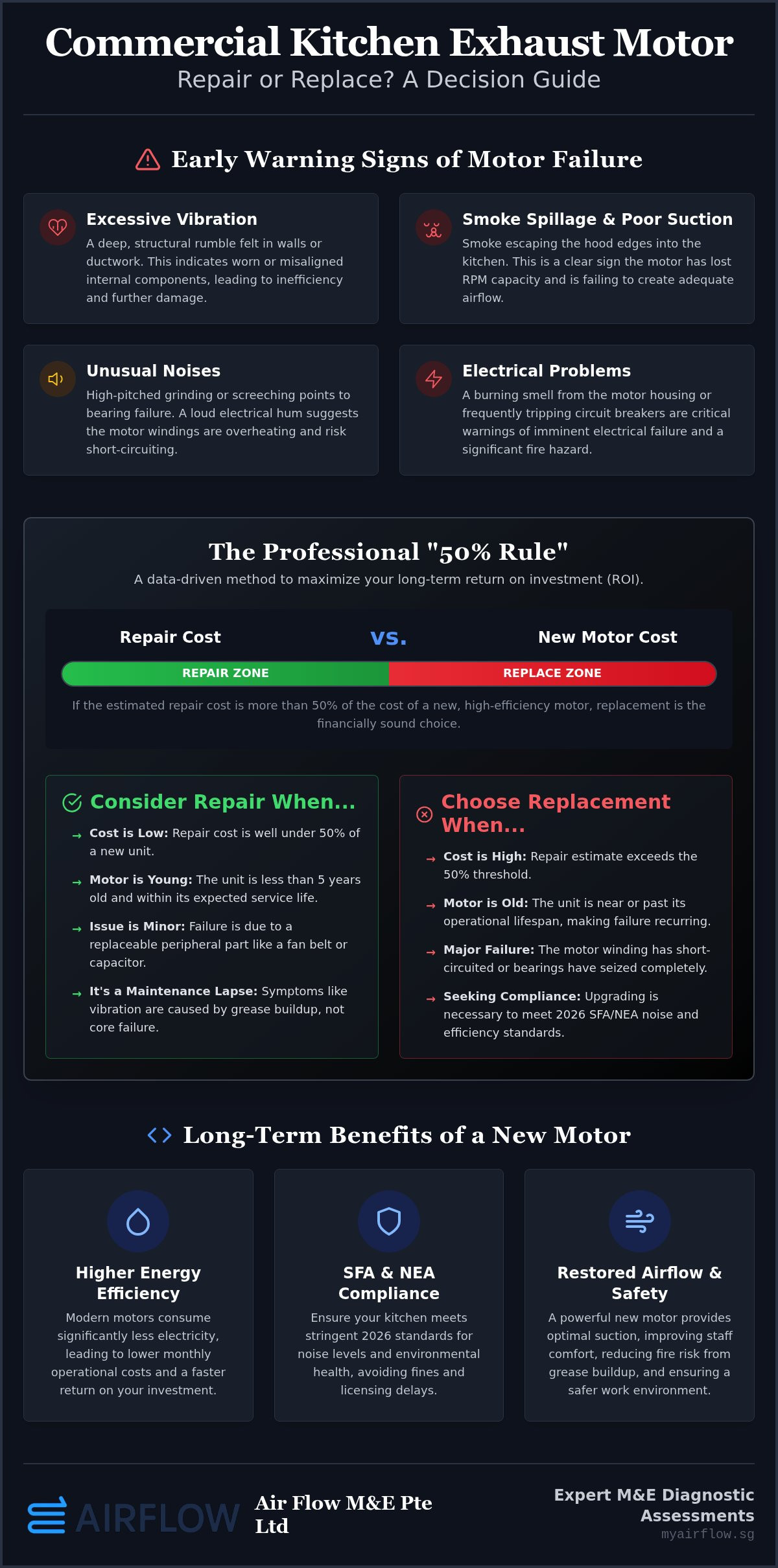
Excessive vibration is a primary red flag. If you feel the walls or ductwork shaking, the motor's internal components are likely misaligned or worn. This often manifests as a deep structural rumble that can be heard even in the dining area. Similarly, a loud electrical hum or a burning smell originating from the motor housing indicates that the internal windings are overheating or short-circuiting.
You might also notice sudden drops in static pressure. When the motor loses its RPM capacity, smoke lingers over the stoves instead of being pulled through the filters. If the starter box or control panel trips frequently, the system is telling you that the motor is drawing too much current. This is a critical warning that a total electrical failure is imminent.
Visual and Auditory Warning Signals
Listen for high-pitched grinding metal sounds. This typically points to bearing failure. While Kitchen ventilation systems are designed to move air efficiently, worn bearings create friction that slows the entire system down. You should also regularly check for grease accumulation inside the motor assembly. While some residue is expected, heavy buildup causes the motor to run hotter than its rated temperature, accelerating wear on the internal components.
- Smoke Spillage: Observe the hood edges during peak cooking hours. If smoke escapes into the kitchen, the motor isn't providing enough suction.
- Bearing Noise: Grinding or screeching sounds indicate that the motor's mechanical integrity is compromised.
- Grease Saturation: A motor "choked" by grease is a major fire hazard and a sign of poor maintenance.
Operational Impact on Your F&B Business
Poor ventilation creates a hazardous work environment. High ambient temperatures lead to staff heat exhaustion and high turnover rates. It's difficult to maintain food quality and service speed when your kitchen team is struggling to breathe in a smoky, humid environment. Beyond staff comfort, a failing motor significantly increases fire risks. When airflow slows, grease particles settle more quickly inside the ducts rather than being exhausted, creating a dangerous fuel source.
Regulatory compliance is the most immediate threat to your operations. SFA and NEA inspectors prioritize ventilation efficiency and noise control. A noisy or underperforming motor can lead to immediate inspection failures. In the 2026 regulatory environment, failing to maintain your exhaust system can result in heavy fines or temporary suspension of your food shop license. Proactive assessment is the only way to avoid these high-stakes consequences.
The Case for Kitchen Exhaust Motor Repair: When Fixes Make Sense
Repairing your system is often a viable path when the core motor remains structurally sound. When weighing the choice between commercial kitchen exhaust motor repair vs replacement, consider the age of your equipment first. If your motor is less than five years old, it's likely still within its expected service life and potentially covered by a manufacturer warranty. In these cases, swapping out a minor component is far more logical than a full teardown. Many global engineering benchmarks are derived from OSHA ventilation standards, which emphasize that regular maintenance of mechanical parts is essential for operator safety and system longevity.
Sometimes, what looks like a mechanical failure is actually a maintenance lapse. Heavy grease buildup on fan blades causes imbalance and vibration, mimicking the symptoms of a dying motor. A professional degreasing of the motor assembly can often "fix" these symptoms without needing new parts. Regular preventive maintenance is the most effective way to extend your motor's lifespan and avoid the high costs of emergency interventions.
Common Repairable Motor Components
Most motor issues stem from peripheral parts rather than the motor winding itself. Fan belts are common culprits; they stretch and slip over time, causing a noticeable drop in RPM and suction. Replacing a belt is a quick, low-cost fix that restores performance immediately. Capacitors and electrical contactors also fail frequently due to heat exposure. If your motor hums but won't start, a faulty capacitor is the likely suspect. Bearing replacement is another common repair that can significantly reduce noise levels in centrifugal fans, helping you maintain a better environment for both staff and customers.
Calculating the Short-Term Cost of Repair
You must factor in more than just the price of a spare part. Specialized M&E technicians charge for labor, and the downtime during the repair process can cost your restaurant significant revenue. If a repair costs less than 30% of a new unit and the motor is relatively young, it's usually a safe investment. However, be cautious of recurring small repairs. If you're fixing the same starter box every few months, you're likely dealing with a systemic electrical issue that a simple patch won't solve. If you're unsure if your motor is salvageable, a professional M&E diagnostic assessment can provide the technical clarity you need to make an informed decision.
The Decision Matrix: Comparing Repair Costs vs Replacement ROI
Choosing between commercial kitchen exhaust motor repair vs replacement shouldn't be based on guesswork. You need a data-driven framework to protect your bottom line. Industry specialists typically apply the "50% Rule" as a primary benchmark. If the quoted repair cost exceeds half the price of a brand-new unit, replacement is the logical choice. This calculation becomes even more compelling when you evaluate the Total Cost of Ownership (TCO) over a three-year operational window. A new motor eliminates recurring call-out fees and prevents the revenue loss associated with sudden kitchen closures.
Energy efficiency is another critical factor in the ROI equation. Modern IE3 and IE4 high-efficiency motors provide significant power savings compared to older, standard-efficiency models. These units are engineered to maintain high performance in the intense heat of Singaporean kitchens while drawing less current. Over a 36-month period, the reduction in monthly utility bills often offsets a substantial portion of the initial installation cost. Newer technology also features better sealing and heat dissipation, which naturally reduces long-term maintenance frequency.
Age and Performance Benchmarks
Most commercial exhaust motors have a functional lifespan of 8 to 10 years. Beyond this point, internal components like windings and rotors suffer from permanent thermal degradation. This leads to a measurable drop in airflow (CFM) even if the motor sounds like it's running normally. Repairing a motor in this age bracket is often a "sunk cost" because secondary components are likely to fail shortly after the initial fix. The ROI of a high-efficiency motor upgrade is realized through lower monthly utility bills, reduced fire risk, and the elimination of emergency repair expenses.
Future-Proofing Your Kitchen Ventilation
Future-proofing your facility involves more than just restoring basic function. A new installation allows for the integration of Variable Speed Drives (VSD), which adjust motor output based on actual cooking volume. This drastically reduces mechanical wear and tear. Furthermore, modern motors are designed to operate more quietly, helping you meet increasingly strict NEA noise level standards for commercial properties near residential areas. Adhering to the NFPA 96 standard ensures your ventilation system meets global fire safety benchmarks. For more technical specifications on hardware, refer to our Commercial Kitchen Exhaust Motor Replacement: The 2026 F&B Reference Guide.
How to Evaluate Your System for SFA and NEA Compliance
Compliance is the baseline for any F&B operator in Singapore. When debating commercial kitchen exhaust motor repair vs replacement, you must look beyond mechanical function to regulatory standing. The Singapore Food Agency (SFA) mandates specific ventilation standards to ensure a safe, hygienic food preparation environment. If your motor is underperforming, smoke and heat accumulate, which can lead to immediate licensing issues during your annual audit.
National Environment Agency (NEA) regulations are equally critical, particularly regarding noise and odour discharge. If your exhaust motor is located near residential areas, it must adhere to strict decibel limits. A repaired motor with worn bearings often emits a high-pitched whine that triggers neighbour complaints and NEA investigations. In these cases, a strategic replacement with a modern, low-noise unit is often the only way to avoid heavy fines and operational stop-work orders.
Any significant change to your exhaust system, including motor swaps, should be treated as an Addition & Alteration (A&A) project. This ensures that the new motor specifications align with the original design intent of the building's mechanical systems. Proper grease filtration is also mandatory to prevent environmental discharge. NEA monitors these discharge points closely, and a failing motor that cannot push air through high-efficiency filters will quickly become a liability.
Passing the SFA Inspection Checklist
SFA inspectors verify that your kitchen maintains adequate air change rates to prevent grease and heat buildup. During an audit, you must provide documentation for all M&E works, including specific motor performance data and maintenance records. Discharge points are also scrutinized; they must be positioned correctly to prevent exhaust from re-entering the building or affecting adjacent premises. Ensuring your motor provides the necessary static pressure is vital for passing these checks and maintaining your food shop license.
Managing Noise and Odour Complaints
Modern motors equipped with vibration isolators are a business necessity in Singapore's dense urban landscape. These components decouple the motor from the building structure, preventing low-frequency hums from traveling through walls. Custom-fitted ductwork also plays a major role by reducing air turbulence noise. If your current system is loud, a professional M&E compliance assessment can identify whether a repair or a full A&A upgrade is required to meet NEA standards and protect your reputation.
Professional Replacement: Enhancing Airflow with Air Flow M&E
Strategic replacement is more than a maintenance expense; it's an investment in operational longevity. When your technical assessment confirms that the commercial kitchen exhaust motor repair vs replacement debate leans toward a new unit, you need a partner that handles the mechanical complexity. Our M&E engineers conduct comprehensive on-site diagnostic assessments to determine the exact requirements of your facility. We don't just provide a motor; we deliver a fully integrated ventilation solution tailored to your specific kitchen layout.
We specialize in the selection and installation of high-performance centrifugal and axial motors. Every kitchen has unique static pressure demands, and choosing the wrong motor type leads to poor suction or excessive noise. Our team manages the entire Addition & Alteration (A&A) service lifecycle. This includes everything from initial technical load calculations to final compliance testing, ensuring your system meets all 2026 Singapore safety standards.
The Air Flow M&E Installation Process
Precision is the hallmark of a successful M&E project. We follow a disciplined three-step process to ensure your new motor performs at peak efficiency from day one.
- Step 1: Technical load calculation and motor sizing. We analyze your hood dimensions and duct length to calculate the precise CFM and static pressure required.
- Step 2: Custom fabrication of transition pieces and supports. Our workshop creates custom-fitted ductwork components to ensure the new motor integrates seamlessly with your existing infrastructure.
- Step 3: Precision installation and airflow balancing. Our engineers execute the installation with a focus on vibration isolation and system balancing to minimize noise and maximize lifespan.
Why Partner with a Commercial Specialist?
Avoid the common "residential contractor" trap. Commercial F&B ventilation is significantly more complex than home kitchen setups; it requires specialized knowledge of high-heat environments and grease management. A residential-focused contractor often lacks the equipment for custom-fitted ductwork or the expertise to manage formal A&A works. Choosing a specialist ensures you have a "safe pair of hands" managing your mechanical systems. We provide the technical authority and long-term support needed to keep your kitchen running without interruption. Contact Air Flow M&E for a professional exhaust motor assessment to secure your kitchen's operational future.
Secure Your Kitchen's Operational Future
Making the right choice for commercial kitchen exhaust motor repair vs replacement requires a pragmatic look at your system's age and performance. While minor component fixes extend the life of newer units, the 50% rule remains the most reliable benchmark for financial planning. Investing in a high-efficiency replacement isn't just about restoring suction; it's a strategic move to lower utility bills and ensure your facility meets strict 2026 SFA and NEA compliance standards.
Air Flow M&E provides a safe pair of hands for your mechanical needs. We are specialized in commercial A&A works and serve as custom ductwork fabrication specialists to ensure every installation fits your unique layout perfectly. Our expertise in SFA/NEA compliance requirements helps you avoid the risk of inspection failures or noise complaints from neighbors. Precision engineering and proactive maintenance are the keys to a stress-free kitchen environment.
Get a Professional Assessment for Your Kitchen Exhaust Motor to keep your business running at peak efficiency. We're here to help you make the right technical choice for your long-term success.
Frequently Asked Questions
Is it better to repair or replace a 10-year-old exhaust motor?
Replacement is almost always the better choice for a 10-year-old motor. Most commercial units are designed for an 8 to 10-year service life. By this stage, internal insulation has degraded and efficiency has dropped significantly. Investing in a repair for such an old unit often leads to "sunk cost" bias. A new high-performance motor offers better reliability, lower energy consumption, and guaranteed compliance with current safety standards.
What are the SFA requirements for commercial kitchen exhaust motors in Singapore?
SFA mandates that your ventilation system effectively removes smoke and grease to maintain a hygienic environment. In 2026, inspectors prioritize air change rates and fire safety. You must keep detailed maintenance records, including proof of annual professional degreasing as required by the SCDF Fire Code. A motor that fails to provide adequate suction can result in a failed audit and potential suspension of your food shop license.
How much downtime should I expect for a motor replacement?
You should expect between 4 to 8 hours of downtime for a standard motor replacement. Our engineers plan these installations during your off-peak hours to minimize impact on your revenue. The process includes removing the old unit, installing the new motor, and performing airflow balancing. If custom-fitted ductwork is necessary, we fabricate the pieces in our workshop beforehand to ensure the on-site installation is fast and efficient.
Can a new motor be installed into my existing ductwork?
Yes, modern motors can be integrated into existing systems, but they often require custom-fitted ductwork transitions. Our M&E engineers assess your current duct diameter and layout to ensure the new motor's static pressure matches the system's needs. Precision fitting is essential to prevent air leaks and vibration. A seamless connection ensures that your ventilation remains efficient and meets the original design specifications of your commercial facility.
Will a more powerful motor solve my kitchen smoke problem?
A more powerful motor isn't always the solution. Smoke problems are often caused by ductwork restrictions, clogged grease filters, or poor hood positioning. Simply increasing motor power can create excessive noise and air turbulence without improving smoke capture. We perform technical load calculations to identify the root cause. This ensures you choose the right airflow capacity rather than just a bigger motor that wastes electricity and increases operational noise.
Does NEA regulate the noise levels of my kitchen exhaust fan?
NEA regulates noise levels strictly, especially for F&B outlets near residential areas. If your exhaust fan emits high-pitched whines or deep structural rumbles, you risk receiving a nuisance complaint. Modern motors with vibration isolators are designed to meet 2026 NEA environmental health standards. Precision installation of the motor and custom-fitted ductwork reduces mechanical noise, helping you maintain a positive relationship with the community and avoiding potential NEA penalties.
What is the difference between a centrifugal and an axial exhaust fan?
Centrifugal fans are the industry standard for commercial kitchens because they handle the high static pressure of grease filters and long duct runs. They are durable and efficient for heavy-duty use. Axial fans move large volumes of air but are less effective when they face resistance. For most Singaporean F&B layouts, centrifugal motors are preferred as they provide the consistent suction needed to ensure SFA compliance and fire safety.
How often should I perform preventive maintenance on my exhaust motor?
You should perform professional preventive maintenance every 3 to 6 months. Regular checks on belt tension, bearing lubrication, and electrical components prevent sudden breakdowns during peak hours. Consistent servicing is the best way to avoid the commercial kitchen exhaust motor repair vs replacement dilemma. It extends equipment life, maintains energy efficiency, and ensures your system continues to meet SFA hygiene standards without requiring expensive emergency interventions or full system overhauls.


