

What if a commercial kitchen could use less ventilation energy without compromising smoke and heat capture during service? Energy efficient commercial kitchen ventilation isn’t simply a matter of turning fans down. Exhaust airflow, replacement air, hood design and cooking demand all need to work together. If a system runs harder than needed during quieter periods, energy may be wasted. If airflow is reduced without maintaining capture, kitchen comfort and reliable operation can suffer.
It’s a balance operators need to get right, especially in Singapore’s hot, humid conditions. This guide explains practical ways to improve an existing or planned system, from control strategies and airflow adjustments to hood, motor and ductwork modifications. You’ll learn how the options differ, which conditions affect their suitability, and why exhaust and replacement air should be assessed as connected parts of the kitchen. We’ll also cover how to keep effective capture in view while planning changes around applicable Singapore requirements.
Key Takeaways
- Assess the hood, exhaust motor, ductwork and replacement air as connected parts of the ventilation system before choosing an efficiency upgrade.
- Learn how energy efficient commercial kitchen ventilation can match airflow to operating demand while keeping capture and containment in focus.
- Compare demand control, hood improvements, airflow and ductwork changes, and heat recovery by their dependencies and operational considerations.
- Build a practical project brief by recording cooking equipment, service patterns, smoke or heat concerns, and available system information.
- See how project-specific commercial exhaust A&A, hood installation, motor installation and custom-fitted ductwork can address existing layout or system constraints.
Why Energy Efficient Commercial Kitchen Ventilation Starts With the Whole System
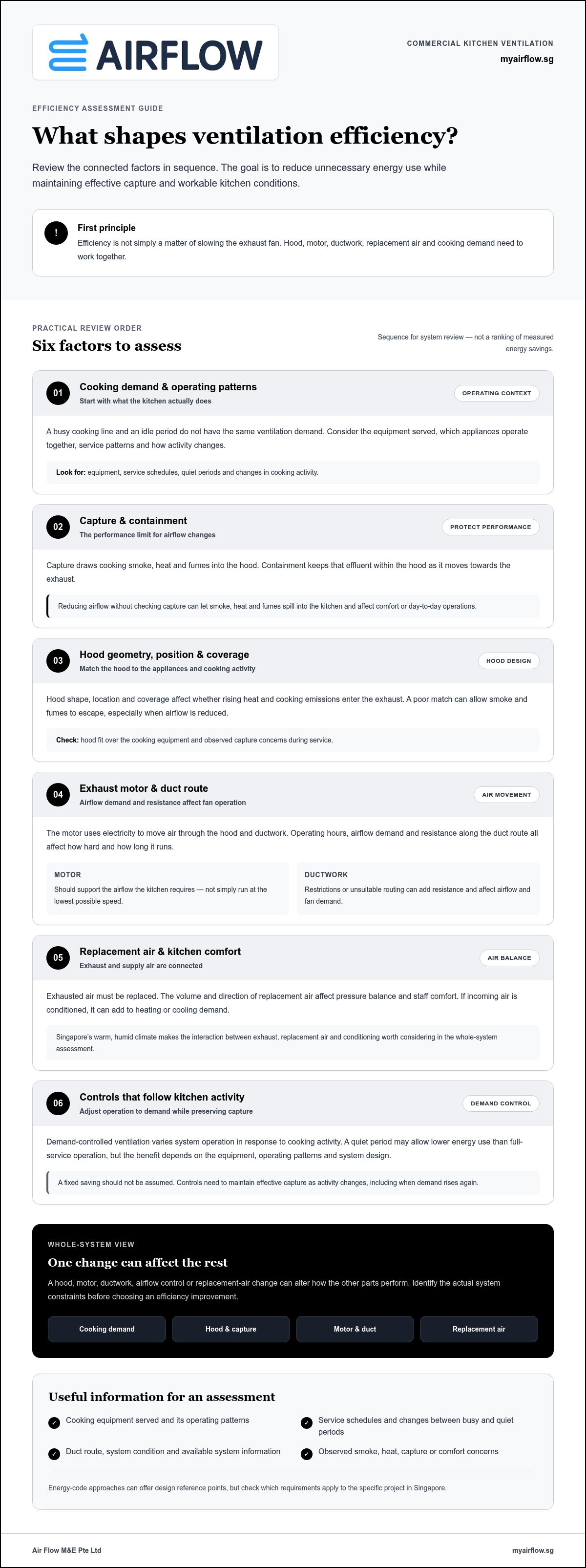
Energy-efficient commercial kitchen ventilation reduces unnecessary energy use while maintaining effective contaminant capture and suitable working conditions. It isn’t simply a matter of slowing the exhaust fan. The hood, exhaust motor, ductwork and replacement air all affect performance. So does conditioned air drawn from the kitchen or supplied to replace exhausted air. A useful overview of the kitchen ventilation system shows why these components need to be considered together.
The right balance depends on the cooking equipment, service patterns, system condition and kitchen layout. A line producing smoke and grease during a busy service has different needs from one that’s idle between meal periods. Improvements should reflect those changes without compromising capture or making the kitchen uncomfortable.
Where a commercial kitchen ventilation system uses energy
The exhaust motor uses electricity to move air through the hood and ductwork. Operating hours affect how long it runs, while airflow demand and resistance along the duct route affect how hard it has to work. Replacement air matters too: exhausted air must be replaced, and conditioning that incoming air can add to heating or cooling loads. In Singapore’s warm, humid climate, this interaction deserves attention when assessing the whole system.
Restrictions, unsuitable duct routing or a mismatch between components can affect airflow and fan demand. The hood, motor and ductwork shouldn’t be assessed in isolation. A change to one part can alter how the others perform, so identifying the system’s actual constraints is a practical first step. Useful information includes the equipment served, the duct route, operating schedules and any observed capture problems.
Why capture and comfort set the efficiency limits
Capture means drawing cooking smoke, heat and fumes into the hood. Containment means keeping that effluent within the hood as it moves towards the exhaust. For example, a hood above a busy cooking line needs to capture rising smoke without letting it spill into the kitchen when staff move nearby or cooking activity changes.
Insufficient control can leave smoke, heat and cooking fumes in the work area, affecting comfort and day-to-day operations. Reducing airflow without checking capture can trade lower fan demand for poorer kitchen performance. Efficiency isn’t a fan-speed target. It means using less energy while maintaining effective capture and workable conditions.
That distinction is central to a sound improvement plan. Compare system behaviour during busy and quiet periods, and assess the hood, motor and ductwork before adjusting airflow. If an existing component limits performance, project-specific modifications can address the connected parts instead of treating fan speed as the only lever.
How Demand, Hoods, Motors, and Airflow Shape Ventilation Efficiency
Ventilation efficiency depends on how components work together under real cooking conditions. Controls can adjust operation to match kitchen activity, but they’re only one part of the picture. The hood must capture emissions, the motor must deliver the airflow the kitchen requires, and the ductwork must let air move without unnecessary resistance. Replacement air matters too: its volume and direction affect pressure balance and staff comfort. If that air is conditioned, it also affects heating or cooling demand.
Energy standards offer useful reference points for system design. For example, commercial kitchen ventilation energy codes explain energy-code approaches to commercial kitchen systems. They aren’t a substitute for checking which requirements apply to a specific project in Singapore.
How demand-controlled ventilation responds to kitchen activity
Demand-controlled ventilation varies system operation in response to cooking activity. During a quiet period, lower demand may allow the system to use less energy than it would at full service. The potential benefit depends on the kitchen’s equipment, operating patterns and system design, so a fixed saving shouldn’t be assumed. Controls need to maintain effective capture as demand changes, including when activity rises again.
Control settings should reflect the cooking line, not just the clock. A lull at one appliance doesn’t necessarily mean ventilation for the whole kitchen can be reduced by the same amount. Consider which appliances operate together and whether activity changes sharply between service periods.
How hood and airflow design affect system performance
Hood geometry, position and coverage affect how well rising heat and cooking emissions enter the exhaust. If a hood is poorly matched to its appliances or cooking activity, reducing airflow may allow smoke and fumes to escape. Ductwork matters too: restrictive routes can add resistance, while airflow that doesn’t match the kitchen’s needs can leave the system performing inefficiently.
Motor selection should be considered alongside the hood and duct route. A motor needs to support the airflow the kitchen requires, not simply run at the lowest possible speed. Replacement air is part of the same balance. Too little or poorly directed supply air can affect pressure and comfort, while conditioned replacement air adds to the cooling or heating load.
Published results need context. A modelled study may report airflow or energy reductions under its own assumptions, but those figures aren’t guaranteed for a different kitchen. Check whether the operating conditions, equipment and system constraints match. For project-specific constraints, commercial exhaust A&A work can bring hood, motor and ductwork modifications into one assessment.
Comparing Commercial Kitchen Ventilation Efficiency Improvements
There’s no single upgrade that suits every kitchen. The right option depends on what’s driving energy use and what’s limiting performance. Compare each measure with the system it must work with, the kitchen’s operating pattern and the information available. This keeps an energy efficient commercial kitchen ventilation project grounded in actual needs rather than assumed savings.
| Improvement | Potential opportunity | Dependencies and operational considerations | Information to assess fit |
|---|---|---|---|
| Demand control | Adjust ventilation as cooking activity changes, potentially reducing unnecessary operation during quieter periods. | Controls must respond appropriately and preserve capture as activity rises or falls. | Cooking schedules, appliance use, existing control setup and observed system behaviour. |
| Hood improvements | Address poor capture or a mismatch between hood coverage and the cooking line. | Hood position and geometry need to suit the appliances and cooking activity. | Equipment layout, capture issues, hood dimensions and service conditions. |
| Airflow and ductwork modifications | Address airflow limitations or avoidable resistance in the system. | Changes can affect the motor, hood performance and replacement-air balance. Target airflow needs technical assessment. | Available airflow and system information, duct route, operating constraints and kitchen layout. |
| Heat recovery | Explore whether energy from exhaust air could be recovered as part of a broader design. | Suitability depends on system design, operating conditions and how exhaust and replacement air can be integrated. | Exhaust and replacement-air arrangements, operating profile and project design constraints. |
When demand control or airflow adjustments may be relevant
Kitchens with clear changes in cooking activity across service periods may be worth assessing for demand-based operation. Start with actual operating schedules and observe system behaviour during busy and quiet periods. This baseline helps show whether ventilation runs beyond demand or whether another constraint is involved. Don’t choose a target airflow by rule of thumb. The target requires technical assessment that accounts for the cooking equipment and effective capture.
When hood, motor, or ductwork modifications deserve attention
Persistent smoke escape, operating constraints or a changed kitchen layout can point to a physical system issue. Controls adjust how a system operates; they don’t correct a hood that doesn’t suit the cooking line or ductwork that restricts airflow. Hood, motor and ductwork modifications may need to be considered together. For more component detail, see Expert Kitchen Ductwork Fabrication in Singapore: A Commercial Guide and the site’s 2026 commercial hood guide.
Heat recovery is a project-specific concept, not a default recommendation. Its suitability depends on the exhaust and replacement-air design and real operating conditions. Compare options using project information, then evaluate performance and applicable Singapore requirements before deciding. Avoid relying on universal savings estimates or payback periods that haven’t been established for the kitchen.
A Practical Singapore Project Framework for Improving Ventilation Efficiency
A reliable energy efficient commercial kitchen ventilation project starts with a clear picture of how the kitchen operates now. Separate recorded facts from assumptions. A fan schedule, equipment list or documented airflow reading is a project fact. An estimate based on memory can provide useful background, but it shouldn’t be treated as a measured baseline or used to promise savings.
What to document before comparing improvement options
Gather the information available, even if records are incomplete. Note cooking activity, service periods, reported comfort issues and planned kitchen changes. Record known hood, motor and ductwork details, along with observations such as smoke escaping during a busy period or heat lingering near a cooking line. These observations help focus an assessment, but they don’t replace technical measurements.
Use this sequence to move from observations to a practical project scope:
- Document operating patterns. Record cooking equipment in use, service schedules and differences between busy and quiet periods.
- Assess current performance. Gather available system records and note how capture, smoke control and kitchen comfort perform during actual operation.
- Identify constraints. Distinguish symptoms from possible causes. Poor capture, for example, may involve the hood, airflow, duct route or how replacement air enters the kitchen.
- Compare options. Weigh controls, airflow adjustments and physical modifications against the specific constraint each could address.
- Plan modifications. Define the project scope around the kitchen layout, operating needs and continued system performance.
How to plan modifications without disrupting kitchen performance
Keep effective capture, safe operation and practical service requirements central to the plan. Changing a hood, motor or ductwork can affect other parts of the exhaust system, so consider connected modifications together. The sequence and implementation depend on the site and scope of the addition or alteration work.
For a fair comparison, establish a baseline before estimating energy impact. Record what was measured, when it was observed and which details remain uncertain. Don’t present a projected reduction as a confirmed result. Before stating that a particular approval or compliance requirement applies, verify current Singapore guidance and its relevance to the project. SFA, NEA and BCA guidance may relate to different aspects of a project, so avoid treating them as interchangeable.
Use the related SFA and NEA requirements guide and kitchen ventilation A&A guide alongside this assessment. To discuss project-specific hood, motor or ductwork modifications, discuss your commercial kitchen ventilation project.
How Air Flow M&E Supports Commercial Kitchen Ventilation A&A
Improving energy efficiency can involve more than adjusting how a system operates. If an existing hood, exhaust motor or ductwork doesn’t suit the kitchen’s layout or service needs, commercial kitchen exhaust addition and alteration work can address those project-specific constraints. The aim is to consider each component in relation to the whole system, rather than change one part in isolation.
For Air Flow M&E, energy efficient commercial kitchen ventilation is an assessment objective alongside effective capture, reliable operation and the demands of food-service operations. The right scope depends on the kitchen’s equipment, layout, current system and planned use. No single modification suits every site.
Connecting exhaust components through project-specific A&A
A hood captures cooking emissions, the exhaust motor moves air, and ductwork carries it away. A change to one can affect how the others perform. For example, a kitchen layout change may mean the hood arrangement and duct route need to be considered together, while the motor must suit the system’s airflow requirements. Air Flow M&E provides commercial kitchen hood and exhaust motor installation, as well as custom-fitted ductwork tailored to commercial kitchen layouts.
Commercial exhaust A&A provides a practical way to address existing system constraints or planned changes. The project scope can be shaped around the site, equipment and operational requirements. For background on this work, see the kitchen ventilation A&A guide.
A straightforward next step for F&B operators
Useful project discussions start with the details of the kitchen. Outline the type of food service, cooking equipment, operating periods and ventilation concerns, such as smoke escape, heat or layout changes. Available information about the hood, motor and ductwork can help frame the project, even if some records are incomplete.
From there, the discussion can focus on the commercial exhaust scope and site requirements. Efficiency is considered alongside capture and day-to-day operating needs, so proposed modifications respond to the actual project rather than assumed savings. Requirements and approvals depend on the specific work and applicable Singapore guidance, which should be assessed for the project.
Discuss your commercial kitchen exhaust project with Air Flow M&E to explore project-specific A&A, hood, motor or ductwork requirements.
Plan a More Efficient Kitchen Ventilation System
Energy efficient commercial kitchen ventilation uses energy thoughtfully while maintaining effective capture, kitchen comfort and reliable operation. The strongest improvements start with the whole system: hood, exhaust motor, ductwork and replacement air. Controls or airflow changes may suit kitchens with varying activity, while physical modifications may be needed to address layout or capture constraints.
Before choosing an approach, document how the kitchen operates and assess current performance. Compare options against real conditions, and treat savings as a project outcome to evaluate, not a figure to assume. For Singapore food-service operators, project-specific commercial exhaust A&A can bring hood, motor and custom-fitted ductwork requirements into a coordinated scope.
Air Flow M&E supports commercial kitchen exhaust projects with A&A and installation services tailored to the work involved. Discuss your commercial kitchen exhaust project with Air Flow M&E to take a practical next step towards a system that supports both efficiency and service needs.
Frequently Asked Questions
Can energy efficient commercial kitchen ventilation still control smoke and cooking fumes?
Yes, if efficiency improvements preserve effective capture and containment. Airflow adjustments depend on hood design, cooking activity and the condition of the wider system. A quieter service period may allow a different operating level, but lower exhaust rates aren’t automatically suitable for every kitchen. Assess performance under actual operating conditions and check which Singapore requirements apply before changing the system.
How does demand-controlled ventilation save energy in a commercial kitchen?
Demand-controlled ventilation responds to changes in kitchen activity instead of maintaining the same operating level in every situation. During quieter periods, a suitable system may reduce fan operation and, where replacement air is conditioned, related heating or cooling demand. The opportunity depends on the existing installation, controls and cooking patterns. Any reduction is project-specific, not a guaranteed saving, and the system must still provide effective capture as activity changes.
What is the most energy efficient commercial kitchen ventilation system?
There’s no single best configuration for every kitchen. Energy efficient commercial kitchen ventilation depends on the cooking equipment, operating patterns, hood capture, airflow, ductwork and replacement-air arrangement. A system suited to a changing cooking schedule may not suit a kitchen with steady, intensive activity. Compare options against actual site conditions, preserve effective ventilation and assess which Singapore requirements apply to the project before settling on a design or modification.
Can a commercial kitchen exhaust fan run at a lower speed to save energy?
It may be appropriate in a system designed or assessed to operate at a lower speed under suitable conditions. But reducing fan speed without checking hood capture, cooking activity and replacement-air balance can lead to smoke or heat escaping into the kitchen. Lower speed isn’t automatically more efficient overall if performance suffers or operations are disrupted. Airflow needs should be assessed for the specific system rather than set using universal settings or savings figures.
Does a commercial kitchen hood affect ventilation energy use?
Yes. Hood design, position and capture performance influence the airflow needed to manage cooking emissions. A hood that suits the appliances and kitchen layout can support an appropriately designed ventilation system, while poor capture may point to the need for operational changes or further assessment. Results depend on the cooking equipment, hood coverage and installation conditions. Don’t assume a hood upgrade will produce a specific energy reduction without project evidence.
How can an F&B operator assess ventilation efficiency before upgrading?
Start by recording operating schedules, cooking activity and reported comfort concerns, such as lingering heat or smoke escape. Gather available hood, motor and ductwork details, then establish a baseline of system performance before comparing controls or physical changes. Separate measured facts from assumptions, and note gaps in the records. For projects in Singapore, verify current guidance and which requirements apply to the specific kitchen and scope of work.
Is heat recovery suitable for every commercial kitchen ventilation system?
No. Heat recovery is a design consideration, not a universal retrofit. Its suitability depends on the exhaust and replacement-air arrangement, operating conditions, available space, maintenance needs and requirements relevant to the project. A concept that fits one system may not fit another. Assess it as part of the full ventilation design, alongside capture and reliable operation, rather than assuming it will deliver a particular energy reduction in every commercial kitchen.


