

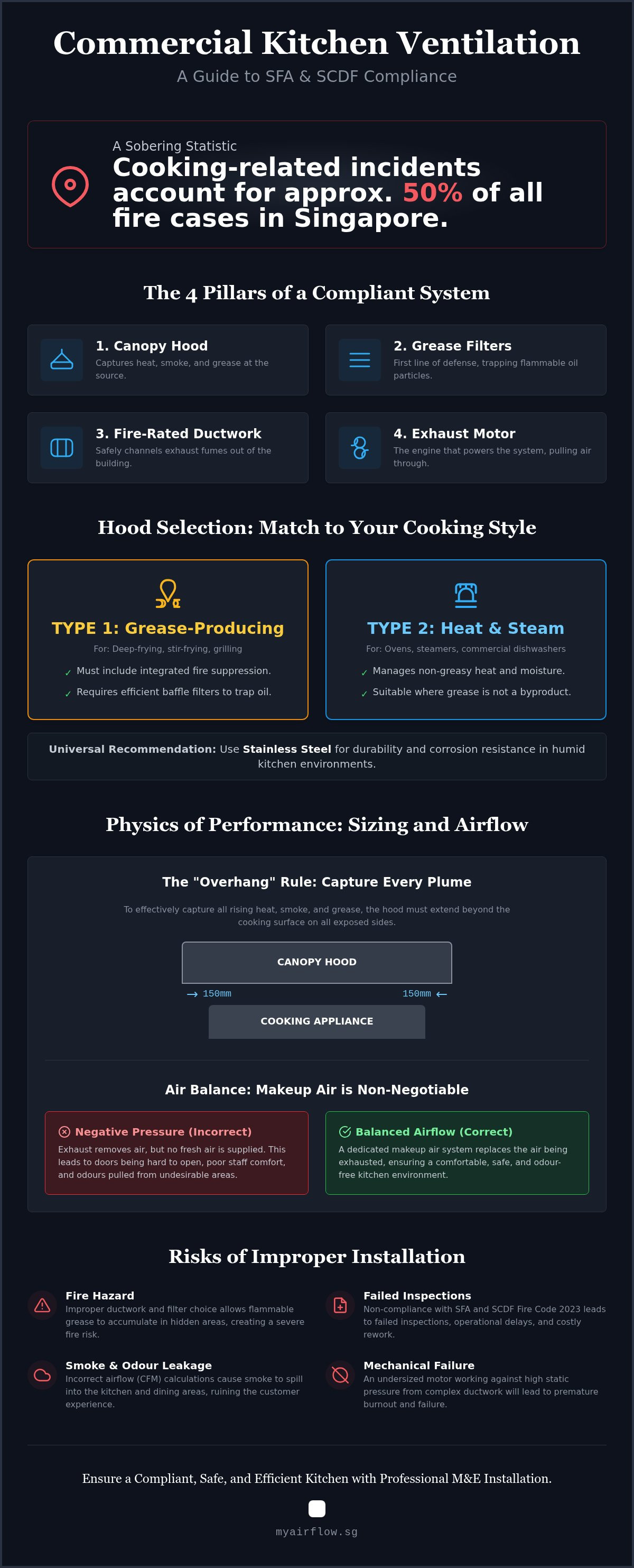
Did you know that cooking-related incidents account for approximately 50% of all fire cases in Singapore? It is a sobering statistic that explains why authorities are stricter than ever about ventilation safety. You probably already know that a poorly planned exhaust system is more than just a nuisance. It is a major risk that can lead to failed SFA inspections, noise complaints from neighbours, and unexpected costs from rework.
Getting your commercial kitchen hood installation right the first time is essential for operational peace of mind. This guide provides a clear roadmap through the technical requirements of the SCDF Fire Code 2023 and SFA standards. We will master the complexities of airflow calculations, fire-rated ductwork, and mandatory suppression systems. By the end of this article, you will understand how to achieve an optimised, smoke-free kitchen that passes licensing requirements on the first attempt. Let's ensure your F&B outlet is built on a foundation of safety and precision.
Key Takeaways
- Identify the core components of a compliant ventilation system, including the canopy, grease filters, and fire-rated ductwork.
- Learn the "overhang" rule and CFM calculation methods to select an exhaust motor that matches your kitchen's specific heat load.
- Understand why custom kitchen ductwork fabrication is essential for maintaining airflow efficiency in restricted Singapore commercial layouts.
- Navigate the complexities of commercial kitchen hood installation to ensure your business meets strict SFA and NEA regulatory standards.
- Gain peace of mind by following a structured M&E approach that guarantees your exhaust system passes safety inspections on the first try.
Commercial Kitchen Hood Installation Standards in Singapore
A commercial kitchen hood is the heart of your kitchen ventilation system. It serves as the primary collection point for heat, smoke, and grease-laden vapours. A standard commercial kitchen hood installation includes four critical components: the canopy, internal grease filters, fire-rated ductwork, and a high-performance exhaust motor. These parts must work in perfect synchronisation to maintain air quality and safety.
Don't attempt to use residential hoods in a professional setting. They are strictly prohibited by the Singapore Food Agency (SFA) and the Singapore Civil Defence Force (SCDF). Residential units lack the suction power and fire-rated materials required to handle the high-volume grease generated by industrial cooking. For business owners taking over existing spaces, these upgrades fall under Addition & Alteration (A&A) works. This process ensures your new equipment integrates safely with the building's original mechanical design.
The Difference Between Type 1 and Type 2 Hoods
Your choice depends on your menu and cooking style. Type 1 hoods are designed for grease-producing applications like deep-frying or stir-frying. These must include an integrated fire suppression system and baffle filters to trap oil. Type 2 hoods manage heat and steam, making them suitable for ovens or commercial dishwashers. We recommend stainless steel for all installations. It provides the durability needed to withstand harsh cleaning chemicals and prevents corrosion in humid environments.
Why General Contractors Aren't Enough
General contractors often lack the specialised engineering knowledge required for precise airflow management. If your CFM (Cubic Feet per Minute) calculations are off, smoke will leak into the dining area. This ruins the customer experience and leads to grease buildup in hidden areas. Proper commercial kitchen hood installation requires an M&E specialist to ensure the exhaust motor is correctly sized for the duct length. Poorly planned systems lead to motor burnout and increased fire risks. Choosing a specialist protects your investment and ensures your kitchen remains compliant with SCDF Fire Code 2023.
Choosing the Right Hood: Sizing, Airflow, and CFM Calculations
Selecting the correct equipment is about physics, not just aesthetics. A successful commercial kitchen hood installation starts with the "overhang" rule. To capture all rising heat and grease, the hood must extend beyond the cooking surface. Generally, this means a minimum of 150mm of overhang on all exposed sides. Without this buffer, thermal plumes will spill into your kitchen, raising ambient temperatures and potentially triggering smoke detectors.
Beyond physical size, you must consider the volume of air being moved. This is measured in CFM (Cubic Feet per Minute). Your required CFM is determined by your cooking temperature, grease volume, and the overall kitchen layout. For example, heavy-duty wok ranges require significantly more extraction power than electric ovens. Failing to match your motor size to these variables leads to poor performance and early mechanical failure.
Don't overlook the importance of makeup air. When your exhaust system pulls air out, that air must be replaced. Without a dedicated makeup air system, your kitchen will develop negative pressure. This makes doors difficult to open and causes air to be sucked from undesirable places like toilets or trash areas. Balanced airflow ensures your staff stay cool and the environment remains odour-free.
Calculating Your Kitchen's Exhaust Requirements
Estimating your needs involves calculating the linear feet of the hood and the duty level of your appliances. CFM is the volume of air moved per minute to maintain air quality. However, the calculation isn't just about the hood itself. Every metre of ductwork and every 90-degree bend increases static pressure resistance. If your duct path is long or complex, you will need a more powerful motor to compensate for these efficiency losses.
Grease Filter Selection for Maximum Efficiency
Filters are your first line of defence against fire. While mesh filters are common in light-duty setups, baffle filters are the industry standard for high-grease F&B outlets. They use a series of vertical vanes to force air to change direction, causing grease to condense and drip into a collection tray. This prevents flammable oil from entering your ductwork. Choosing easy-to-remove filters ensures your staff can perform daily cleaning without specialised tools. For a detailed breakdown of filter types and their compliance requirements, our commercial kitchen hood replacement Singapore comparison guide covers the latest 2026 standards. If you are unsure which setup fits your menu, consulting an expert for commercial kitchen hood installation can prevent costly regulatory delays.
Custom Ductwork and Motor Installation: The Invisible Infrastructure
While the canopy is the most visible part of a commercial kitchen hood installation, the ductwork and motor represent the engine room of the system. In Singapore's dense urban environment, space is a premium. Most F&B outlets operate in tight shoplots or shopping malls where ceiling voids are narrow. This makes professional kitchen ductwork fabrication Singapore essential. Standard, off-the-shelf ducting rarely fits these complex layouts without causing significant airflow resistance.
Precision routing is critical to prevent "dead spots" where grease can pool and harden. These areas are major fire hazards. Every joint must feature grease-tight welding to ensure no leakage occurs within the ceiling or wall cavities. Additionally, noise mitigation is a priority for NEA compliance. If your kitchen is near residential units, you must install silencers and vibration isolators. These components prevent mechanical hums from bothering neighbours and ensure your business remains a good tenant.
Fabricating Ductwork for Commercial Efficiency
Off-the-shelf solutions often fail because they don't account for the unique structural obstacles found in Singaporean commercial buildings. We utilise 1.2mm thick stainless steel or galvanised iron for all grease ducts to meet durability and fire safety standards. Thinner materials can warp under heat or vibrate excessively. SCDF regulations require periodic degreasing of the entire system. To facilitate this, we install strategically placed access panels. These allow cleaning crews to reach every inch of the duct interior, ensuring you pass your annual fire safety inspections without issue.
Motor Placement and Performance
Selecting the right exhaust motor is a balance of power and pressure. For most high-pressure systems with long duct runs, centrifugal fans are the logical choice. They are far more effective at overcoming static pressure than axial fans. Whether you choose a rooftop or wall-mounted installation depends on your building's venting path. Rooftop motors are often preferred as they discharge odours away from street level. In 2026, energy efficiency is a key operational focus. Installing Variable Frequency Drives (VFDs) allows you to adjust motor speed based on cooking volume. This reduces electricity costs and extends the lifespan of your equipment by preventing unnecessary wear during prep hours.
Navigating SFA and NEA Compliance for Kitchen Exhaust A&A
Opening a successful F&B outlet in Singapore requires more than a great menu. It requires a valid Food Shop License from the Singapore Food Agency (SFA). You won't secure this license if your ventilation system is non-compliant. The SFA focuses on hygiene and fire safety, while the National Environment Agency (NEA) regulates air pollution. Together, these agencies ensure your commercial kitchen hood installation doesn't negatively impact public health or the environment.
If you're taking over a space or upgrading equipment, you'll likely need Building and Construction Authority (BCA) approval for Addition & Alteration (A&A) works. This process involves submitting technical plans that prove your system meets structural and electrical safety standards. Once the work is finished, you must provide "As-Built" drawings. These documents are the final record of the physical installation. They are essential for the final inspection and for your annual fire safety certificate renewals.
The Step-by-Step Compliance Roadmap
- Step 1: Design and Submission. Your M&E specialist prepares design drawings and CFM calculations for BCA and SFA review. This ensures the system is theoretically sound before any metal is cut.
- Step 2: Professional Installation. The system is built exactly to the approved layout. Any deviation here can lead to a failed inspection and costly rework.
- Step 3: Commissioning and Testing. We perform airflow testing to verify the system hits the target CFM. This step balances the air to ensure smoke is captured without creating excessive noise.
- Step 4: Final Inspection. SFA officers visit the site to verify the installation matches the submitted plans. Once they sign off, your Food Shop License is issued.
Odour and Smoke Control Systems
NEA standards for air quality are particularly strict in mixed-use buildings. If your kitchen produces heavy smoke or oil, you'll need an Electrostatic Precipitator (ESP) and Carbon Filters. These systems strip grease particles and odours from the air before it is discharged. The "vertical discharge" rule is another critical factor. Exhaust air must typically be directed at least 3 metres above the roofline to prevent it from blowing into neighbouring windows. NEA requires specific odour control for kitchens near residential areas. If you need help meeting these strict standards, you can book a compliance consultation to ensure your kitchen is ready for inspection.
Why Professional M&E Installation is the Logical Conclusion
Managing a commercial kitchen hood installation shouldn't be a source of stress for F&B owners. You have enough to worry about with staffing, menu development, and daily operations. Leaving the mechanical and electrical engineering to specialists is the only way to guarantee safety and regulatory compliance. Air Flow M&E handles the technical complexities of A&A works so you don't have to. We translate complex SCDF and SFA requirements into a functional, high-performance ventilation system that protects your staff and your investment.
Our "Safe Pair of Hands" approach means we anticipate inspection hurdles before they happen. We don't just install equipment. We manage the entire commercial kitchen hood installation process to ensure you pass SFA licensing on the first attempt. This precision engineering offers long-term value that goes beyond the initial setup. Properly balanced airflow reduces grease buildup and strain on your exhaust motor. This results in fewer fire risks and lower maintenance costs over the lifespan of your kitchen. It is a pragmatic investment in your business's future.
Specialised A&A Services for Singapore F&B
We focus strictly on commercial mechanical and electrical engineering for Singapore's high-stakes kitchens. Generic contractors often provide one-size-fits-all solutions that don't account for tight ceiling voids or specific heat loads. We provide custom-fitted ductwork and high-performance motors tailored to your unique kitchen layout. Our goal is reliability. We ensure your kitchen stays operational with minimal downtime during upgrades or alterations. It's about building a system that works as hard as your chefs do every single day.
Request Your Site Assessment
Every professional project starts with a detailed site survey. We don't believe in guessing dimensions or airflow needs. Our team performs a thorough layout review to identify potential ducting obstacles and electrical requirements. We coordinate closely with your renovation team to ensure seamless project delivery. This prevents costly project delays and ensures every component is installed to code. Don't leave your licensing to chance. Contact Air Flow M&E today for your commercial kitchen exhaust installation and let us handle the technical complexities for you.
Secure Your Kitchen's Operational Future
Successful F&B operations in Singapore rely on more than just a great menu. They require a ventilation system that operates with mechanical precision and absolute safety. We have explored how proper sizing, fire-rated ductwork, and compliant motor selection form the backbone of a reliable kitchen. A professional commercial kitchen hood installation ensures you meet the strict SFA and NEA standards without the risk of costly rework or failed inspections. By focusing on custom-fitted solutions and expert M&E engineering, you protect your staff and your investment from day one.
Precision isn't just about passing a test; it's about long-term efficiency and peace of mind. Don't leave your licensing or fire safety to chance with generic setups that don't account for Singapore's unique building constraints. Ready to build a compliant and efficient workspace? Get a Professional Site Assessment for Your Kitchen Exhaust System today. Our team of custom ductwork fabrication specialists is here to provide the technical authority you need. Let us handle the complex engineering so you can focus on growing your brand with confidence.
Frequently Asked Questions
Do I need a new hood if I am only changing my cooking equipment?
You may need an upgrade if your new equipment changes the total heat load or physical footprint of your cooking line. SFA and SCDF regulations require the hood to cover the full cooking surface with a minimum 150mm overhang. If you switch from electric to gas or add high-heat wok ranges, your current commercial kitchen hood installation might lack the suction power required for safety. A professional reassessment ensures your ventilation remains compliant.
How much does commercial kitchen hood installation cost in Singapore?
Total costs vary based on system complexity, duct length, and motor power requirements. While basic slimline hoods are simpler to install, heavy-duty industrial systems requiring custom ductwork and fire suppression involve a more significant investment. Factors like building height for roof discharge and the need for ESP filters also influence the final price. Every project requires a detailed site survey to provide a precise technical quote based on your specific layout.
What is the required distance between the cooking range and the hood?
The standard vertical clearance typically ranges between 1000mm and 1200mm from the cooking surface to the lower edge of the hood. This distance is critical for balancing effective smoke capture with fire safety. If the hood is too low, it becomes a fire hazard from flare-ups; if it is too high, grease and heat will escape into the kitchen. Exact requirements depend on your appliance type and manufacturer safety guidelines.
Can I install a ventless hood for my Singapore food shop?
Ventless hoods are only permitted in specific scenarios where external ducting is impossible and the cooking process generates minimal smoke or grease. These systems rely on advanced internal filtration to clean the air before recirculating it. However, the SFA and NEA have very strict approval processes for ductless setups. Most commercial F&B outlets in Singapore still require a fully ducted system to ensure proper heat removal and air quality management.
How often does the SFA require commercial exhaust systems to be cleaned?
The SCDF and SFA mandate that the entire exhaust system, including hoods, filters, and ductwork, must be degreased and cleaned at least once every 12 months. High-volume kitchens doing heavy frying often require more frequent cleaning to prevent grease fires. You must maintain detailed maintenance records and certificates of cleaning for inspection by authorities. Failure to provide these records can result in penalties or the rejection of your annual fire safety certificate.
What happens if my kitchen exhaust system fails an NEA noise or odour test?
Failure to meet NEA standards can result in fines, legal notices, or a suspension of your food shop license. You will be required to implement immediate mitigation measures, such as installing silencers for noise or electrostatic precipitators (ESP) for odour control. Professional commercial kitchen hood installation avoids these issues by integrating proper filtration and vibration isolators from the start. This ensures your kitchen stays within the permissible decibel and emission limits for your area.
Is BCA approval always required for kitchen exhaust A&A works?
Formal BCA approval is typically required when the installation involves structural changes or significant modifications to the building's mechanical and electrical systems. These are classified as Addition & Alteration (A&A) works. A Professional Engineer (PE) must endorse the plans to ensure they meet the Fire Code 2023 standards. We handle the technical design and submission process to ensure your project remains fully authorised and safe for long-term operation.
Can Air Flow M&E help with both the hood and the exhaust motor installation?
Air Flow M&E provides a complete end-to-end service for commercial F&B clients across Singapore. We specialise in the installation of the kitchen hood, custom-fitted ductwork, and high-performance exhaust motors. Our team manages the entire mechanical setup to ensure all components are perfectly synchronised for optimal airflow. This integrated approach simplifies your renovation and ensures your kitchen meets all SFA and NEA compliance standards on the very first attempt.


