

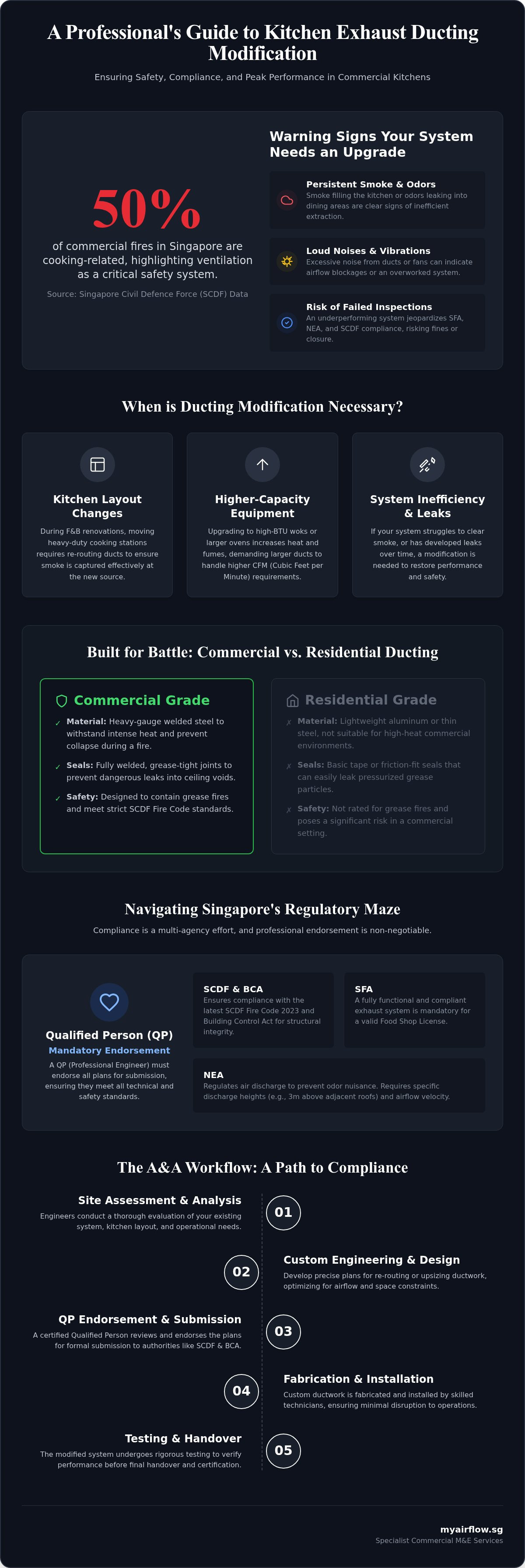
Did you know that cooking-related incidents account for approximately 50% of all commercial fire cases in Singapore? This SCDF data highlights why your ventilation system is a vital safety component rather than just a utility. If you're struggling with persistent smoke or loud, vibrating ducts, you likely feel the pressure of a pending inspection. A strategic kitchen exhaust ducting modification is the most effective way to ensure SFA compliance and fix these operational headaches.
We know you need a system that works without the constant worry of failing an NEA check. This article provides a clear roadmap for your A&A works. It shows you how to improve airflow and maintain a smoke-free environment. We'll cover the mandatory role of a Qualified Person, the latest fire safety standards, and how custom-fitted ductwork solves space constraints. You'll learn how to achieve a compliant, high-performance kitchen with minimal disruption to your daily operations.
Key Takeaways
- Secure SFA and SCDF approvals by understanding the mandatory role of a Qualified Person (QP) in the A&A process.
- Fix persistent smoke and noise issues through a strategic kitchen exhaust ducting modification designed for high-volume commercial use.
- Optimize your kitchen's airflow by choosing between re-routing for structural obstacles or upsizing to meet higher CFM requirements.
- Minimize operational downtime with a methodical workflow that prioritizes precise site assessments and custom-fitted ductwork.
- Ensure long-term compliance and safety by engaging specialists who focus strictly on commercial mechanical and electrical (M&E) systems.
What is Kitchen Exhaust Ducting Modification?
Kitchen exhaust ducting modification is the physical alteration of ventilation paths to improve grease extraction and air velocity. In Singapore, this is classified as a specialized Addition & Alteration (A&A) service. It isn't just about moving a pipe; it involves re-engineering the airflow to meet specific operational demands. When you change your cooking style or expand your menu, your existing ductwork might become a bottleneck that compromises safety and air quality.
Commercial systems are complex mechanical networks. Unlike residential setups, these systems must handle high volumes of heat, smoke, and vaporized grease for hours on end. A kitchen exhaust ducting modification ensures that your ventilation keeps pace with your kitchen's output. By utilizing custom-fitted ductwork, specialists can optimize airflow even in restricted M&E spaces, navigating around existing structural beams or electrical trays without losing suction power.
Common Reasons for Ductwork Alterations
Kitchens are dynamic environments. A layout that worked for a small cafe won't handle the demands of a high-volume stir-fry station. You'll likely need to modify your system if you're experiencing any of the following:
- Kitchen layout changes: During an F&B renovation, moving your heavy-duty equipment means your extraction points must follow. Re-routing ensures smoke is captured at the source before it spreads.
- Higher-capacity equipment: Upgrading to larger ovens or high-BTU wok ranges increases heat and effluent levels. You'll need to upsize your ducts to accommodate a higher Cubic Feet per Minute (CFM) requirement.
- Persistent odor leakage: If smells or smoke are drifting into the dining area, it's a sign that your current duct paths are inefficient or have developed leaks over time.
Commercial vs. Residential Ducting Standards
Professional environments demand a level of durability that residential products can't provide. Kitchen ventilation systems in commercial spaces must withstand constant heat and heavy grease loads. While residential ducts often use light materials like aluminum, commercial systems utilize heavy-gauge welded steel. This material is vital for fire safety. It prevents the duct from collapsing or leaking during a grease fire, providing a critical layer of protection for your property.
Grease-tight seals are another critical differentiator. In a professional kitchen, oil particles are pressurized and pushed through the system. If the seals aren't perfect, grease will leak into your ceiling voids. This creates a hidden fire risk and attracts pests. Proper duct routing is also essential in high-heat zones. If a duct is routed too close to combustible materials without proper clearance, it poses a direct threat to the building's integrity. Specialist A&A works ensure every joint is secure and every route is optimized for long-term safety.
Regulatory Compliance: SFA and NEA Standards in Singapore
Compliance in Singapore is a multi-agency effort. The Singapore Food Agency (SFA) requires a fully functional exhaust system for your food shop license to remain valid. Meanwhile, the National Environment Agency (NEA) monitors air discharge to ensure your kitchen doesn't create a smell nuisance for neighbors. If you're planning a kitchen exhaust ducting modification, you must navigate these intersecting rules to avoid heavy fines or operational stoppages. Most modifications also require a Qualified Person (QP) to endorse the plans before submission to the SCDF and BCA.
The SCDF Fire Code 2023, which became mandatory on March 1, 2024, serves as the primary guideline for fire safety. It's essential to follow these rules to ensure your kitchen remains a safe environment. Professional M&E endorsement isn't just a formality; it's a guarantee that your system handles heat and grease without risk. If your layout is changing, a professional assessment is the best way to stay compliant. If you're unsure if your current setup meets these standards, our team can provide expert A&A services to bring your kitchen into full alignment with local regulations.
Discharge Height and Airflow Velocity
NEA guidelines specify that exhaust air must be discharged vertically upward. In many cases, this means the discharge point must be at least 3 meters above the roof level of nearby buildings to prevent odors from entering neighboring windows. Maintaining the correct face velocity at the hood is equally important. If the air moves too slowly, grease and smoke won't be captured effectively. A strategic modification ensures your system hits these technical benchmarks by optimizing fan power and duct diameter to maintain the required suction at all times.
Grease Filtration and Fire Safety
Fire safety is the backbone of any commercial kitchen. Following the NFPA 96 standard provides a globally recognized framework for grease-laden vapor removal. Your system must include high-efficiency grease filters to reduce buildup within the ducts. Additionally, SCDF requires access panels for cleaning and degreasing, which must be done at least once every 12 months. In certain building zones, you'll also need fire-rated ducting to prevent flames from spreading through the ventilation shaft during an emergency. These access points aren't optional; they're vital for both safety and routine maintenance.
Types of Ducting Modifications and Upgrades
Every kitchen exhaust ducting modification should solve a specific operational problem. Modification isn't just about repair; it's a strategic upgrade to your mechanical system. Some projects focus on clearing structural obstacles like new support beams or fire sprinklers that were added during a building-wide renovation. Others address performance gaps. If you've added a heavy-duty grill or deep fryer, your original ducting might be too narrow. Upsizing the duct diameter allows for higher Cubic Feet per Minute (CFM) without straining the motor. This prevents smoke from lingering in your kitchen and improves the overall workspace for your staff.
High noise levels often stem from air turbulence within the system. Installing custom-fitted transitions helps smooth the air path. These bespoke pieces reduce static pressure, which means your motor doesn't have to work as hard to move the same volume of air. This results in a quieter kitchen and lower energy costs. Precision in these transitions is vital. A poorly fitted joint can lead to grease leaks and increased vibration, which eventually damages the motor and duct supports. Professional A&A works ensure every transition is aerodynamic and secure.
Motor and Fan Integration
Upgrading to commercial-grade centrifugal fans is a common part of a kitchen exhaust ducting modification. These fans provide the powerful suction needed for heavy grease loads. During A&A works, we often integrate Variable Speed Drives (VSD). A VSD allows you to adjust the fan speed based on your cooking volume. You can turn down the power during prep time and ramp it up during peak service. This flexibility saves energy and extends the lifespan of your motor. We also prioritize motor positioning. Placing the motor in an accessible location ensures that future maintenance and degreasing can be done quickly without dismantling your entire kitchen setup.
Duct Material and Shape Optimization
The choice between rectangular and round ducts depends on your kitchen's physical constraints and performance needs. Rectangular ducts are excellent for fitting into tight ceiling voids where vertical space is limited. However, round ducts are superior for airflow efficiency. They have no corners where grease can pool, making them easier to clean and more hygienic over time. For high-corrosion environments, such as seafood restaurants or high-steam areas, stainless steel is the best material choice. It resists rust and withstands the chemical cleaners used during degreasing. Additionally, we install high-temperature insulation to manage heat transfer and prevent condensation from forming on the duct's exterior.
The A&A Workflow: Process of Modifying Your Exhaust System
A successful kitchen exhaust ducting modification follows a disciplined engineering path. It isn't a simple replacement job. Every project begins with a deep dive into the existing mechanical and electrical (M&E) infrastructure. This ensures that new additions don't overstress the building's structural or electrical capacity. By following a methodical workflow, we ensure your system meets regulatory standards while maintaining peak performance.
The workflow transitions from data gathering to physical execution. We handle the technical complexities so you can focus on running your business. This process includes four key stages:
- Initial site assessment: Measuring current airflow and pressure to find the root cause of ventilation issues.
- Design and engineering: Creating a modified layout that optimizes air velocity and grease capture.
- Fabrication: Building custom duct sections and transitions in a controlled environment for a perfect fit.
- Installation and testing: Mounting the system and verifying performance through rigorous commissioning.
Site Assessment and Technical Planning
We start by identifying bottlenecks in your current exhaust motor performance. Many systems fail because the motor can't overcome the static pressure of poorly routed ducts. We also check the structural integrity of your site. New ductwork requires heavy-duty supports that comply with BCA standards. Once we have these technical details, we draft a formal A&A proposal. You'll need this document to secure management or building owner approval before work starts. This planning phase prevents costly mid-project changes and keeps the timeline on track.
Installation and Minimizing Downtime
F&B operators can't afford long closures. We coordinate our works during off-peak hours or overnight to keep your kitchen running. A strategic kitchen exhaust ducting modification ensures your new layout is both efficient and fire-safe. During the installation, we use grease-tight welding and professional-grade sealants. These are vital for fire safety and preventing leaks. After the ducting is mounted, we perform a final smoke test. This test verifies capture efficiency at the hood and ensures no smoke escapes into the dining area. It's the final proof you need before an SFA inspection. If you're planning an upgrade, book a site assessment with our specialists to get started.
The final step is commissioning. We balance the air levels to ensure the exhaust volume doesn't create negative pressure issues in your restaurant. This balance keeps doors easy to open and prevents unwanted drafts. A properly commissioned system provides a better environment for both your staff and your customers.
Choosing an M&E Specialist for Your Ducting Works
Selecting the right partner for your mechanical and electrical (M&E) works is a critical business decision. Many general contractors offer ventilation services as part of a larger renovation package. However, they often lack the technical depth required for high-velocity commercial systems. A kitchen exhaust ducting modification is a specialized engineering task. It requires a deep understanding of airflow dynamics, grease-tight welding, and fire safety protocols. Choosing a specialist ensures that your system doesn't just look right but performs under the heavy demands of a professional kitchen.
A specialist acts as a "safe pair of hands" for your regulatory compliance. In Singapore, the stakes for SFA and NEA inspections are high. Mistakes in duct routing or discharge height can lead to costly rework and delayed licensing. Specialists bring technical authority to the table. They understand how to navigate the 2023 Fire Code and BCA requirements with precision. This expertise minimizes your risk and provides peace of mind, allowing you to focus on your culinary operations while the technical complexities are handled by experts.
Technical authority is especially vital in custom duct fabrication. Standard, off-the-shelf components rarely fit the tight M&E spaces found in Singapore food shops. We evaluate every project based on its unique structural constraints. Our team handles complex challenges, such as routing ducts around existing gas lines or electrical trays, without compromising air velocity. This level of detail prevents the common issues of vibration, noise, and grease leakage that plague poorly installed systems.
The Air Flow M&E Advantage
Air Flow M&E focuses strictly on commercial food-service establishments. Our approach is professional, pragmatic, and entirely solution-oriented. We don't believe in one-size-fits-all fixes. Instead, we provide engineering that prioritizes durability and precision. Every kitchen exhaust ducting modification we perform is built to withstand high-heat environments. We use heavy-gauge materials and professional-grade sealants to ensure long-term functionality. Our goal is to deliver a system that passes every inspection and provides a clean, safe workspace for your staff.
Next Steps for Your Kitchen
Don't wait for a failed inspection to address your ventilation issues. If you are preparing for an SFA licensing renewal or a new shop opening, a comprehensive system audit is the first step. We identify hidden bottlenecks and potential fire risks before they become expensive problems. Our team provides clear, actionable proposals that align with Singapore's strict regulatory framework. Taking proactive steps now ensures your kitchen remains compliant and operational without unexpected downtime. Ensure your kitchen is compliant with Air Flow M&E by reaching out for a professional assessment today.
Secure Your Kitchen's Operational Future
A successful food-service business relies on more than just great food. It depends on a safe, compliant, and high-performing environment. As established throughout this guide, a strategic kitchen exhaust ducting modification is the most effective way to address persistent smoke, noise, and regulatory gaps. By focusing on custom-fitted transitions and precise airflow engineering, you protect your staff and ensure your shop passes every SFA or NEA inspection with confidence.
Don't let poor ventilation or outdated ducting compromise your license or customer experience. Air Flow M&E is your dedicated partner for commercial mechanical and electrical solutions. We are specialists in SFA/NEA compliance for F&B shops and provide expert custom duct fabrication and installation. Our team handles the technical complexities of A&A works so you can focus on running your business. We're here to be your reliable M&E partner for the long haul.
Ready to optimize your ventilation? Request a Professional Site Assessment from Air Flow M&E to ensure your kitchen is fully compliant and efficient. We'll help you build a smoke-free, durable workspace that supports your continued success.
Frequently Asked Questions
Do I need SFA approval for kitchen exhaust ducting modification?
Yes, any major modification to your exhaust system is considered an Addition & Alteration (A&A) work that requires professional endorsement. The Singapore Food Agency (SFA) requires your ventilation to be fully functional for licensing. You must engage a Qualified Person (QP) to submit plans to the SCDF and BCA. This ensures the kitchen exhaust ducting modification meets the 2023 Fire Code standards. Proper documentation is vital for passing your final inspection and maintaining your license.
How long does a typical ducting A&A project take?
The timeline for a ducting A&A project depends on the complexity of the rerouting and fabrication. A simple transition modification might take one to two nights, while a full system overhaul could take longer. We coordinate works during off-peak hours or overnight to ensure your kitchen operations face minimal disruption. Our focus is on precision and speed, utilizing custom-fitted sections prepared off-site to accelerate the installation process and reduce on-site welding time.
Can I modify my exhaust system without replacing the whole motor?
You can often modify your ductwork without replacing the entire motor, provided the current motor can handle the new system's static pressure. If the modification involves lengthening the duct or adding more bends, the motor must have enough power to maintain the required airflow velocity. We perform airflow measurements during our initial site assessment to determine if your existing equipment is compatible with the proposed layout or if a motor upgrade is necessary.
What are the signs that my kitchen ducting needs modification?
Persistent smoke in the dining area and high noise levels are immediate indicators that your system isn't functioning correctly. You should also look for grease stains on ceiling tiles, which suggest leaks in your duct joints. If you've recently added high-heat cooking equipment like woks or grills, your current ducting may be undersized. Failing an SFA or NEA inspection due to poor air discharge or smell nuisance is another definitive sign that a modification is required.
Is fire-rated ducting mandatory for all commercial kitchens in Singapore?
Fire-rated ducting is mandatory in specific building zones according to the SCDF Fire Code 2023. If your duct passes through different fire compartments or is located near combustible materials, it must have a fire-resistance rating. This prevents flames from spreading through the ventilation shaft during a kitchen fire. We assess your building's fire safety plan during the technical planning phase to ensure your kitchen exhaust ducting modification complies with these mandatory life-safety requirements.
How does duct routing affect my kitchen exhaust noise levels?
Duct routing directly impacts noise because sharp bends and restrictive transitions create air turbulence. When air hits a 90-degree corner too fast, it creates a loud rushing sound and causes the duct walls to vibrate. By installing custom-fitted transitions and smoothing out the routing, we reduce static pressure. This allows air to flow more quietly and prevents the motor from overworking, which significantly lowers the decibel levels in both your kitchen and dining areas.
What is the difference between a grease duct and a normal air duct?
Grease ducts are designed specifically to handle high-temperature, grease-laden vapors and are built from heavy-gauge welded steel. Normal air ducts used for air conditioning are typically made of thin galvanized iron and aren't grease-tight. Grease ducts must feature continuous liquid-tight welds to prevent oil from leaking into ceiling voids. They also require specialized access panels for degreasing, which SCDF mandates must be cleaned at least once every 12 months to prevent fire hazards.
Will modifying my ductwork help with smoke problems in the dining area?
Modifying your ductwork is the most effective way to solve persistent smoke issues in your dining area. Smoke often escapes when the suction at the hood is too weak due to poor duct design or high static pressure. By optimizing the duct diameter and reducing bottlenecks, we improve the capture efficiency of your exhaust system. This ensures that all cooking effluents are pulled directly into the hood and discharged safely outside, keeping your front-of-house air clean.


