

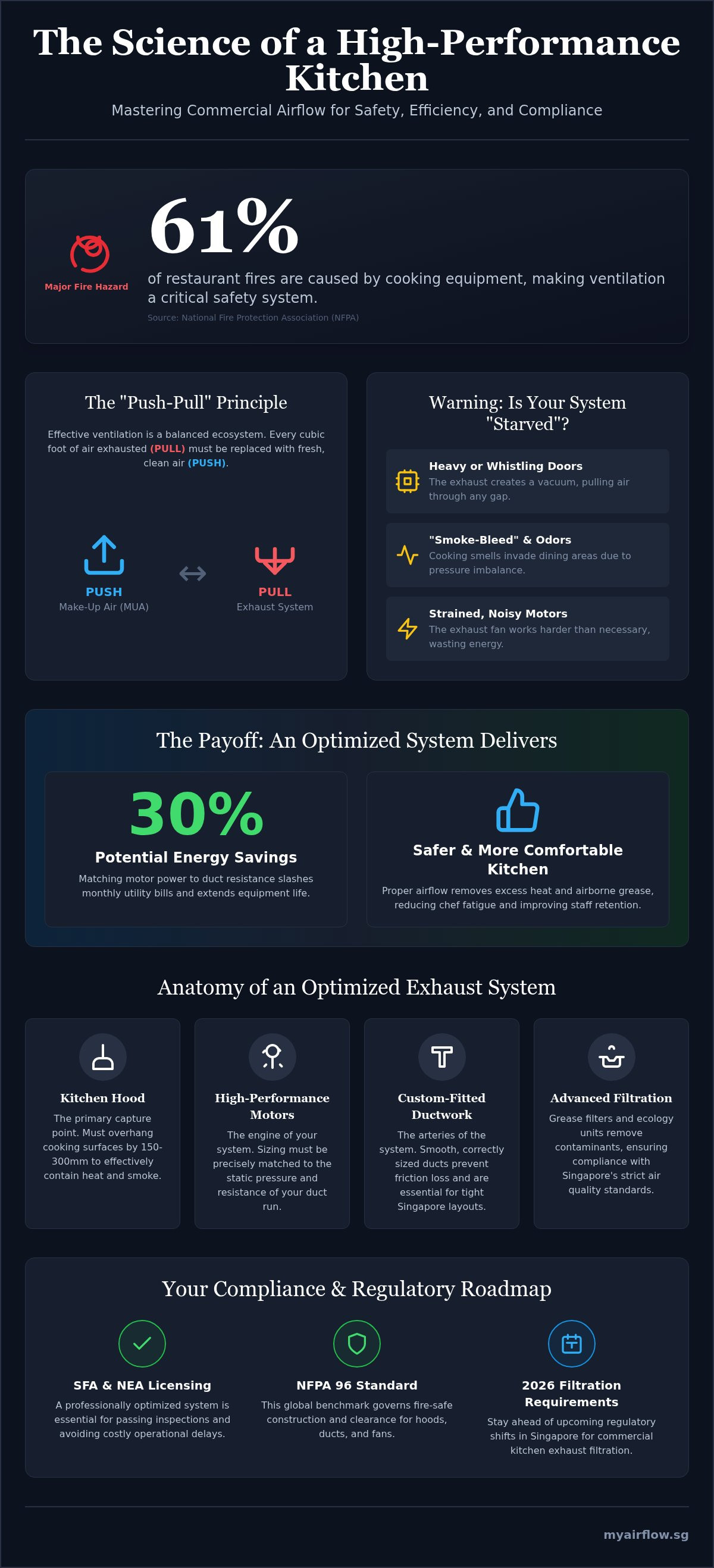
Cooking equipment is the primary cause of 61% of restaurant fires, according to data from the National Fire Protection Association. This sobering statistic highlights why your ventilation system is more than just a fan. It is a critical safety and operational asset that requires technical precision and regular maintenance to protect your investment.
Running a high-volume kitchen in Singapore means battling relentless humidity, lingering grease, and rising energy costs. You've likely realized that simply installing a larger exhaust motor doesn't always solve the heat problem. Effective commercial kitchen airflow optimization requires a balanced mechanical ecosystem that manages air pressure and filtration with professional accuracy.
This guide shows you how to master ventilation principles to improve staff comfort and reduce monthly utility bills by up to 30%. We provide a clear roadmap for achieving full compliance with SFA and NEA licensing standards, including the upcoming 2026 filtration requirements. We also explore how custom-fitted ductwork and efficient motor configurations create a safer, more profitable environment for your business.
Key Takeaways
- Learn why "starved" exhaust systems cause whistling doors and how the "Push-Pull" principle keeps cooking odors out of your dining area.
- Discover how matching your exhaust motor to duct resistance can slash energy overheads by up to 30% while improving chef comfort.
- Master the technical steps for commercial kitchen airflow optimization to ensure your facility meets strict SFA and NEA licensing standards.
- Stay ahead of regulatory shifts by understanding the 2026 kitchen exhaust filtration requirements for Singapore commercial operations.
- Find out why custom-fitted ductwork is the most reliable solution for the tight and complex layouts found in Singapore commercial kitchens.
Understanding the Mechanics of Commercial Kitchen Airflow
Commercial kitchen airflow optimization is the strategic science of managing air intake and extraction. It's more than just keeping the room cool. It involves maintaining air quality and controlling temperature through calculated mechanical movements. When your airflow is correctly calibrated, your kitchen functions as a high-performance environment rather than a heat trap.
Think of your kitchen as a set of lungs. Every cubic foot of hot, greasy air your exhaust pulls out must be replaced by fresh air. This "Push-Pull" principle is the foundation of all professional kitchen ventilation systems. If you ignore the "push" (intake), your "pull" (exhaust) will struggle. This leads to motor strain, excessive noise, and poor performance.
We measure this performance using Cubic Feet per Minute (CFM). This metric tells us the volume of air moving through your ducts. High-volume kitchens require specific air exchange rates. These rates dictate how many times per hour the entire air volume in the space is refreshed. In Singapore's humid climate, these rates must be precise to prevent moisture buildup and mold growth.
When these mechanics fail, your business suffers. Excessive heat causes chef fatigue and high staff turnover. Lingering odors can drift into guest zones, ruining the dining experience. A poorly managed system also forces your exhaust motors to work harder, which spikes your monthly energy bills and shortens the lifespan of your equipment.
The Role of Negative Pressure in Kitchens
In the tight layouts of Singapore shophouses or mall units, maintaining negative pressure is vital. Air should naturally flow from the dining room into the kitchen, never the other way. This prevents the "smoke-bleed" effect where cooking smells invade guest spaces. You can identify a pressure imbalance without specialized tools. If the kitchen door is suddenly heavy to open or if you feel a strong draft whistling through gaps, your system is likely "starved" for air.
Thermal Comfort vs. Ventilation Efficiency
There is a major difference between cooling a kitchen and ventilating it. Many owners try to fix heat issues by cranking up the air conditioning. This usually fails. AC units recirculate air. They don't remove the airborne grease and moisture that make a kitchen feel oppressive. True efficiency comes from achieving a neutral air balance. The exhaust removes heat at the source while the intake provides filtered air. This creates a stable environment where chefs can perform without the physical toll of extreme heat. Achieving professional commercial kitchen airflow optimization ensures your M&E system works for you, not against you.
Primary Components of an Optimized Exhaust System
A high-performance exhaust system relies on the synergy of several mechanical parts. If one component is undersized or poorly installed, your entire commercial kitchen airflow optimization strategy will fail. Achieving a balance between extraction power and energy efficiency requires a detailed understanding of how these elements interact within a professional environment.
- The Kitchen Hood: This is your primary collection point. It must be sized to capture heat and smoke before they disperse into the room.
- High-Performance Motors: These units provide the necessary suction. Motor sizing must account for the specific static pressure of your duct run.
- Custom-Fitted Ductwork: The "veins" of your system. Internal friction from rough surfaces or sharp bends can drastically reduce extraction efficiency.
- Filtration Systems: Modern grease filters and ecology units are essential for removing airborne contaminants and meeting Singapore's air quality standards.
Compliance with the NFPA 96 standard is a critical benchmark for these components. This standard governs everything from hood construction to grease duct clearance. Following these guidelines ensures your system is not only efficient but also fire-safe. In Singapore, failing to meet these technical requirements can lead to licensing delays or forced shutdowns during SFA inspections.
Selecting the Right Commercial Kitchen Hood
Wall-mounted hoods are the standard for most Singapore kitchens because the wall acts as a natural barrier, improving smoke capture. Island hoods are more complex. They require higher air volumes because they are open on all sides. Regardless of the type, a proper overhang of 150mm to 300mm beyond the cooking surface is necessary to contain smoke plumes. Stainless steel remains the professional choice for durability and ease of cleaning. If you are planning a new layout, a professional exhaust system assessment can help determine the ideal hood configuration for your specific menu.
Exhaust Motor Placement and Performance
Motors are the heart of your ventilation. Centrifugal fans are generally preferred over axial fans for commercial use. They handle the resistance of long duct runs and grease buildup much more effectively. Placement is a delicate balance. Installing the motor too close to the hood creates excessive noise, while placing it too far can require a more powerful, energy-hungry unit. Using vibration isolators during motor installation is a pragmatic way to prevent structural humming from reaching the dining area. Every bend and turn in your ductwork adds resistance, so your motor must be calibrated to overcome this "friction loss" without wasting electricity. If you are experiencing weak suction or smoke leaking into your dining area, understanding the root causes is essential — our detailed guide on kitchen exhaust suction improvement covers the precise technical steps to restore extraction power and meet Singapore's latest compliance standards.
The Balancing Act: Integrating Make-Up Air (MUA) Systems
Make-Up Air is the fresh air brought into your facility to replace the volume removed by your exhaust. If you don't replace this air, your kitchen enters a state of high negative pressure. This isn't just a technical detail; it's a fundamental requirement for commercial kitchen airflow optimization. When you don't replace the air, your exhaust fan works against a vacuum. This significantly reduces its ability to pull out smoke and grease, regardless of how powerful the motor is.
Standards such as the Uniform Mechanical Code (UMC) requirements emphasize that MUA must be carefully balanced with the exhaust volume. In a professional setup, we typically aim for the MUA to provide about 80% to 90% of the air being exhausted. The remaining 10% to 20% is drawn from the dining area. This slight imbalance ensures that air always flows from the front-of-house into the kitchen, keeping cooking smells away from your customers.
Choosing between passive and mechanical MUA depends on your specific layout. Passive systems use wall louvers or windows, but they offer no control over temperature or humidity. Mechanical MUA uses a dedicated fan to push air in. This is the professional standard for Singapore's tight commercial spaces. It allows for better filtration and prevents the "starved" exhaust issues that lead to equipment failure and sky-high energy bills.
Signs Your Kitchen is Starved for Air
When a system is out of balance, the physical symptoms are immediate and disruptive. You'll likely notice:
- Entrance doors become difficult to pull open or slam shut with excessive force.
- Gas-fired appliances, like ovens or ranges, suffer from back-drafting. This happens when the exhaust pull is so strong it draws flames or pilot lights toward the duct.
- A noticeable drop in extraction efficiency. Even with the motor at full speed, smoke lingers at the cookline because there's no fresh air to "push" it toward the hood.
Optimizing MUA for Singapore's Climate
In Singapore, introducing raw outdoor air is often a mistake. Our high humidity means unconditioned MUA can turn a kitchen into a swampy oven. To maintain commercial kitchen airflow optimization, we often use "tempered" air systems or integrate MUA with existing air conditioning. This prevents the fresh air from spiking your cooling costs. Vents must be placed strategically to avoid "short-circuiting." This occurs when fresh air is sucked into the hood before it actually reaches the chefs, wasting energy and leaving the kitchen hot. Proper placement ensures the air circulates through the workspace before being extracted.
Strategic Steps for Airflow Optimization and Compliance
Achieving peak performance begins with a professional airflow audit. This diagnostic process identifies hidden bottlenecks, such as grease-clogged ducts or undersized motors, that compromise your kitchen's environment. Sizing your components correctly is the next vital step. A kitchen focused on heavy grease production, like a burger joint or a stir-fry station, requires significantly higher extraction rates than a bakery or a salad bar. Precision in these initial stages is the only way to ensure your commercial kitchen airflow optimization strategy delivers long-term results.
Modification projects in Singapore typically fall under Addition & Alteration (A&A) works. These technical updates must be planned meticulously to avoid operational downtime. By coordinating with specialists who understand the local landscape, you can schedule ductwork installations or motor replacements during off-peak hours. This keeps your business running while you upgrade to a safer, more efficient system.
Navigating Singapore Regulatory Standards
Compliance is a non-negotiable part of operating a food business in Singapore. The Singapore Food Agency (SFA) has strict requirements for exhaust filtration and the location of discharge points to prevent public nuisance. For instance, new regulations moving toward 2026 emphasize even higher standards for air purity. The National Environment Agency (NEA) also monitors odor and noise pollution. If your exhaust motor is too loud or your filtration fails to strip cooking smells, you risk heavy fines. Additionally, any structural changes to your ventilation layout require BCA approval to ensure the building's integrity isn't compromised. Following these rules during your commercial exhaust system upgrade ensures you pass inspections without costly delays.
Energy Efficiency and Demand-Controlled Ventilation
Energy is one of the highest overhead costs for Singaporean kitchens. You don't need your exhaust motor running at 100% capacity during prep hours when only one stove is on. Variable Frequency Drives (VFDs) solve this by allowing the motor to ramp up or down based on actual demand. Implementing Demand-Controlled Ventilation (DCV) can reduce your monthly energy overhead by up to 30%. While high-efficiency motors and smart sensors require an initial investment, the long-term ROI is undeniable. You'll see lower utility bills and reduced wear on your mechanical components, providing the peace of mind that comes with a sustainable, high-performing kitchen. If you're ready to optimize your setup, you can consult with our M&E specialists to design a system that balances compliance with cost-savings.
Professional A&A Services for Long-Term Performance
Relying on a general contractor for your ventilation needs is a common mistake that often leads to inspection failure. While a general builder might be skilled at tiling or plumbing, they often lack the technical M&E expertise required for complex air management. A poorly designed system can result in "starved" exhaust or excessive noise, triggering complaints from neighbors and attracting NEA scrutiny. Professional A&A services from Air Flow M&E Pte Ltd provide a "safe pair of hands" to ensure your kitchen remains fully compliant and operational.
Custom-fitted ductwork is a necessity in Singapore's commercial landscape. Many kitchens are situated in heritage shophouses or modern mall units with extremely tight ceiling voids and restrictive structural beams. Standard off-the-shelf ducts simply don't fit these spaces without compromising airflow. Our engineers at Air Flow M&E Pte Ltd design bespoke solutions that navigate these obstacles while maintaining the internal static pressure needed for effective extraction. This level of precision is the cornerstone of sustainable commercial kitchen airflow optimization.
Tailored Solutions for Commercial Kitchens
Targeted upgrades are a key part of commercial kitchen airflow optimization, allowing you to fix specific bottlenecks without a total teardown. In many cases, we can significantly improve performance by upgrading specific components. Replacing an aging, inefficient exhaust motor with a modern high-performance unit can restore suction power without the cost of replacing all your ductwork. This pragmatic approach improves chef comfort while managing your capital expenditure. Air Flow M&E Pte Ltd has solved years of chronic heat and odor issues for many clients by simply adjusting duct transitions or motor sizing to better suit the specific cooking volume of the facility.
Ensuring Peace of Mind through Expert Installation
The final step in any A&A project is professional commissioning. This isn't just a quick test run. It involves using calibrated instruments to measure air velocity at the hood and ensure the MUA system is perfectly balanced. This meticulous approach guarantees that your kitchen remains a safe and hygienic environment for your staff. At Air Flow M&E Pte Ltd, we prioritize long-term functionality and regulatory adherence in every task we undertake. If you're struggling with heat or odor problems, it's time to act. You can Contact Air Flow M&E Pte Ltd for your kitchen exhaust A&A needs to schedule a technical assessment today. Our team is ready to design a solution that fits your unique layout and keeps your operations running smoothly.
Securing Your Kitchen's Operational Future
Achieving professional commercial kitchen airflow optimization isn't just about safety; it's a strategic investment in your business's longevity. By balancing high-performance extraction with proper make-up air, you create a more productive environment for your chefs while managing long-term utility costs. These systems protect your staff from heat exhaustion and your brand from regulatory penalties. A well-designed mechanical ecosystem is the invisible engine of a successful food service operation.
Compliance with SFA and NEA standards remains the ultimate benchmark for success in the Singapore F&B scene. As a specialist in Addition & Alteration (A&A) works, Air Flow M&E Pte Ltd provides the technical precision required for custom-fitted ductwork in tight commercial layouts. Whether you need a specific exhaust motor upgrade or a complete system overhaul, professional engineering ensures your facility remains hygienic and efficient for years to come.
Take the first step toward a more efficient operation today. Optimize your kitchen airflow with expert M&E services from Air Flow M&E Pte Ltd to gain the peace of mind that comes with a high-performing ventilation system. Your team deserves a comfortable workspace, and your business deserves the reliability that comes with technical excellence.
Frequently Asked Questions
Why is my commercial kitchen so hot even with the exhaust on?
Extreme heat usually stems from an air imbalance known as "starved" exhaust. If your system removes air without a dedicated make-up air source, it creates a vacuum that prevents the fan from pulling effectively. Other common causes include grease-clogged filters or an undersized exhaust motor that can't handle the heat load. Professional commercial kitchen airflow optimization addresses these bottlenecks to ensure heat is removed at the source before it spreads.
Does SFA require a specific type of kitchen exhaust system?
Yes, the Singapore Food Agency (SFA) mandates systems that effectively capture grease, smoke, and odors. Your system must comply with specific discharge standards, typically requiring air to be released at least 2 meters above the roof level. If roof discharge isn't possible, you must install approved high-efficiency filtration units. Staying compliant with these evolving standards is essential for passing your licensing inspections and avoiding operational delays.
What is the difference between a kitchen hood and a full exhaust system?
A kitchen hood is only the intake canopy located directly above your cooking equipment. A full exhaust system is the entire mechanical ecosystem. This includes the hood, grease filters, custom-fitted ductwork, and the high-performance exhaust motor. While the hood captures the initial smoke plume, the rest of the system is responsible for transporting and filtering that air before it's safely discharged outside your facility.
How often should I upgrade my commercial exhaust motor?
Most commercial motors last between 5 and 10 years, but you should consider an upgrade if you notice increased vibration, louder operation, or a drop in suction. Upgrading is a strategic part of commercial kitchen airflow optimization. Modern motors equipped with Variable Frequency Drives (VFDs) allow you to adjust speeds based on cooking volume. This reduces wear and can lower your monthly energy consumption by up to 30%.
Can I modify my existing ductwork to improve airflow?
Yes, modifying existing ducts is a core part of Addition & Alteration (A&A) services. We often improve airflow by straightening sharp bends, increasing duct diameters, or replacing sections that have internal grease buildup. Custom-fitted ductwork ensures that air moves with minimal friction. These targeted modifications can significantly improve extraction power without the need for a full system replacement, making it a cost-effective solution for many F&B owners.
What happens if my kitchen fails an NEA odor or noise inspection?
Failure typically results in a formal rectification order from the National Environment Agency (NEA). You'll be required to implement solutions such as ecology units for odor control or silencers and vibration isolators for noise reduction. If you don't address these issues within the stipulated timeframe, you may face heavy fines or even the suspension of your operating license. Professional M&E engineering ensures your system meets these strict environmental benchmarks.
How much does it cost to optimize a commercial kitchen's airflow in Singapore?
The total investment depends on your kitchen's specific layout, the type of cooking equipment used, and the current condition of your M&E components. Factors like the length of custom-fitted ductwork and the horsepower of the exhaust motor will influence the final cost. Because every commercial space is unique, we recommend a technical audit. This allows us to provide a precise, itemized quote based on your actual operational needs and regulatory requirements.
Is make-up air mandatory for all commercial kitchens?
While the specific requirement depends on your exhaust volume, most high-volume kitchens in Singapore require a make-up air (MUA) system. It's a fundamental part of commercial kitchen airflow optimization. Without MUA, your kitchen enters a state of high negative pressure. This makes entrance doors heavy to open, causes whistling sounds, and forces your exhaust motor to work harder. Installing a balanced MUA unit ensures your ventilation system functions at peak efficiency. For a deeper look at how to diagnose and resolve persistent suction problems, our Singapore F&B guide to kitchen exhaust suction improvement outlines the A&A solutions and 2026 compliance steps most relevant to local operators.


