

It's 7:00 PM on a Friday, your dining room is packed, and a thick haze of grease-laden smoke begins to drift from the kitchen toward your guests. When the air turns heavy and the heat rises, your first instinct is to worry about SFA inspections or a potential S$10,000 fine for non-compliance. Mastering commercial kitchen exhaust motor troubleshooting is the only way to regain control before a minor mechanical hiccup turns into a full-scale operational shutdown.
We know how high the stakes are for F&B operators in Singapore. You need your ventilation system to work perfectly to keep your staff comfortable and your records clean for the next SCDF or SFA audit. This article promises to help you identify and resolve motor issues quickly to ensure safety and uninterrupted service. We'll provide a pragmatic 2026 checklist for basic safety checks and guide you on when it's time to call a specialist for a professional motor replacement. You'll gain the technical clarity needed to protect your bottom line and your peace of mind.
Key Takeaways
- Spot warning signs like excessive smoke and grinding noises early to prevent sudden F&B operation shutdowns.
- Utilize a safe, step-by-step approach to commercial kitchen exhaust motor troubleshooting by checking power and VFD codes first.
- Differentiate between mechanical belt slippage and electrical phase failure to determine the correct repair path.
- Maintain SFA and SCDF compliance to avoid potential fines of up to S$10,000 for non-functional ventilation.
- Recognize the threshold for professional intervention, including thermal diagnostics and precision motor overhauling.
Common Symptoms of Commercial Kitchen Exhaust Motor Failure
Detecting a failing motor before it stops completely is critical for maintaining a safe, compliant F&B environment in Singapore. A sudden breakdown during a peak lunch rush doesn't just halt production; it creates an immediate fire hazard and risks SFA penalties. Most motor issues manifest through physical changes in the kitchen environment or audible cues that signal internal wear. Understanding these signs is the first step in effective commercial kitchen exhaust motor troubleshooting.
The most immediate symptom is a noticeable rise in ambient temperature and humidity. If your kitchen staff are struggling with heat that lingers longer than usual, the motor likely isn't spinning at its rated RPM. You might also see smoke escaping the hood perimeter, drifting into the dining area where it affects the customer experience. In extreme cases, you may detect a sharp, acrid burning smell or see visible sparks near the motor housing. These are critical failures that require an immediate system shutdown to prevent a fire.
Audible Warning Signs: What Your Motor is Telling You
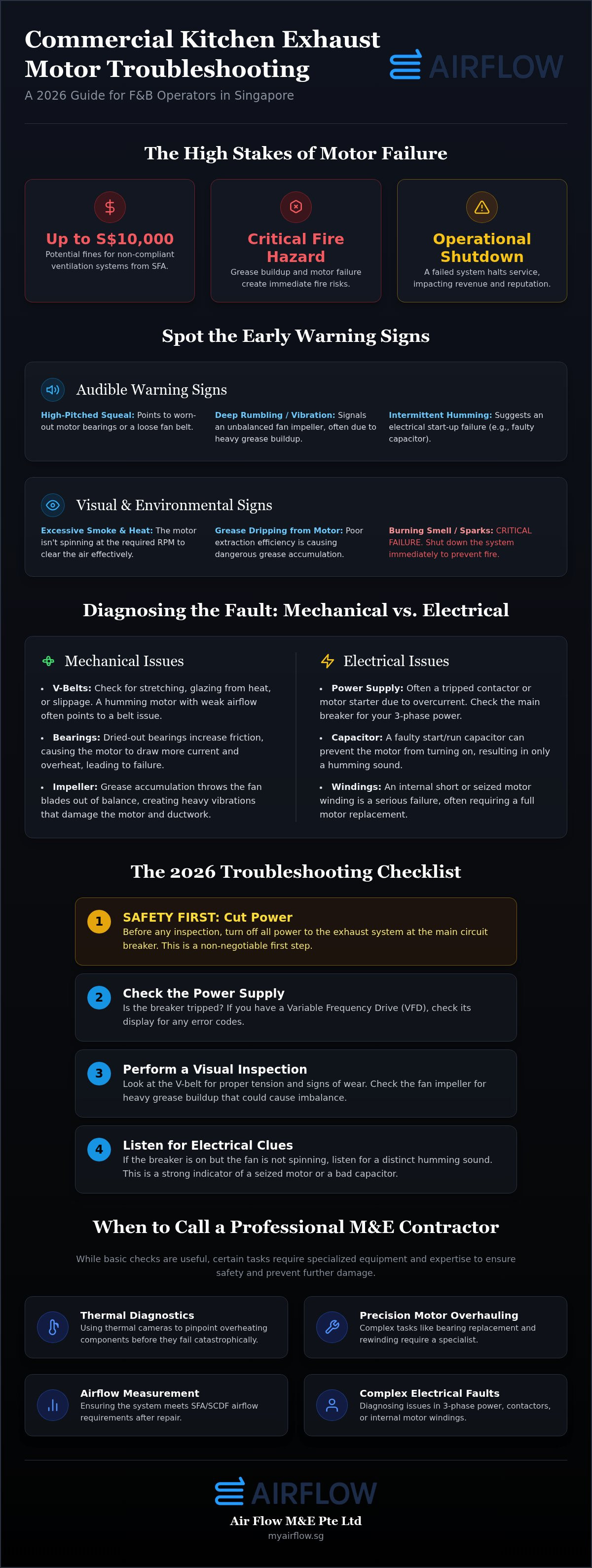
Mechanical components often scream before they fail. A high-pitched squealing sound usually points to worn-out motor bearings or a fan belt that has lost its tension. If you hear a deep rumbling or feel heavy vibrations through the ductwork, the fan impeller is likely unbalanced or clogged with heavy grease deposits. This imbalance puts immense strain on the motor shaft. Conversely, an intermittent humming sound without any fan movement suggests an electrical start-up failure, often related to a faulty capacitor or a seized motor winding.
Visual and Environmental Indicators
Effective Kitchen ventilation systems must maintain a specific airflow rate to clear grease-laden air. If you notice grease dripping from the motor casing or the surrounding ductwork, the system is likely suffering from poor extraction efficiency. This buildup creates a drag that forces the motor to work harder, leading to overheating and shortened equipment lifespan.
You can perform a simple tissue test to verify suction levels. Hold a single piece of tissue paper near the grease filters while the system is running. If the tissue doesn't pull firmly against the filter, your airflow is insufficient. This lack of suction confirms that your commercial kitchen exhaust motor troubleshooting should focus on either a failing motor or a significant mechanical obstruction within the ducting. In the high-stakes Singapore F&B market of 2026, catching these visual cues early ensures your operations remain uninterrupted and compliant with NEA standards.
Understanding the Mechanics: Electrical vs. Mechanical Issues
To perform effective commercial kitchen exhaust motor troubleshooting, you must first separate mechanical failure from electrical faults. While both stop the fan, the solutions are vastly different. A commercial motor's primary job is to maintain negative pressure within the hood, ensuring that heat and fumes are sucked out rather than pushed into the dining area. Unlike residential fans, these heavy-duty systems operate under extreme heat and grease loads, which changes how they fail and how they must be diagnosed.
Mechanical Components: Belts, Bearings, and Impellers
Mechanical issues often stem from the physical connection between the motor and the fan impeller. In many Singaporean kitchens, these are belt-driven systems. V-belts can stretch over time or become glazed from heat, leading to slippage. If your motor is humming but the airflow is weak, the belt is likely the culprit. Bearings are another common failure point; they must withstand high RPMs and constant heat. When bearings dry out, the friction increases, causing the motor to draw more current and eventually overheat.
Grease is the silent killer of mechanical efficiency. According to the AIRAH Guide to Kitchen Exhaust Management, grease accumulation is the primary driver of system strain. Grease sticks to the impeller blades, throwing them out of balance. This imbalance creates heavy vibrations that can shake the motor's internal components apart or even damage the custom-fitted ductwork. Regular cleaning is essential, but once the balance is lost, the motor's lifespan is already compromised.
Electrical Components: Capacitors, Contactors, and Wiring
Electrical faults are often more deceptive than mechanical ones. Most commercial kitchens in Singapore use 3-phase power for their exhaust systems. A common issue is a tripped contactor or motor starter, which acts as a safety switch when the motor pulls too much electricity. If the system won't start at all, your first check should be the control panel. If you find yourself repeatedly resetting a breaker, don't ignore it; the system is telling you that the motor is under dangerous levels of stress.
A more critical condition is single phasing, where one of the three power lines fails while the motor is running. The motor will continue to spin but will grow extremely hot as the remaining two phases carry the entire load. This condition quickly melts the internal motor windings. If you suspect your system is losing power or running at reduced capacity, it's safer to consult a specialist for a professional commercial exhaust motor installation or repair. Commercial motors require this rigorous diagnostic approach because a failure here can lead to a significant fire risk in a high-production kitchen.
The 2026 Kitchen Exhaust Motor Troubleshooting Checklist
Effective commercial kitchen exhaust motor troubleshooting starts with a systematic, non-invasive approach. You don't need to be an engineer to perform these initial checks. Your goal is to gather as much data as possible safely before deciding to call in a specialist. Documenting these findings helps your M&E contractor diagnose the fault faster, which can reduce labor costs and downtime for your F&B operations.
Step 1: Preliminary Power and Control Checks
Begin at the electrical control panel. Ensure the main circuit breaker hasn't tripped due to a power surge. Next, locate the local isolator switch, which is usually found near the motor unit itself. It's common for these to be accidentally switched off during routine cleaning. In 2026, most high-performance systems utilize a Variable Frequency Drive (VFD). Check the VFD screen for specific error codes like "Overload" or "Low Voltage." Finally, verify that the emergency stop (E-stop) button hasn't been engaged by mistake, as this is a frequent cause of "dead" systems.
Step 2: External Component Inspection
Look and listen without dismantling any housings. If you have safe access to the fan assembly, check for loose or snapped V-belts. If the motor is spinning but the fan remains stationary, the belt is the likely culprit. Examine your grease filters. Heavily clogged filters restrict airflow so significantly that they can mimic the symptoms of a failing motor. Listen closely to the motor housing while it's powered. A loud, persistent hum without any rotation, often called the "hum of death," indicates a seized shaft or a failed start capacitor.
Step 3: Environmental Assessment
Check the external discharge point. Obstructions like bird nesting, debris, or stuck discharge louvers create backpressure that forces the motor to work harder, leading to premature burnout. You should also evaluate your makeup air (MUA) system. If the MUA is failing, the exhaust motor is forced to pull against a vacuum, which causes overheating and poor suction at the hood. Before you authorize any major work, consult the Commercial Kitchen Exhaust Motor Repair vs Replacement guide to weigh your next steps. This systematic check ensures you don't overpay for a simple fix or ignore a critical safety risk.
Safety and Compliance: Singapore Standards for Exhaust Failures
Operational safety in a Singaporean F&B environment is inseparable from mechanical reliability. When you engage in commercial kitchen exhaust motor troubleshooting, you are doing more than just fixing a fan; you are managing a significant fire risk. A stalled motor causes immediate heat stagnation within the ductwork. Without the constant draw of air, temperatures around accumulated grease can reach ignition points in minutes. In 2026, SFA and SCDF standards for kitchen ventilation are stricter than ever, making a functional exhaust system a legal mandate for any food shop license holder.
The Fire Hazard of Grease and Heat Stagnation
A failed motor removes the primary cooling mechanism for your kitchen's extraction system. When airflow stops, the grease-laden vapors that usually pass through the duct begin to settle and overheat. This creates a dangerous feedback loop where the duct itself becomes an oven. The motor plays a vital role in your fire suppression strategy by ensuring that flash heat from cooking surfaces is safely vented away from flammable deposits.
Grease buildup is the primary cause of kitchen fires in 2026 because it acts as a high-energy fuel source that ignites rapidly when heat is no longer being actively exhausted from the system. If your motor has seized, the risk of a flash fire increases by over 40% during high-heat cooking operations. This is why a "wait and see" approach to motor failure is never an option for professional operators.
Regulatory Risks of Operating with a Failed Exhaust
Operating a commercial kitchen with a failed exhaust motor is a direct violation of SFA Environmental Public Health regulations. SFA inspectors prioritize ventilation during audits because poor extraction leads to degraded indoor air quality and smoke nuisances for neighboring units. Under the Fire Safety Act, failure to maintain exhaust ducts can result in fines of up to S$10,000 or even imprisonment. You must maintain an updated maintenance log that includes motor service dates and cleaning certificates to present during these inspections.
In Singapore, "DIY" repairs on commercial 3-phase motors are strictly prohibited. These systems operate on high-voltage power and require a licensed M&E contractor for any Addition & Alteration (A&A) works or motor replacements. Attempting to bypass safety contactors or rewire a motor yourself can void your fire insurance and lead to catastrophic electrical failure. If your troubleshooting confirms a motor burnout, you need to engage professional commercial kitchen exhaust system A&A services to ensure your replacement meets all current SCDF fire codes and SFA hygiene standards. Keeping your system compliant is the only way to protect your business from both physical fire and legal penalties.
When to Call a Professional M&E Contractor
There is a distinct threshold where staff-led commercial kitchen exhaust motor troubleshooting reaches its limit. While a visual check of the VFD or belts is safe, opening electrical housings or testing internal motor windings requires specialized diagnostic equipment. If your initial inspection reveals a persistent burning smell, recurring circuit trips, or a motor that remains hot to the touch even when idle, it is time to step back. Air Flow M&E Pte Ltd provides the technical expertise to handle these high-voltage complexities, ensuring your system returns to peak performance without risking accidental damage or injury.
Professional Diagnostics and Overhauling
A professional M&E contractor uses tools that go far beyond the naked eye. We utilize thermal imaging cameras to identify hotspots within the motor stator and rotor before they lead to a catastrophic burnout. This level of detail is a core part of high performance commercial kitchen exhaust motor overhauling. Unlike a simple cleaning, a professional overhaul involves a complete teardown of the unit to replace internal bearings and renew the insulation of the copper windings.
Precision balancing is another critical service staff cannot perform. Even after cleaning, a fan impeller can remain slightly off-balance due to microscopic metal loss or uneven wear. We use dynamic balancing sensors to ensure the assembly rotates with zero vibration. This eliminates the mechanical resonance that often leads to premature bearing failure and noisy ductwork, providing a quieter and more durable ventilation solution for your F&B establishment.
Replacement and A&A Services
Deciding between a fix and a full upgrade is a matter of long-term operational cost. If your motor is over five years old or has suffered multiple winding failures, a kitchen exhaust motor replacement is often the more pragmatic choice. Modern motors in 2026 offer significantly higher efficiency ratings, which can lower your monthly utility bills and provide better suction for high-production cooking lines.
Sometimes the motor isn't the only problem. If your kitchen layout has changed since the original installation, your existing ductwork may be creating excessive backpressure. Air Flow M&E Pte Ltd specializes in Addition & Alteration (A&A) services to optimize your airflow. By installing custom-fitted ductwork with smoother transitions, we reduce the load on your motor, extending its lifespan and improving smoke extraction. For a reliable, engineering-led solution, contact us for professional commercial exhaust motor installation Singapore. We ensure your system is not just running, but operating at maximum efficiency and in full compliance with all local codes.
Secure Your F&B Operations for 2026
Maintaining a high-performance kitchen requires more than just culinary skill; it demands mechanical vigilance. Implementing a systematic approach to commercial kitchen exhaust motor troubleshooting protects your staff from excessive heat and your business from costly SFA penalties. While basic checks on filters and power switches are helpful, complex 3-phase electrical faults and bearing overhauls require a specialist's precision. Proactive maintenance ensures your ventilation system remains a reliable asset rather than a fire liability.
Air Flow M&E Pte Ltd provides expert engineering for Singapore F&B businesses. We specialize in SFA-compliant kitchen exhaust systems, high-performance motor installation, and A&A services. Our team offers the technical authority and peace of mind you need to focus on your guests. Don't wait for a total system failure to address your ventilation concerns. We are here to ensure your operations remain safe, clean, and fully compliant with all local regulations.
Schedule a Professional Exhaust Motor Inspection with Air Flow M&E Pte Ltd today to keep your kitchen running at peak efficiency.
Frequently Asked Questions
Can I run my kitchen if the exhaust motor is making a loud noise?
You shouldn't continue operations if your motor is emitting loud grinding or squealing sounds. These noises usually indicate failing bearings or a damaged fan belt. Running a compromised system leads to poor air extraction, which violates SFA hygiene standards and increases fire risks. It's best to perform commercial kitchen exhaust motor troubleshooting immediately to determine if the unit requires a simple adjustment or a full professional replacement.
How often should a commercial kitchen exhaust motor be serviced in Singapore?
In Singapore, the entire exhaust system must be degreased and cleaned by a specialist contractor at least once every 12 months to meet SCDF and SFA requirements. For high-volume kitchens, we recommend quarterly mechanical inspections. Keeping detailed maintenance records is essential, as SFA inspectors treat a lack of documentation as a failure to maintain the system. Regular servicing prevents grease from unbalancing the impeller and straining the motor.
What is the most common cause of exhaust motor failure in F&B shops?
Excessive grease buildup is the primary cause of motor failure in commercial kitchens. Grease accumulates on the fan blades, creating a mechanical imbalance that puts immense strain on the motor's bearings and shaft. This added resistance causes the motor to draw more current and overheat. Other common issues include worn-out V-belts and electrical component failure, such as a blown start capacitor or a tripped motor contactor.
Is it cheaper to repair or replace a commercial kitchen exhaust fan motor?
Replacing the motor is often more cost-effective than repairing an older, inefficient unit. While minor fixes like belt replacements are affordable, a full motor rewind or bearing overhaul can be costly. Modern 2026 motor models are more energy-efficient and can reduce energy consumption by up to 40% compared to neglected equipment. If your motor is over five years old, a new professional installation provides better long-term reliability.
Does SFA require a specific type of motor for kitchen exhaust systems?
SFA doesn't mandate a specific motor brand, but the system must effectively manage smoke and odors to maintain indoor air quality. The installation must comply with SCDF Fire Code Clause 7.1 regarding fire-rated ducts and proper clearances. All Addition & Alteration (A&A) works must be handled by a licensed M&E contractor to ensure the motor's capacity matches the kitchen's cooking load and meets Singapore's strict regulatory standards.
Why does my exhaust motor trip the circuit breaker repeatedly?
Repeated tripping indicates that the motor is drawing more electrical current than the circuit can safely handle. This is often caused by seized bearings or an unbalanced impeller that makes the motor work too hard. It can also signal a "single phasing" issue in 3-phase systems, where one power line fails and causes the remaining phases to overheat. You must stop the system immediately to prevent a potential electrical fire.
How can I reduce the noise of my kitchen exhaust motor?
Reducing noise starts with professional balancing of the fan impeller and replacing worn bearings. You can also install vibration isolators to prevent mechanical sounds from traveling through the ductwork. Ensuring your V-belts are properly tensioned eliminates high-pitched squealing. Some modern, energy-efficient motors are designed to produce up to 50% less noise. Custom-fitted ductwork also helps by minimizing air turbulence and static pressure, leading to a quieter kitchen environment.
Can grease buildup actually stop the exhaust motor from spinning?
Yes, heavy grease accumulation can physically seize the fan impeller or the motor shaft. Grease acts as a thick, sticky adhesive that increases mechanical drag until the motor can no longer turn. This forced stall causes the internal windings to overheat rapidly, often leading to a total motor burnout. Regular degreasing of the hood and fans is the only way to prevent this type of catastrophic failure and maintain SFA compliance.


