

What if poor extraction isn’t just a cleaning issue? When smoke, heat or cooking odours linger, it can be difficult to tell whether the hood, filters, fan or ductwork needs attention, or whether the system no longer suits the kitchen. A commercial kitchen exhaust retrofit Singapore assessment can help clarify the difference.
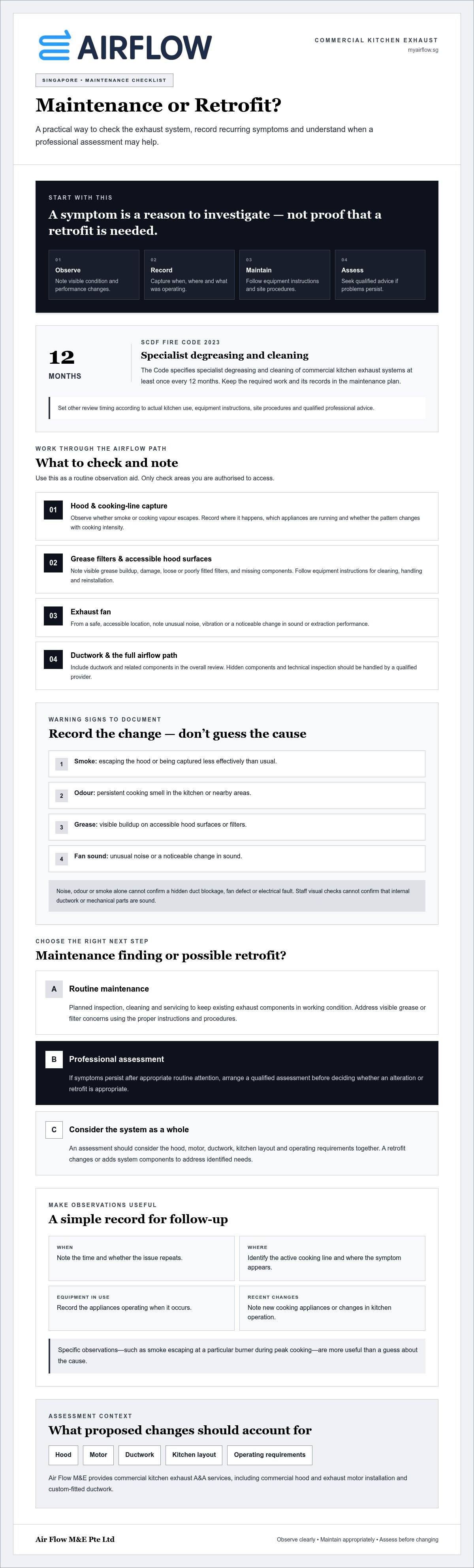
Start by checking routine maintenance. Grease buildup and blocked filters can affect extraction, but recurring problems may point to a mismatch between the exhaust system, kitchen layout and operating demands. Singapore’s SCDF Fire Code 2023 specifies specialist degreasing and cleaning for commercial kitchen exhaust systems, so keep the required work and its records in your maintenance plan.
This checklist helps you review key exhaust components, record signs that warrant a professional assessment and distinguish routine maintenance needs from possible reasons to consider an alteration or retrofit. It also explains what information to gather so proposed changes can be considered in the context of your kitchen layout and service requirements.
Key Takeaways
- Use a component-by-component checklist to record visible condition, airflow concerns, unusual noise and follow-up needs.
- Follow equipment instructions and site procedures. Set review timing according to actual kitchen use and qualified professional advice.
- Separate routine maintenance findings from recurring issues that may warrant a professional assessment. A symptom alone doesn’t mean a retrofit is necessary.
- A commercial kitchen exhaust retrofit Singapore assessment should consider the hood, motor, ductwork, kitchen layout and operating requirements together.
- Air Flow M&E provides commercial kitchen exhaust A&A services, including commercial hood and exhaust motor installation and custom-fitted ductwork.
Commercial Kitchen Exhaust Maintenance in Singapore: Why a Checklist Matters
Weak smoke capture, lingering odours or a noisy fan can disrupt kitchen work, but these symptoms don’t confirm that a component has failed. A checklist gives operators a consistent way to record what they observe and decide whether routine attention or a closer technical assessment may be needed.
Routine maintenance is planned inspection, cleaning and servicing to keep existing exhaust components in working condition; a retrofit changes or adds system components to address identified needs. A symptom is a reason to investigate, not proof that a retrofit is required. Making this distinction helps avoid assumptions before the system has been assessed.
What does commercial kitchen exhaust maintenance cover?
Checks should consider the full airflow path: the hood that captures cooking fumes, its filters, the exhaust fan, ductwork and related components. Grease can accumulate along this path and restrict airflow. The grease duct fire protection role also makes appropriate cleaning and upkeep important beyond day-to-day extraction performance.
Use equipment instructions, kitchen use and site conditions to guide checks and cleaning arrangements. SCDF Fire Code 2023 specifies specialist degreasing and cleaning of the commercial kitchen exhaust system at least once every 12 months. Operators can record visible conditions and changes in performance, while hidden components, technical inspection and repair should be handled by a qualified provider. A visual check by staff cannot confirm that internal ductwork or mechanical parts are sound.
Which warning signs should operators record?
Note changes that could help a professional understand the problem. Record what happens, when it happens and whether it repeats. Useful observations include:
- Smoke escaping the hood or being captured less effectively than usual.
- Persistent cooking odour in the kitchen or nearby areas.
- Visible grease on accessible hood surfaces or filters.
- Unusual fan noise, or a noticeable change in its sound.
Add the time, the active cooking line and the equipment in use. Record recent changes too, such as a new cooking appliance or a change in how the kitchen operates. These details help distinguish a one-off observation from a recurring pattern.
Don’t diagnose a hidden duct blockage, fan defect or electrical fault from noise, odour or smoke alone. If symptoms persist after appropriate routine attention, arrange a professional assessment before deciding whether a commercial kitchen exhaust retrofit Singapore is appropriate. Consider the findings alongside the kitchen layout and operating requirements, rather than treating a symptom as an automatic reason to change the system.
A Commercial Kitchen Exhaust Maintenance Checklist for Key Components
Use this checklist to make routine observations consistent and easier to follow up. It’s a planning aid, not a substitute for qualified inspection, technical servicing or repair. Follow each component’s equipment instructions and your site procedures. Don’t remove guards, open restricted equipment or enter areas staff aren’t authorised to access.
Check the hood, grease filters, exhaust fan, ductwork and airflow path, recording visible condition and any change in extraction. Separate what staff can safely observe from work that requires trained personnel. A note such as “smoke escapes at the rear burner during peak cooking” is more useful than a guess about the cause.
Hood, grease filters, and cooking-line capture
During an appropriate routine check, look for visible grease buildup on accessible hood surfaces and filters. Note damage, filters that appear loose or poorly fitted, and any missing components. Don’t assume a filter is correctly installed just because it looks clean. Follow the equipment instructions for cleaning methods, handling and reinstallation.
Observe capture during normal operation across the cooking line. Record where smoke or cooking vapour escapes, which appliances are running and whether the issue changes with cooking intensity. This helps identify a repeatable pattern without treating one observation as a confirmed system fault.
Exhaust fan, ductwork, and airflow observations
Listen for unusual fan noise or vibration from a safe, accessible location. Note persistent odour and any change in extraction performance. Record visible grease or damage only where it can be seen without dismantling equipment or entering restricted areas. Avoid touching moving parts or electrical components.
Concealed ductwork and internal mechanical or electrical conditions need professional assessment. Don’t try to confirm a blockage or fault from noise, odour or weak airflow alone. Share your observations and when they occur, then have an appropriately qualified provider determine what inspection or work is needed.
- Hood and filters: Note visible grease, damage, fit and missing components.
- Capture: Record where smoke or vapour escapes during normal cooking.
- Fan: Describe unusual sound, vibration or changes in operation.
- Ductwork: Note accessible signs of grease or damage, without opening restricted areas.
- Follow-up: Log the date, operating conditions and any action taken.
Repeated findings help a professional decide whether maintenance attention is enough or whether a broader assessment is warranted. If observations suggest a possible commercial kitchen exhaust retrofit Singapore, consider how the system serves your actual kitchen layout and operating needs. For information on commercial exhaust A&A and installation work, see commercial kitchen exhaust services.
Maintenance or Retrofit? How to Assess Commercial Kitchen Exhaust Issues
A symptom is a prompt to investigate, not a verdict on the system. Visible filter buildup may call for checks against the equipment instructions and approved routine cleaning. If extraction concerns continue, return or follow a change in cooking operations, record what you observe and seek a professional assessment before deciding whether alteration or retrofit work is appropriate.
Use this comparison to choose a sensible next step. It does not diagnose faults or replace a technical inspection.
| Finding | Possible next step | Who should assess it |
|---|---|---|
| Visible grease on accessible filters | Check equipment instructions and site procedures. Record the condition before and after approved routine cleaning. | Operators can observe; trained personnel should handle work that requires specialist cleaning or access. |
| Smoke capture seems reduced on one cooking line | Note which appliances are operating and whether the issue persists after routine checks. | A qualified provider if the concern recurs or remains unexplained. |
| Persistent odour, unusual fan noise, or vibration | Record when it occurs. Don’t assume cleaning will resolve the cause. | A qualified provider for technical assessment. |
| Cooking equipment, kitchen layout, or operating demands have changed | Review whether the existing system still suits the current arrangement and requirements. | A provider experienced in commercial kitchen exhaust A&A. |
When cleaning or routine servicing may be the next step
If grease is visible on an accessible filter, first verify the correct handling and cleaning method in the equipment instructions. After approved routine cleaning, record whether smoke capture or extraction seems different under comparable operating conditions. This before-and-after note is useful, but it doesn’t prove that the filter was the only cause or that cleaning has resolved an airflow problem.
When to request a professional retrofit assessment
Recurring symptoms deserve a closer look, especially if cooking equipment, operating patterns or the kitchen layout have changed. A professional review should consider the existing hood, exhaust motor, duct route and current operating requirements together. The assessment may identify maintenance needs, another issue to investigate or a case for system changes. A commercial kitchen exhaust retrofit Singapore is not automatically required just because odour, noise or weak capture occurs.
For upgrade-specific considerations, see the commercial kitchen exhaust system upgrade guide. For broader context on addition and alteration planning, read the kitchen ventilation A&A works guide. Both can help you frame questions around your actual kitchen instead of assuming a one-size-fits-all solution.
How to Put a Singapore Commercial Kitchen Exhaust Maintenance Checklist into Practice
A checklist works best as a shared record, not a one-off inspection sheet. Use it to track observations, cleaning, servicing and follow-up actions over time. Set review timing according to equipment instructions, actual kitchen use, site conditions and qualified professional advice. Don’t apply a fixed schedule to every system without considering those factors.
What to include in the maintenance log
Keep each entry brief and factual. Record the date, component checked, observation, action taken and person responsible. For example, note which filter was checked, whether visible grease was present, what approved cleaning was completed and whether a performance concern remained afterwards. Attach equipment guidance, service reports or other relevant records where available.
Look for patterns across entries. Repeated smoke-capture concerns during the same cooking operation give a contractor more useful context than a single report. Record unresolved items and who will follow up, so observations aren’t lost between shifts.
- Date and component: Identify when the check took place and which part of the exhaust system was observed.
- Finding and action: Describe what was seen or heard, then note any cleaning, servicing or referral.
- Responsibility and follow-up: Name the person responsible for the entry and track any outstanding action.
- Supporting records: Keep relevant equipment instructions and service documentation with the log.
Keep general maintenance planning distinct from official requirements. Singapore’s SCDF Fire Code 2023, Clause 7.1.13, specifies specialist degreasing and cleaning of the commercial kitchen exhaust system at least once every 12 months. Keep records of cleaning and maintenance, and check current official guidance for the requirements applicable to your premises. Maintain records in the form required by the relevant authority.
How to prepare for an on-site assessment
Before arranging an assessment, gather the kitchen layout, cooking equipment details, operating pattern and symptom history. Identify access constraints and possible operational windows with the provider in advance. Agree how proposed work will be coordinated with service needs. Timing depends on the system and scope, so don’t assume a fixed duration.
For requirements-focused reading, see the F&B kitchen exhaust requirements guide. If recurring findings suggest a possible commercial kitchen exhaust retrofit Singapore, a professional assessment can help relate the existing system to your layout and operating needs. To discuss commercial kitchen exhaust A&A, hood or exhaust motor installation, or custom-fitted ductwork, contact Air Flow M&E.
When Commercial Kitchen Exhaust A&A Can Address Persistent Maintenance Findings
Recurring extraction concerns or repeated checklist findings may justify a closer review of the existing system. They don’t automatically mean a retrofit is needed. Since a symptom can have more than one possible cause, use your maintenance log and professional findings to understand the issue before deciding on system changes.
A commercial kitchen exhaust retrofit in Singapore should be planned around the kitchen it serves. Cooking equipment, operating patterns and layout all affect what the system needs to accommodate. A change that suits one kitchen may not suit another.
What a commercial exhaust A&A assessment can consider
A site-specific review can consider how the existing hood, exhaust motor and ductwork route relate to the kitchen layout and operational needs. Share recurring observations and any relevant equipment or layout changes. This gives the provider context to assess whether the findings point to a system alteration or another next step.
Any proposed scope should follow site findings and confirmed requirements, not assumptions based on one symptom. Air Flow M&E Pte Ltd’s commercial scope includes kitchen exhaust addition and alteration (A&A) services, commercial kitchen hood installation, commercial exhaust motor installation and custom-fitted ductwork. This work is separate from routine cleaning or maintenance. An assessment or proposed change does not guarantee a particular extraction outcome, compliance result or approval.
What information to prepare before contacting a provider
An organised enquiry can make the initial discussion more useful. Prepare:
- Business and kitchen context: Your type of food operation and a simple kitchen layout, if available.
- Equipment details: The cooking appliances served by the exhaust system, including any recent or planned changes.
- System information: Available details about the hood, exhaust motor and duct route.
- Recorded symptoms: What you observed, when it happens, which cooking line is active and whether it recurs.
- Images or documents: Relevant photos or plans, shared only when safe and appropriate. Don’t enter restricted areas or dismantle equipment to obtain them.
This information can help connect the reported issue to the physical arrangement and demands of the kitchen. It also keeps the discussion focused on the commercial exhaust system and any A&A scope that may be relevant.
If persistent findings have you considering a commercial kitchen exhaust retrofit Singapore, discuss your commercial requirements with Air Flow M&E. Share your checklist observations, system details and kitchen layout to start a focused conversation about commercial kitchen exhaust A&A, hood or exhaust motor installation, or custom-fitted ductwork. Discuss your commercial exhaust requirements.
Take the Next Step with a Clear Exhaust System Plan
A consistent maintenance log helps your team spot recurring issues and share useful details with a professional. Visible grease, odour, smoke or unusual fan noise are reasons to investigate, not proof that a retrofit is required. Base next steps on the findings, your kitchen layout and how the system is used.
If a commercial kitchen exhaust retrofit Singapore assessment may be appropriate, Air Flow M&E focuses on commercial kitchen exhaust A&A and installation. Its scope includes commercial kitchen hoods, exhaust motors and custom-fitted ductwork for commercial kitchen layouts. A site-specific discussion can help clarify what work may suit your requirements, without assuming that every persistent symptom calls for a system change.
Prepare your observations, equipment details and relevant layout information, then discuss your commercial kitchen exhaust requirements with Air Flow M&E.
Frequently Asked Questions
Is commercial kitchen exhaust maintenance required in Singapore?
Yes. Operators should maintain equipment according to manufacturer instructions, site conditions and applicable official requirements. SCDF Fire Code 2023, Clause 7.1.13, specifies specialist degreasing and cleaning of the commercial kitchen exhaust system at least once every 12 months. Keep cleaning and maintenance records, and check current requirements for your premises. This general checklist isn’t a compliance determination; seek qualified advice if you’re unsure what applies to your site.
How often should a commercial kitchen exhaust system be maintained?
There isn’t one routine maintenance interval that suits every kitchen. Timing can depend on equipment guidance, cooking activity, observed grease buildup and qualified professional advice. Establish a documented schedule based on those factors, then review it as kitchen use or site conditions change. Check applicable official requirements separately, since specialist cleaning may have a specified interval. Don’t assume a general maintenance schedule replaces that requirement.
What should be included in a commercial kitchen exhaust maintenance checklist?
Include visible hood and filter condition, grease buildup, smoke capture, unusual fan noise or vibration, and accessible ductwork observations. Log the date, findings, actions taken and follow-up needed. Check only areas staff are authorised to access. Don’t open restricted equipment or attempt electrical or concealed mechanical work. Refer concerns that need technical investigation to qualified personnel, and follow the relevant equipment instructions and site procedures.
Can poor kitchen exhaust performance be fixed by cleaning the filters?
Cleaning filters according to equipment instructions may address visible filter buildup, but it can’t confirm or resolve every airflow problem. Persistent smoke, odour or weak extraction may have other causes involving the fan, ductwork, kitchen layout or system operation. Record when the symptom occurs and whether it continues after approved cleaning. If the problem persists, arrange a professional assessment instead of assuming filter cleaning is the complete fix.
What happens if a commercial kitchen exhaust system keeps showing the same problem?
Document when the issue occurs, which cooking equipment is operating and what maintenance has already been performed. Repeated symptoms warrant qualified assessment of the relevant components and operating conditions. Findings may point to servicing, repair, operational changes or an A&A assessment. A recurring problem doesn’t automatically mean a retrofit is needed. Share your maintenance log so the provider can review a pattern, not just an isolated report.
When should a commercial kitchen consider an exhaust retrofit?
Consider an assessment if persistent problems, kitchen layout changes or new operating needs remain unresolved after routine checks. A qualified provider should review the existing hood, exhaust motor, ductwork and site requirements before recommending work. A commercial kitchen exhaust retrofit in Singapore shouldn’t be the default response to every symptom or older system. The right next step depends on the findings and the kitchen’s actual requirements.
Who can assess a commercial kitchen exhaust system in Singapore?
Seek a provider experienced in commercial kitchen exhaust and M&E work, and confirm that the proposed scope matches your site needs. Air Flow M&E Pte Ltd provides commercial exhaust A&A services, commercial kitchen hood and exhaust motor installation, and custom-fitted ductwork. Its stated scope focuses on commercial systems, not residential kitchen ventilation. Share your layout, system details and recorded symptoms to support a focused discussion.


