

If your kitchen is filled with smoke despite the fans running at full speed, scrubbing your filters again won't solve the problem. You understand the frustration of staff complaining about stifling heat and the constant worry of SFA or NEA non-compliance penalties. Finding a permanent commercial kitchen hood suction fix requires looking beyond surface-level grime to the mechanical and design integrity of your ventilation system.
We'll help you identify the root causes of poor airflow and explain how professional Addition & Alteration (A&A) modifications can restore your hood's power. This guide provides a clear breakdown of mechanical failures versus fundamental engineering flaws. You'll learn how to bring your setup back into compliance with the latest SS 553:2026 Singapore safety standards. The goal is a cooler, safer workspace and restored efficiency without the cost of a full system replacement.
Key Takeaways
- Identify the critical difference between routine maintenance issues and fundamental design flaws that cause smoke and heat to linger in your kitchen.
- Understand how grease accumulation degrades motor bearings and why a professional commercial kitchen hood suction fix is necessary to restore peak performance.
- Learn about the "Vacuum Effect" and why your exhaust system requires balanced make-up air to function effectively without straining the motor.
- Stay compliant with the latest 2026 SFA and NEA regulations, including the revised SS 553:2026 standards for air-cleaning and fire safety.
- Discover how targeted Addition & Alteration (A&A) services can re-engineer your existing ductwork and hood setup for a permanent solution to airflow problems.
Common Symptoms of a Failing Kitchen Exhaust System
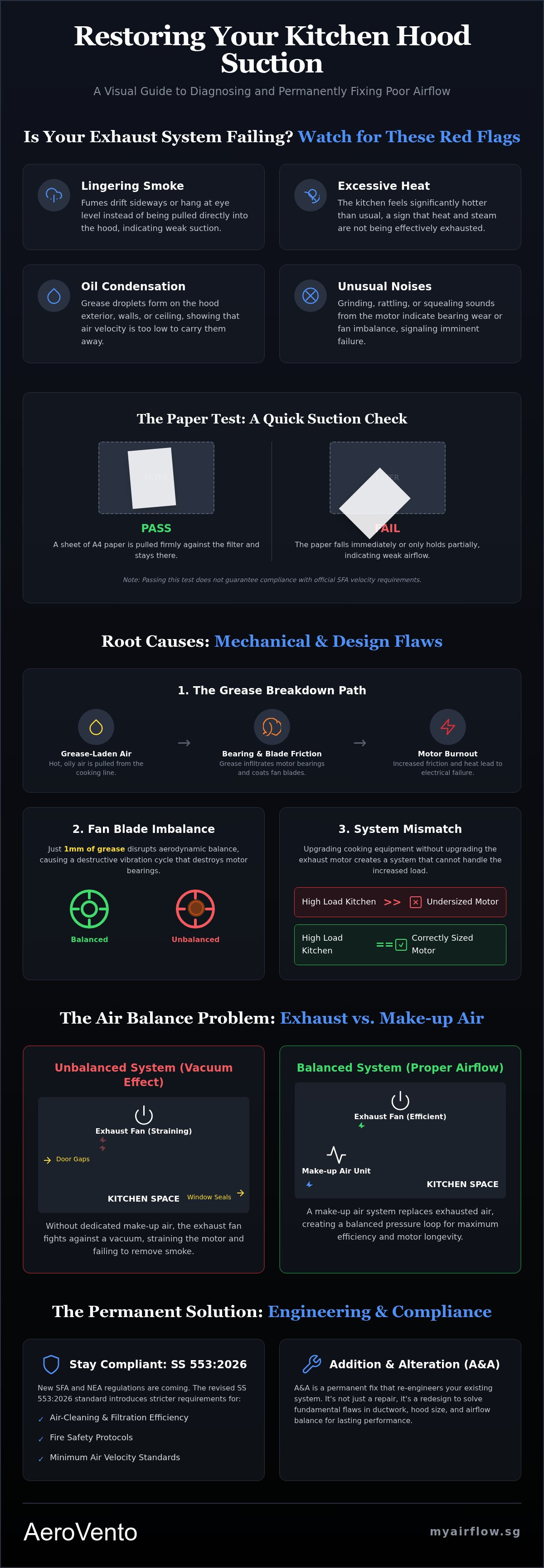
Recognizing the signs of a failing system is the first step toward a permanent commercial kitchen hood suction fix. Don't ignore the obvious. When a system begins to fail, the symptoms are usually physical and immediate. Watch for these red flags:
- Lingering smoke: Fumes drift sideways or hang at eye level instead of being pulled into the hood.
- Excessive heat: The kitchen feels significantly hotter than usual, even with the fans on full power.
- Oil condensation: Droplets form on the hood exterior or the ceiling, suggesting poor air velocity.
- Mechanical noise: Grinding or rattling from the motor indicates bearing wear or fan imbalance.
Understanding the design of commercial kitchen ventilation systems helps you see that these aren't just annoyances; they're indicators of mechanical strain that can lead to motor failure. If your staff is constantly complaining about the air quality, the system isn't doing its job. Unchecked heat and smoke lead to fatigue and increase the risk of fire hazards from grease buildup.
The 'Paper Test' for Immediate Suction Assessment
A quick way to check your system is the paper test. Hold a single sheet of A4 paper near the grease filters while the fan is running. If the suction is healthy, the paper should be pulled firmly against the filter and stay there. If it drops immediately or only holds partially, your airflow is insufficient. A successful test shows some suction exists, but it doesn't guarantee your system meets the specific velocity requirements mandated by the SFA for 2026. You'll likely need a technical audit to confirm actual performance levels.
Visual Red Flags in the Ductwork and Hood
Inspect your duct joints for visible grease leakage. Seepage indicates that the internal pressure is wrong or the seals have failed. Check the fan blades if they're accessible; deformation or heavy carbon buildup will kill your CFM output. Finally, pay attention to a "heavy air" feeling. If the kitchen feels humid and smells strongly of old oil, the air exchange rate is likely far below the necessary standard. Identifying these issues early prevents a total system shutdown and helps you determine if you need a specialized commercial kitchen hood suction fix before your next regulatory inspection.
Mechanical Causes: Why Your Exhaust Motor is Losing Power
Motor failure isn't always sudden. It's often a slow decline caused by the harsh environment of a commercial kitchen. Grease-laden air is the biggest threat. It infiltrates motor bearings and fan impellers, creating friction and heat. Over time, this leads to electrical faults like capacitor failure or wiring degradation. High temperatures in the motor room only accelerate this process, causing the motor to trip or burn out prematurely.
For belt-driven centrifugal fans, belt slippage is a common culprit for weak suction. A worn or loose belt can't transfer power efficiently, leading to a significant drop in fan RPM. This mechanical inefficiency directly violates OSHA ventilation requirements, which mandate specific air volumes to keep workers safe. If your fan sounds like it's spinning but you feel no air movement, the belt is likely the first thing to check during a commercial kitchen hood suction fix.
Fan Blade Imbalance and Grease Accumulation
Aerodynamic balance is fragile. Just 1mm of grease on a fan blade can disrupt its center of gravity. This creates a "vibration cycle" where the wobbling blade puts uneven pressure on the motor bearings. Eventually, the bearings fail, resulting in the loud grinding noises mentioned earlier. At this stage, a simple cleaning won't work. You'll need a professional commercial kitchen hood suction fix to determine if the motor can be salvaged or if a replacement is required.
Undersized Motors vs. Changed Kitchen Layouts
Many F&B owners upgrade their cooking line without considering the exhaust system. Adding a heavy-duty grill or an extra fryer increases the smoke volume beyond what your current motor can handle. Horsepower alone doesn't guarantee performance; it's about the Cubic Feet per Minute (CFM) the motor can pull against the resistance of your ductwork. Motor capacity must match the total hood length and duct resistance. If your kitchen layout has evolved, a standard repair won't suffice. You might need a professional exhaust motor installation to bring your system back to peak efficiency.
The Make-up Air Problem: Why Airflow Balance is Critical
Many business owners assume that if a fan is spinning, it must be exhausting air. This is a common misconception. For an exhaust system to work, it must replace every cubic foot of air it removes. This replacement air is called make-up air. Without a dedicated source of fresh air, your kitchen creates a "Vacuum Effect." The exhaust motor tries to pull air out of a sealed room, but physics won't allow it. This resistance forces the motor to work significantly harder, leading to overheating and premature failure.
Signs of this imbalance are often physical. You might notice that kitchen doors are difficult to open or slam shut on their own. You may hear air whistling through electrical outlets or ceiling gaps. If you're experiencing these issues, a standard cleaning won't help. You likely need a professional commercial kitchen hood suction fix that addresses the building's air pressure balance. When the motor fights negative pressure, its CFM output drops drastically, leaving smoke and heat trapped at the cooking line.
Passive vs. Active Make-up Air Systems
Relying on open windows or back doors is known as passive make-up air. In Singapore's humid climate, this is rarely effective. It introduces dust, pests, and unconditioned heat into your workspace. Active systems use dedicated supply air fans to mechanically pump fresh air into the kitchen. Following standard Mechanical Ventilation System Requirements ensures that your kitchen maintains a slight negative pressure. A common industry benchmark is the 80/20 rule, where you supply 80% of the air being exhausted. This prevents cooking odors from drifting into the dining area while ensuring the exhaust fan has enough air to function efficiently.
Integrating Fresh Air with Your Exhaust A&A
A proper Addition & Alteration (A&A) project doesn't just look at the hood; it looks at the entire airflow circuit. Poorly placed supply vents can cause "short-circuiting," where fresh air is sucked straight into the exhaust before it clears any smoke. We design supply air ducts to deliver air where it's needed most without blowing directly on the cooking surface, which can cool down food or flicker gas flames. For establishments with limited space, Expert Kitchen Ductwork Fabrication in Singapore is essential to fit these dual systems into tight ceiling voids. Balancing these two streams is the only way to achieve a permanent commercial kitchen hood suction fix that meets modern safety standards.
SFA Standards and Regulatory Compliance for Suction Fixes
In Singapore, your kitchen's ventilation isn't just about comfort; it's a legal requirement for licensing. The Singapore Food Agency (SFA) mandates that exhaust systems effectively remove fumes and heat to maintain food hygiene. Capture velocity is the critical metric here. For most standard hoods, the minimum air velocity at the hood face should be 0.5 m/s. If your system falls below this, you'll likely fail your pre-licensing inspection or annual renewal. DIY fixes often fail because they don't account for these specific airflow measurements.
The National Environment Agency (NEA) adds another layer of complexity. They focus on what leaves your building. If your exhaust discharges smoke or strong odors that affect neighbors, you risk heavy fines. This is why a professional commercial kitchen hood suction fix often includes installing Electrostatic Precipitators (ESP) or carbon filters. These components ensure your discharge meets the SS 553:2026 standards for clean air emission, especially in mixed-use developments where residential units are nearby.
The Role of BCA and SFA in Exhaust Modifications
Major changes to your ventilation system fall under Addition & Alteration (A&A) works. These often require a Professional Engineer (PE) endorsement to ensure the structural and mechanical integrity of the building. You must also comply with SCDF fire codes. These codes mandate that ducts be constructed from fire-rated steel and equipped with an automatic fire suppression system. Proper suction isn't just for smoke. It prevents the heavy grease accumulation that turns ductwork into a fire hazard. A professional commercial kitchen exhaust A&A service ensures every modification meets these multi-agency requirements.
Avoiding Penalties for Non-Compliant Exhaust Systems
Fines or forced closures are far more expensive than a professional commercial kitchen hood suction fix. NEA and SFA inspections are thorough. They look for maintenance records and physical proof of airflow efficiency. To prepare, ensure your system is degreased at least every 12 months as per SCDF mandates. Your motor must pull at the required CFM to keep the kitchen environment safe. For a deeper look at these requirements, refer to our 2026 Commercial Kitchen Hood Guide. We can help you navigate these regulations so you can focus on running your business with peace of mind.
Addition & Alteration (A&A): The Permanent Suction Fix
When routine maintenance fails to clear the smoke, the problem is usually systemic. Simple repairs like belt tightening or filter degreasing only work if the original system was engineered correctly. In many Singapore kitchens, the exhaust setup was either undersized from the start or became obsolete after equipment upgrades. Achieving a permanent commercial kitchen hood suction fix requires an Addition & Alteration (A&A) approach. This process moves beyond surface-level fixes to address the fundamental physics of your ventilation.
Our A&A process starts with a comprehensive site audit. We don't just look at the fan; we calculate the required Cubic Feet per Minute (CFM) based on your current heat load and duct length. We then upgrade components to match these needs. This might involve installing high-performance exhaust motors that can handle higher static pressure. By re-balancing the system, we ensure that your kitchen meets 2026 safety standards while reducing the strain on your hardware. This prevents the frequent motor burnouts that plague poorly designed setups.
Re-engineering Your Ductwork for Maximum Flow
Static pressure is the enemy of suction. Every sharp 90-degree elbow in your ductwork acts as a bottleneck, creating turbulence that slows down air. During an A&A project, we often replace these "airflow killers" with smooth, long-radius transitions. Increasing the duct diameter is another effective way to reduce air friction and noise. Because Singapore kitchens often have very tight ceiling voids, we specialize in kitchen ductwork fabrication that is custom-fitted to your specific layout. This precision engineering is the only way to maximize the CFM output of your motor.
When to Opt for a Complete Hood Replacement
Sometimes, the hood itself is the bottleneck. Older "box" style hoods are often inefficient at capturing high-velocity plumes from modern wok ranges or charbroilers. If your hood size doesn't match the actual heat load of your equipment, smoke will always escape into the kitchen. Upgrading to a high-efficiency model with better grease extraction can be a more cost-effective commercial kitchen hood suction fix than constantly repairing an undersized system. You should also consider the state of your filtration. For a detailed look at modern options, check our Commercial Kitchen Hood Filters Singapore guide. Matching the right filter to your cooking intensity ensures long-term suction and easier maintenance.
Secure Your Kitchen's Operational Future
A weak exhaust system does more than just frustrate your staff. It risks your SFA license and creates a hazardous, grease-laden environment. A permanent commercial kitchen hood suction fix requires moving beyond surface cleaning to address mechanical failures and airflow imbalances. Whether the issue is a worn motor or poorly designed ductwork, identifying the root cause is essential for long-term operational success and fire safety.
Our expert M&E engineers specialize in Addition & Alteration (A&A) works tailored specifically for Singapore's high-stakes F&B sector. We focus on SFA/NEA compliance and utilize custom ductwork fabrication to ensure your system delivers the precise CFM your kitchen requires. Don't let poor ventilation compromise your safety or regulatory standing. We provide the technical precision needed to keep your air clean and your kitchen running smoothly.
Book a Professional Airflow Audit for Your Kitchen today. It's the most reliable way to ensure your establishment remains compliant, efficient, and comfortable throughout 2026.
Frequently Asked Questions
Why is my kitchen hood making a loud noise but not sucking smoke?
Loud noises without effective suction usually indicate a mechanical failure or severe imbalance within the system. This often stems from worn motor bearings, a slipping fan belt, or an impeller heavily laden with grease. When these components fail, the fan cannot reach the required RPM to move air effectively. A professional commercial kitchen hood suction fix involves a technical inspection to determine if the motor requires a specialized repair or a full replacement.
Can cleaning the filters fix all suction problems?
No, cleaning filters only addresses surface-level blockages. While saturated grease filters definitely restrict airflow, many suction issues are caused by deeper problems like undersized ductwork, failing exhaust motors, or a lack of make-up air. If your hood fails to pull smoke after a thorough degreasing, the issue is likely structural or mechanical. In these cases, you may require professional Addition & Alteration (A&A) services to re-engineer the system for optimal performance.
What is the SFA requirement for kitchen exhaust suction in Singapore?
The Singapore Food Agency (SFA) mandates that exhaust systems effectively remove all fumes and grease to maintain food hygiene standards. A key technical requirement is the capture velocity at the hood face, which is typically set at a minimum of 0.5 meters per second (m/s). Systems must also comply with the updated SS 553:2026 standards. Failure to meet these velocity benchmarks can lead to licensing delays or penalties during your annual official inspections.
How often should I have my commercial exhaust motor inspected?
You should have your exhaust motor and the entire mechanical system inspected at least once every six months. While SCDF mandates a full degreasing of the system every 12 months, high-intensity kitchens often require more frequent technical checks. Regular preventative maintenance helps identify belt wear, bearing friction, and electrical degradation early. This proactive approach prevents unexpected downtime during peak service hours and extends the lifespan of your expensive mechanical components.
Will a bigger exhaust fan always fix my suction issues?
Not necessarily, as a larger fan can actually worsen problems if the existing ductwork is too small. Increasing the fan size without expanding the duct diameter creates excessive static pressure and loud noise. It can also lead to severe negative pressure if your kitchen lacks sufficient make-up air. A successful commercial kitchen hood suction fix requires balancing the fan's horsepower with the duct's capacity and the room's fresh air supply through professional calculations.
What is make-up air and why does my kitchen need it?
Make-up air is the fresh air brought into the kitchen to replace the volume of air being pulled out by the exhaust fan. Without it, your kitchen becomes a vacuum, making it physically impossible for the hood to suck out smoke effectively. This imbalance strains the exhaust motor and causes doors to slam or whistle through cracks. An active make-up air system ensures the exhaust fan operates efficiently without fighting against negative room pressure.
Does poor suction increase the risk of a kitchen fire?
Yes, inadequate suction allows grease-laden vapors to settle inside the hood and ductwork rather than being exhausted out of the building. This heavy grease accumulation is highly flammable and acts as fuel if a flash fire occurs on the cooking line. Maintaining proper air velocity ensures these particles are moved through the system efficiently. Effective ventilation is a critical part of your establishment's fire safety strategy and SCDF regulatory compliance.
What are A&A works for a kitchen exhaust system?
Addition & Alteration (A&A) works involve significant modifications to an existing ventilation setup to improve performance or meet new regulatory requirements. This can include installing high-performance exhaust motors, fabricating custom-fitted ductwork, or re-configuring the hood layout. Unlike simple repairs, A&A services address the root engineering flaws of a system. These works often require Professional Engineer (PE) endorsement to ensure the modifications comply with Singapore's building and fire safety codes.


