

A heavy duty commercial kitchen hood installation is a complex engineering task, not just a hardware purchase. In the high-stakes environment of Singapore's F&B industry, a poorly calibrated system does more than just leak smoke; it puts your entire business at risk of fire hazards and regulatory shutdowns. You likely already know that weak suction leads to grease-slicked walls and unhappy diners. It's a constant battle to keep equipment clean while worrying if your setup will pass the next SFA inspection.
We understand that peace of mind comes from knowing your mechanical systems are built for long-term durability. This technical guide provides the clarity you need to master the latest SCDF fire codes and SFA licensing requirements for 2026. You'll learn how to achieve efficient heat extraction through precision-fitted ductwork and high-performance exhaust motors. We'll walk through the critical specifications for material fabrication, noise mitigation, and the essential maintenance cycles required to keep your kitchen running safely and legally.
Key Takeaways
- Learn why Grade 304 stainless steel is the essential material standard for durability in high-volume Singaporean F&B environments.
- Understand the latest 2026 SFA and NEA regulatory standards to ensure your heavy duty commercial kitchen hood installation passes every inspection.
- Identify how high-performance extraction motors and baffle filtration systems work together to mitigate fire risks and smoke accumulation.
- Master the technical calculations for hood sizing and overhang requirements to capture all heat and grease effluent effectively.
- Discover the importance of custom-fitted ductwork and professional A&A services for maintaining peak airflow during kitchen renovations.
Understanding Heavy Duty Commercial Kitchen Hood Fabrication
Heavy duty hoods are specifically engineered for kitchens that produce massive volumes of grease, smoke, and heat. Unlike standard units, a heavy duty commercial kitchen hood installation must withstand constant thermal stress without losing structural integrity. These systems act as the primary defense against fire hazards in high-pressure Singaporean F&B environments. They aren't simple metal boxes; they're precise mechanical components designed to manage extreme air volumes.
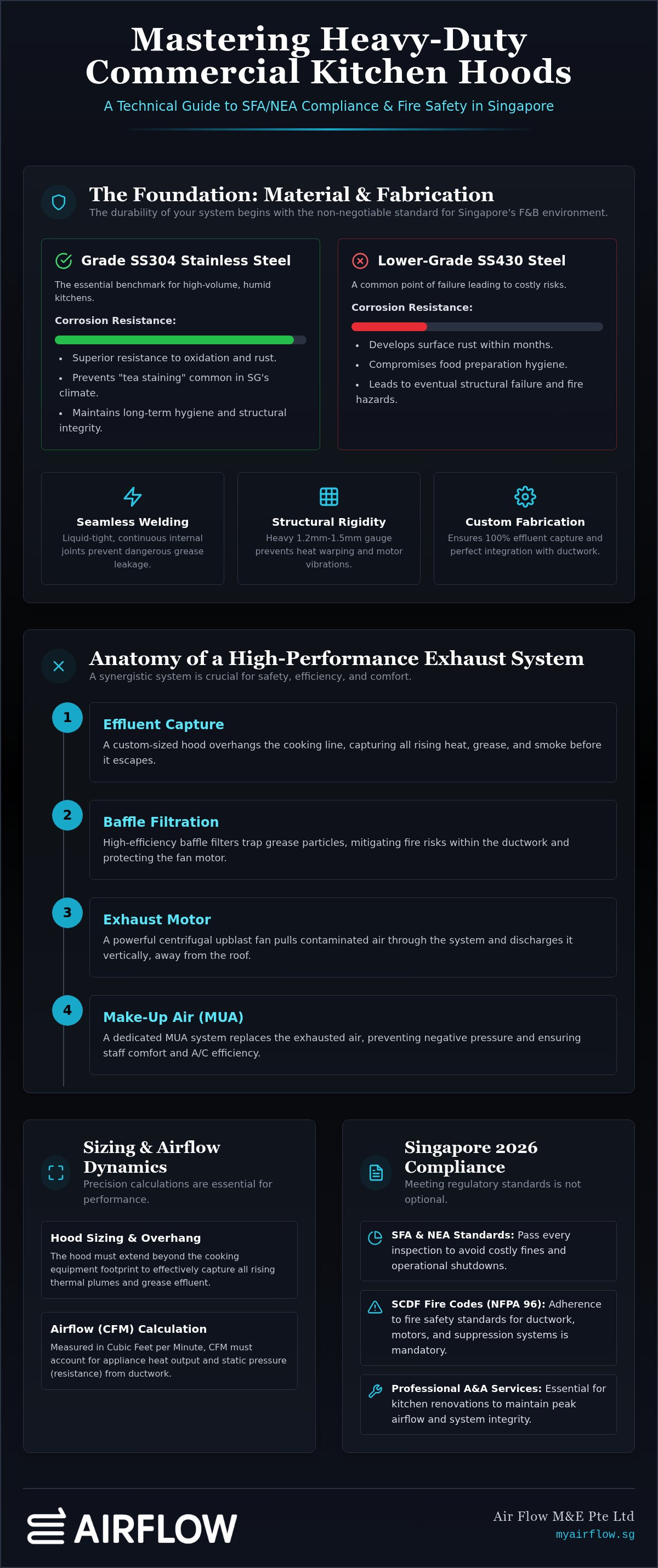
High-performance Kitchen ventilation systems rely on material quality to maintain efficiency. In Singapore, Grade 304 stainless steel is the non-negotiable benchmark. It contains chromium and nickel, providing superior resistance to oxidation and rust. In our humid climate, lower-grade steels like SS430 often develop surface rust or "tea staining" within months. This compromises the hygiene of your food preparation area and can eventually lead to structural failure.
Material Grades and Durability
Choosing the right material gauge is a matter of long-term cost-efficiency. A heavy-duty hood must handle temperatures that would cause standard metal to buckle. Using a 1.2mm or 1.5mm thickness provides the rigidity needed to prevent heat warping. When metal warps, it creates gaps in the seals. These gaps allow grease to escape into the ceiling void, which is a major fire risk.
- SS304 vs SS430: SS304 is non-magnetic and offers the best corrosion resistance for wet, busy kitchens.
- Seamless Welding: We utilize liquid-tight, continuous welding on all internal joints. This prevents grease leakage and makes the hood easier to degrease during mandatory maintenance.
- Structural Rigidity: Heavier gauges ensure the hood doesn't vibrate or rattle when the high-capacity exhaust motor is running at full speed.
Custom Fabrication Benefits
Off-the-shelf hoods rarely match the specific footprint of a commercial cooking line. If the hood depth is too shallow, it won't capture the rising thermal plumes. This results in smoke escaping into the dining area. Custom fabrication allows us to tailor the dimensions to ensure 100% effluent capture based on your specific equipment layout.
A bespoke approach also simplifies technical integration. We build the structure to house internal lighting and fire suppression nozzles directly into the chassis. Most importantly, the hood is designed to support custom-fitted ductwork. This ensures a perfect, airtight seal between the extraction point and the exhaust motor. For any complex heavy duty commercial kitchen hood installation, customization is an operational necessity that guarantees both performance and safety.
Key Components of a High-Performance Exhaust System
A successful heavy duty commercial kitchen hood installation depends on the synergy between the hood and the mechanical components hidden behind the walls. If the motor is underpowered or the filtration is inefficient, the hood becomes a decorative fixture rather than a safety tool. Airflow management, measured in Cubic Feet per Minute (CFM), is the foundation of this system. These calculations must account for the specific heat output of your appliances and the resistance caused by ductwork bends. Accurate CFM ensures that all smoke and grease are pulled into the system before they can drift into the dining area.
To maintain balance, a dedicated make-up air (MUA) system is essential. When a high-capacity motor pulls thousands of cubic feet of air out of the kitchen, that air must be replaced. Without MUA, your kitchen faces negative pressure. This leads to heavy doors that are hard to open, whistling noises, and reduced air conditioning efficiency. A well-designed system ensures the kitchen remains comfortable for staff without putting undue stress on the building's ventilation.
Selecting the Right Exhaust Motor
The extraction motor is the heart of the system. For heavy-duty F&B operations, centrifugal upblast fans are the standard. Unlike axial fans, they handle grease-laden air more effectively and discharge it vertically, away from the roof surface. When calculating motor horsepower, we look beyond the kitchen's size. We factor in static pressure, which is the resistance the air meets as it travels through the ductwork. Adhering to NFPA 96 installation standards ensures that these motors are mounted correctly with weatherproof housing to withstand Singapore's intense tropical rainfall. If your current motor is struggling with smoke, you might need a professional commercial exhaust motor installation to restore proper airflow and safety.
Advanced Grease Filtration
Filtration is your first line of defense against duct fires. Baffle filters are designed to force grease-laden air through a series of sharp turns. This causes grease droplets to lose momentum and settle on the metal surface, eventually draining into a collection cup. High-efficiency extractors can trap over 90% of grease particles, significantly reducing the buildup inside your ducts. Regular cleaning is mandatory under SFA regulations to prevent these filters from becoming fire hazards. For a deeper look at the best options for your setup, see our Commercial Kitchen Hood Filters Singapore: 2026 Comparison Guide.
Sizing and Airflow Requirements for Heavy Duty Hoods
Proper sizing is the difference between a clean kitchen and a smoke-filled dining room. When planning a heavy duty commercial kitchen hood installation, we start with the cooking equipment footprint. It's a common mistake to match the hood size exactly to the stove dimensions. In reality, the hood must extend beyond the equipment to account for the "thermal plume." This is the expanding column of hot air, grease, and smoke rising from the heat source. While basic setups might get by with a 6-inch overhang, heavy-duty stations require more precision to prevent spillover.
Adhering to NFPA 96 Installation Standards is vital for maintaining safe air velocity. We aim for a face velocity of 50 to 100 feet per minute (FPM). If the velocity is too low, smoke escapes. If it's too high, you waste energy and risk pulling flames into the filters. Kitchen layout also plays a massive role. A wall-mounted hood is more efficient because the wall acts as a natural barrier. Island hoods require significantly higher CFM to compensate for being open on all four sides.
Hood Sizing by Equipment Type
Wok stations are the most demanding. The intense heat and rapid steam production require deeper hoods with at least a 12-inch overhang on the front and sides. This prevents the plume from rolling out from under the hood during high-heat stir-frying. Deep fryers and charbroilers produce heavy grease loads that necessitate high-velocity extraction to prevent duct buildup. Conversely, combi ovens and steamers focus on moisture. These require hoods designed to handle high humidity without dripping condensate back onto the food or floor.
Airflow Calibration and Troubleshooting
Signs of poor airflow are usually obvious. If you notice smoke spillage or lingering odors in the seating area, your system isn't calibrated correctly. We often recommend using Variable Frequency Drives (VFDs). These allow you to adjust the motor speed based on the actual cooking load. You save energy during prep hours while maintaining full power during the peak rush. If your system is underperforming, check our guide on Commercial Kitchen Hood Suction Fix: Troubleshooting Weak Airflow in 2026 for specific diagnostic steps.
Installation Standards and SFA/NEA Compliance in Singapore
Compliance in Singapore is a multi-agency process that requires strict adherence to safety and environmental standards. A heavy duty commercial kitchen hood installation must satisfy the requirements of the Singapore Food Agency (SFA) for licensing and the National Environment Agency (NEA) for air pollution control. Failing to meet these standards doesn't just result in failed inspections; it can lead to costly retrofitting or the suspension of your operations. Every component, from the hood mounting to the final discharge point, must be documented and verified for safety.
Fire safety is equally critical. All heavy-duty hoods must be integrated with a kitchen fire suppression system, such as an Ansul system, as mandated by the SCDF Fire Code. These systems are designed to automatically detect fires and discharge wet chemical agents to extinguish flames before they reach the ductwork. Ensuring your system is compliant from day one is the only way to protect your investment and your staff. If you are planning a new outlet or upgrading your current setup, contact Air Flow M&E for expert guidance on regulatory compliance.
Passing SFA and NEA Inspections
NEA regulations focus heavily on the height of discharge and odor mitigation. Your exhaust must discharge at least 2 meters above the roof level of the building or any nearby windows to prevent smoke from entering residential or office spaces. If your kitchen produces high-odor or high-grease effluent, NEA may mandate secondary filtration. This often includes:
- Electrostatic Precipitators (ESP): These units use an electric charge to trap fine grease particles that baffle filters miss.
- Activated Carbon Filters: These are used specifically for odor removal in sensitive areas.
- Maintenance Logs: SFA requires operators to degrease the entire system at least once every 12 months. You must keep these records on-site for inspection.
Structural Integrity and Mounting
Heavy-duty Grade 304 stainless steel hoods are significantly heavier than standard units. The Building and Construction Authority (BCA) requires that these structures are mounted safely to withstand the weight and the vibration of the exhaust motor. Mounting must be done directly into concrete slabs or reinforced steel beams rather than relying on false ceiling structures. All ductwork joints must be grease-tight and fire-rated to prevent leaks in the ceiling void. We ensure every heavy duty commercial kitchen hood installation we perform meets these structural benchmarks, providing a "safe pair of hands" for your M&E requirements.
Professional A&A Services with Air Flow M&E
Kitchen layouts are rarely static. As menus evolve or cooking volumes increase, your ventilation system must adapt to maintain safety and efficiency. Addition & Alteration (A&A) services are critical for F&B operators who need to upgrade their infrastructure without a total system overhaul. Whether you're adding a high-heat wok station or replacing an aging fryer, a heavy duty commercial kitchen hood installation requires precise technical adjustments to the existing ductwork and motor capacity. We focus on providing pragmatic, engineering-led solutions that ensure your kitchen remains compliant with Singapore's strict fire and health codes.
Our process begins with a detailed site measurement to assess your current airflow performance. We don't believe in guesswork. By identifying bottlenecks in your existing ductwork, we can design custom-fitted components that optimize suction. We handle everything from custom fabrication to the final heavy duty commercial kitchen hood installation, ensuring that every joint is grease-tight and every motor is calibrated for the specific static pressure of your setup. This meticulous approach minimizes operational downtime, allowing you to resume business with a safer, more efficient kitchen.
Addition & Alteration (A&A) Expertise
Modifying an active kitchen requires a deep understanding of M&E infrastructure. We specialize in integrating new high-performance hoods into older systems, often requiring custom duct transitions to maintain airtight seals. If your new menu produces more smoke than your current motor can handle, we provide seamless motor upgrades. Our goal is to ensure that new installations don't just fit physically, but also function perfectly within the building's overall ventilation balance. You can read more about our technical standards in our commercial kitchen hood installation guide.
The Air Flow M&E Advantage
Air Flow M&E projects the confidence of an experienced specialist. We act as a "safe pair of hands" for complex F&B projects across Singapore. Our team coordinates directly with M&E consultants and SFA inspectors to ensure every alteration meets the latest 2026 regulatory standards. We provide clear, actionable information and avoid unnecessary fluff. This disciplined mindset allows us to solve ventilation challenges quickly and effectively. When you partner with us, you gain a dedicated service provider that prioritizes long-term functionality and fire safety above all else.
Secure Your Kitchen's Operational Future
A heavy duty commercial kitchen hood installation is an investment in your brand's longevity and safety. By prioritizing Grade 304 stainless steel and precise airflow calibration, you eliminate the risks of grease buildup and smoke spillage. Meeting Singapore's strict SFA and NEA standards ensures that your business remains compliant and avoids the stress of failed inspections or costly retrofitting. Every component, from the motor horsepower to the ductwork seal, must work in harmony to maintain a productive cooking environment.
Air Flow M&E provides the technical expertise required for complex M&E works. We are specialists in Singapore SFA/NEA compliance and offer expert A&A services for F&B renovations. Our focus on custom-fitted ductwork and high-performance motors ensures your system handles high-volume cooking with ease. We handle the technical complexities so you can stay focused on your culinary operations. Get a Professional Quote for Your Kitchen Hood Installation and partner with a team that values precision and safety. With the right engineering support, you can maintain a clean, efficient, and fully compliant kitchen for years to come.
Frequently Asked Questions
What is the difference between a standard and heavy-duty kitchen hood?
A heavy-duty hood is constructed from thicker Grade 304 stainless steel, typically 1.2mm or 1.5mm gauge, to prevent heat warping. Standard hoods often use thinner 430-grade steel which lacks the corrosion resistance needed for high-volume frying and wok cooking. These heavy-duty units feature continuous liquid-tight welding to prevent grease leaks. They are specifically engineered to handle the extreme thermal plumes and grease loads found in busy Singaporean F&B environments.
Does my kitchen exhaust system need SFA approval in Singapore?
Yes, every commercial kitchen exhaust system must meet SFA and NEA standards to secure and maintain a food shop license. SFA officers inspect the exterior of the system and check maintenance records during routine visits. Establishments must ensure their heavy duty commercial kitchen hood installation includes proper discharge heights and odor mitigation. Failure to provide proof of degreasing or non-compliance with air pollution standards can lead to enforcement action or license revocation.
How often should heavy-duty grease filters be cleaned?
Under SFA regulations, the entire interior and exterior of the exhaust duct and kitchen hood must be degreased at least once every 12 months. However, for high-volume heavy-duty operations, baffle filters should be removed and cleaned daily or weekly to maintain airflow. Clogged filters increase fire risk and place unnecessary strain on your exhaust motor. Keeping a detailed maintenance log is mandatory for passing regulatory inspections and ensuring long-term system durability.
What is the required discharge height for kitchen exhaust in Singapore?
NEA mandates that the exhaust discharge point must be at least 2 meters above the roof level of the building. Additionally, it should be located at least 5 meters away from any neighboring windows or air intake points. These standards are designed to prevent smoke and odors from becoming a nuisance to nearby residents or office workers. If these height requirements aren't met, you may be required to install secondary filtration like activated carbon.
Can I modify my existing kitchen hood without a full replacement?
You can modify your existing setup through Addition & Alteration (A&A) services without a total replacement. This often involves upgrading to a high-performance exhaust motor or modifying custom-fitted ductwork to accommodate new cooking equipment. A&A works are a cost-effective way to improve suction and ensure your kitchen remains compliant with 2026 safety codes. It's a practical solution when your menu changes or cooking volume increases beyond the original system's capacity.
Why is my kitchen still smoky despite having a heavy-duty hood?
Smoke accumulation is usually caused by insufficient airflow velocity or a lack of make-up air (MUA). Even with a heavy duty commercial kitchen hood installation, the system will fail if it cannot pull enough air or if there is no replacement air entering the kitchen. Other common causes include undersized hood overhangs for wok stations or high static pressure in the ductwork. Professional calibration is required to balance the CFM and ensure the thermal plume is captured.
How much CFM does a 4-burner wok station require?
A 4-burner wok station typically requires high-capacity extraction due to the intense heat and steam produced. While exact requirements depend on the hood length and height, you generally need between 2,000 to 3,500 CFM for this setup. Wok stations also require deeper hoods with larger overhangs to capture the rapidly rising effluent. It's critical to calculate the static pressure of your ductwork to ensure the exhaust motor can maintain these airflow levels consistently.
Do I need a fire suppression system inside my kitchen hood?
Yes, the SCDF Fire Code Clause 7.1 requires a fire suppression system for most commercial cooking operations. Systems like Ansul are designed to automatically discharge wet chemical agents when they detect high heat or flames. This is essential for protecting your staff and building from grease fires that can quickly spread through the ductwork. Integrating these nozzles during the fabrication phase ensures the system is both aesthetically clean and technically compliant with Singapore safety standards.


