

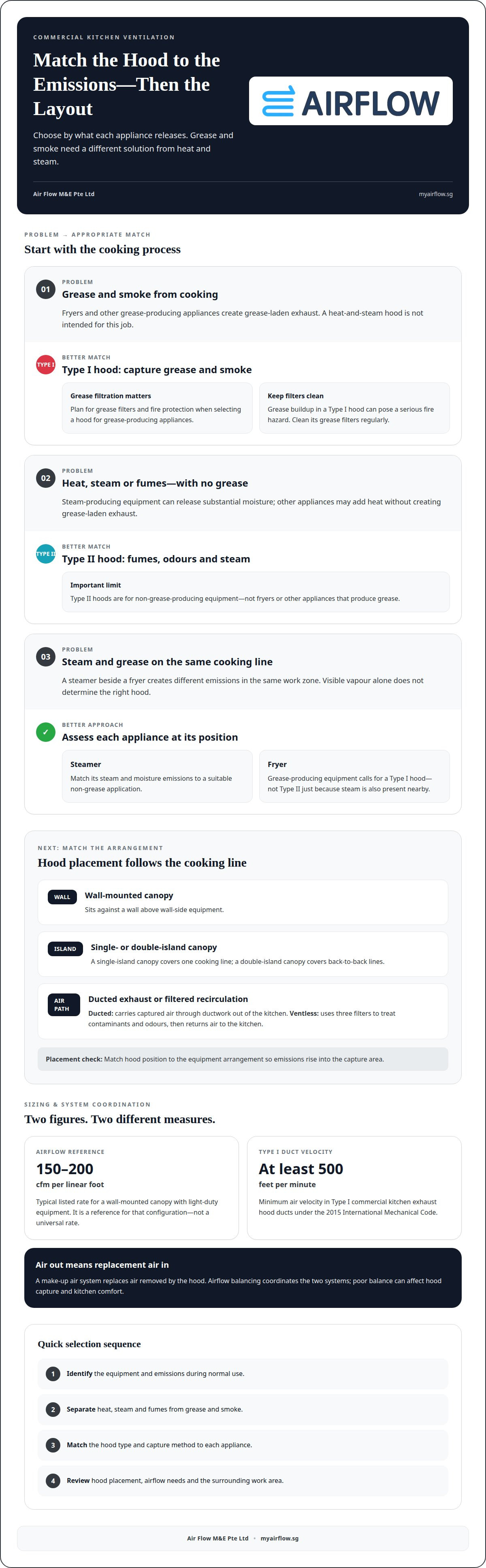
The right commercial kitchen hood types and benefits depend on the cooking equipment and the emissions it produces. Type I hoods are designed to capture grease and smoke, while Type II hoods handle heat and steam from equipment that does not produce grease. Start by matching the hood to the cooking process, then compare configurations against the kitchen layout.
It’s easy to focus on hood size or airflow alone, but the capture method and placement matter too. A hood suited to one cooking line may not suit an island layout, and a heat-and-steam hood isn’t intended for grease-producing equipment. This guide explains how exhaust-only and heat-removal options differ, compares common hood configurations, and clarifies when Type I is the appropriate choice for grease and smoke. You’ll come away with practical criteria for narrowing the options and understanding the role of airflow, equipment duty, and kitchen layout in the decision.
Key Takeaways
- Match the hood’s function to the cooking process: grease and smoke call for a different solution than heat and steam.
- Compare wall-mounted and island configurations against your equipment layout to narrow down suitable hood placement.
- Plan for grease filtration and fire protection when selecting a hood for grease-producing appliances.
- For a commercial kitchen hood installation, Air Flow M&E Pte Ltd can provide hood installation, exhaust motor installation, and custom-fitted ductwork.
Exhaust-only hood ventilation
An exhaust-only hood captures cooking emissions and carries them through ductwork out of the kitchen. Airflow needs to suit the hood design and cooking equipment, rather than follow one rate for every kitchen.
To estimate airflow, account for hood style, cooking duty and hood length. Typical listed wall-mounted canopy rates for light-duty equipment are 150-200 cfm per linear foot. This is a reference for that configuration, not a universal rate for every hood. Equipment producing more demanding exhaust can require a different design.
An undersized or poorly maintained hood may not capture emissions effectively. Grease buildup in a Type I hood can pose a serious fire hazard, so clean its grease filters regularly.
| Option | What it handles | Air movement | Key consideration |
|---|---|---|---|
| Wall-mounted canopy | Cooking emissions from wall-side equipment | Exhausts air through ductwork | Light-duty reference: 150-200 cfm per linear foot |
| Condensate hood | Steam and condensation | Baffles turn condensation into liquid that drains away | Wire mesh filters aren’t designed for high-volume grease removal |
| Type II hood | Fumes, odours and steam | Exhausts captured air | Not intended for grease-producing equipment |
| Ventless hood | Contaminants and odours | Three filters treat air before it returns to the kitchen | Air is recirculated rather than exhausted outdoors |
Choose a hood by matching its capture method to the cooking process, then sizing airflow for the hood design and equipment duty. Mesh filters in a condensate hood do not replace grease filtration when cooking produces substantial grease.
Exhaust removes air from the kitchen, so replacement air matters. A make-up air system supplies air to replace what the hood removes. Once both systems are installed, airflow balancing helps coordinate them. Poor balance can affect hood capture and kitchen comfort.
The 2015 International Mechanical Code requires Type I commercial kitchen exhaust hood ducts to have an air velocity of at least 500 feet per minute. Type II commercial kitchen exhaust hoods collect fumes, odors, and steam, and no fire requirements apply to them.
Duty classifications also distinguish commercial kitchen exhaust by expected temperature. Heavy-duty commercial kitchen exhaust is classified as having temperatures of 600°F or less, while extra-heavy-duty commercial kitchen exhaust is classified as having temperatures of 700°F or less.
Heat-removal hood uses
Type II hoods suit equipment that releases heat, steam or fumes without producing grease. They are intended for appliances such as steam-producing equipment, not fryers or other grease-producing appliances. Choose by the emissions the appliance produces, not by visible vapour alone.
Start by listing the appliances beneath the proposed hood. A steamer can release substantial moisture, while a heat-producing appliance may add warmth without creating grease-laden exhaust. These conditions differ from those of a fryer, which releases grease and calls for a Type I hood. Classify each appliance by its cooking process, not just its position in the kitchen.
A practical selection sequence is:
- Identify the equipment and the emissions it produces during normal use.
- Separate heat, steam and fumes from grease and smoke.
- Match non-grease-producing appliances to a Type II application.
- Review the hood’s placement against the equipment layout and surrounding work area.
Mixed cooking lines need careful assessment. A steamer beside a fryer, for example, produces steam and grease-laden exhaust in the same work zone. A Type II hood should not be used over the fryer simply because it also captures steam. The emissions from each appliance determine the appropriate hood for that position.
Consider how heat and moisture affect nearby tasks. Steam can condense on cooler surfaces, while heat can make an enclosed work area less comfortable. Hood placement should account for where emissions rise and how staff move around the appliances. If the hood sits over the wrong equipment, emissions may escape its capture area.
Type II hoods are one part of the commercial kitchen hood types and benefits comparison, but they’re suitable only for the right emissions. For a kitchen with both steam-producing and grease-producing equipment, map each appliance before selecting a hood. For help planning a commercial kitchen system, explore commercial hood ventilation planning.
Hood installation configurations
Ducted hoods carry captured air through ductwork out of the kitchen; ductless hoods filter air and return it indoors. Placement also depends on whether the cooking equipment sits against a wall or on an island.
Ducted Hood Configurations
A ducted hood connects to an exhaust path that carries captured air away from the cooking area. Wall-mounted canopy hoods sit against a wall above wall-side equipment. Single-island canopy hoods hang above one cooking line, while double-island canopy hoods cover back-to-back lines. Each layout offers different positioning and coverage, so match the hood to the equipment arrangement.
Ductless Hood Configurations
A ductless hood filters kitchen air, then recirculates it into the room instead of discharging it through an exhaust duct. Ventless commercial kitchen hoods use three filters together to capture contaminants and odours. Their air path differs from ducted systems, which exhaust air outdoors. The choice depends on the required air handling and cooking setup.
Map the cooking line before comparing configurations. Wall-side equipment may suit a wall-mounted canopy, while an island line may suit a single-island canopy. Back-to-back island lines need a different canopy arrangement. In each case, the hood must be positioned to capture emissions from the appliances beneath it.
Hood styles include eyebrow, back shelf, wall-mounted canopy, passover, single-island canopy and double-island canopy. They provide different coverage for different equipment placements. A back-shelf hood sits close to the cooking equipment, while a canopy covers equipment from above. Required overhangs and location affect the final fit.
Compare each option by its exhaust route, equipment position and capture coverage. Then check whether the placement suits the kitchen layout and required overhangs. For example, an island cooking line needs an island configuration rather than a wall-mounted canopy.
Type 1 hoods for grease and smoke
Type I hoods are designed for equipment that produces grease and smoke, including fryers, broilers, ranges and tilt skillets. They use grease filters and are commonly integrated with fire suppression systems because grease-laden environments carry fire risk.
Type I and Type II hoods serve different cooking conditions. Type I captures grease and smoke, but its filters need regular cleaning and its application requires fire protection. Type II handles heat, steam and fumes, but is not suitable over grease-producing equipment.
Choose by matching the hood to the appliances and menu. A fryer or broiler points to Type I; equipment producing heat or steam without grease points to Type II. If a cooking line includes both, assess each appliance’s emissions and the hood’s coverage.
For Singapore kitchens, include fire protection when planning a Type I hood. Type I applications require fire protection systems, and the installation must account for applicable local requirements.
No single cleaning interval suits every kitchen. Clean Type I grease filters regularly, and plan maintenance around grease accumulation and kitchen use. Routine cleaning matters because built-up grease can create a serious fire hazard.
- Match the hood: Identify whether each appliance produces grease, smoke, heat or steam.
- Check protection: Include fire protection when planning a Type I application.
- Maintain filters: Clean grease filters regularly and address buildup before it accumulates.
A Type II hood is not suitable for a fryer line, even though the fryer also releases heat. For a steamer without grease-producing equipment, Type II may suit the emissions. The menu matters because it determines which appliances operate and what they release.
For a Type I setup, plan a commercial kitchen hood installation around the appliances, grease capture and fire protection needs.
Regular cleaning helps grease filters work effectively, so their condition is part of maintaining a Type I hood. Include filter care in the maintenance plan rather than treating it as a one-time task.
Commercial kitchen hood fire suppression systems are frequently required to meet health codes for Type 1 hoods. All Type I commercial kitchen hood applications require fire protection systems, making this a core consideration when planning the installation.
Air Flow M&E Pte: Commercial Kitchen Hood Installation
Air Flow M&E Pte Ltd installs commercial kitchen hoods for businesses planning a new system or updating an existing kitchen. Once you have matched the hood type and configuration to your equipment, installation is the practical next step.
For changes to an existing exhaust system, Air Flow M&E Pte Ltd also provides Commercial Kitchen Exhaust System Addition & Alteration services. Commercial exhaust motor installation and custom-fitted ductwork can address related components of the ventilation setup.
Consider these services when your kitchen layout, cooking equipment or exhaust arrangement calls for installation or alteration work. Share the project details with Air Flow M&E Pte to discuss the relevant commercial kitchen work. Visit myairflow.sg to get in touch.
Turn the Selection into a Practical Project Brief
Before finalising a hood plan, document your kitchen’s operating needs. Record the equipment schedule, menu changes under consideration, available installation space and constraints that could affect the work. This gives the design discussion a clear starting point and keeps the hood choice connected to the wider setup.
Use that brief to focus on operational fit. Consider how the arrangement supports workflow, how connected components will work together and whether planned changes could affect system requirements. Understanding commercial kitchen hood types and their benefits helps ground decisions in how your kitchen operates.
When you’re ready to discuss a commercial installation, contact Air Flow M&E Pte Ltd about your project. A thoughtful brief is a practical foundation for the next decision, helping your kitchen move forward with greater clarity.
Frequently Asked Questions
What is the difference between wall-mounted canopy, island, and proximity hoods?
A wall-mounted canopy sits against a wall above equipment placed there, while an island canopy hangs from the ceiling over a cooking line. A proximity hood sits close to the cooking equipment, focusing capture around that appliance rather than covering a broad overhead area. Compare appliance positions and the cooking surface each hood needs to cover.


