

A new hood or exhaust motor may improve cooking conditions at one stall, but it also needs to work with the centre’s existing ventilation arrangement. Hawker centre kitchen exhaust solutions therefore involve more than choosing equipment for the stall. Smoke, heat or odour during service can point to an issue, but the right scope depends on how the hood, motor and ductwork connect to the rest of the system.
A practical upgrade starts with the cooking setup and the existing exhaust route. This guide explains which components matter at stall level, how to plan installation or A&A work around the current layout, and what details to gather before work begins.
Coordination with centre management and the relevant approval processes belongs in the plan from the outset. Documenting the cooking equipment, exhaust route and connection points helps define the work and organise the next steps.
Key Takeaways
- Hawker centre kitchen exhaust solutions need to suit a stall’s cooking needs and the centre’s existing infrastructure.
- Trace the route from hood to ductwork, motor and discharge point to understand where an exhaust issue may arise.
- A hood or motor change may not address a mismatch elsewhere in the system. Consider the full scope and its connections before choosing an upgrade.
- Before planning installation or A&A work, gather details on the stall layout, cooking equipment, connection points and work access.
- Air Flow M&E provides commercial exhaust A&A, hood and motor installation, and custom-fitted ductwork tailored to the kitchen layout.
Why hawker centre kitchen exhaust solutions must account for the whole setup
Each hawker stall has its own cooking demands, while the route carrying fumes away may connect to infrastructure serving other parts of the centre. A change inside one stall can involve more than the visible hood. Before planning an upgrade, identify where the stall equipment ends and any shared exhaust arrangement begins. Centre layouts vary, so confirm the actual connection rather than assuming how it is configured.
A hawker centre exhaust solution coordinates the capture, movement and discharge of cooking fumes, from the stall’s cooking equipment to the system outlet. The hood captures fumes at source. Filters, ducts and an exhaust motor help move extracted air along its route. Depending on the centre’s arrangement, parts of that route may serve one stall or connect to shared infrastructure.
Smoke, heat, grease-laden vapour and odour are related parts of the cooking environment, but they do not behave in exactly the same way. The hood captures fumes above the cooking area, while the ductwork and motor move air onwards. Grease carried in the air can affect components along the route, and odour or visible fumes at the discharge point can affect the surrounding environment. Focusing on one symptom alone may leave another part of the system unaddressed.
Which exhaust components serve an individual hawker stall?
The hood sits above cooking equipment and captures rising fumes. Filters intercept grease and other particles as air enters the exhaust route. Ductwork conveys the extracted air, while the exhaust motor moves it through the system. These components work together, but their positions and connections depend on the stall layout. For more detail on hood design and function, see this commercial kitchen hood guide and this overview of how a kitchen hood removes airborne cooking contaminants.
Where can stall-level work meet shared centre infrastructure?
The interface may be where a stall’s duct connects to a larger route, or where the stall equipment relies on a centre-level exhaust arrangement. The setup differs between sites. Identify the actual connection points and separate the work inside the stall from any work involving the wider system. Include neighbouring stalls and centre operations in the planning so the installation scope reflects the site rather than an assumed layout.
For a stallholder, this distinction makes project discussions more practical. Record the cooking equipment, hood position, visible duct route and known connection points. Then note which parts are changing and which existing interfaces must be coordinated. These details help define whether the work is focused on stall equipment or needs a broader exhaust A&A scope. That is the starting point for hawker centre kitchen exhaust solutions that fit both the cooking needs and the centre’s actual infrastructure.
How hawker centre kitchen exhaust systems move cooking fumes
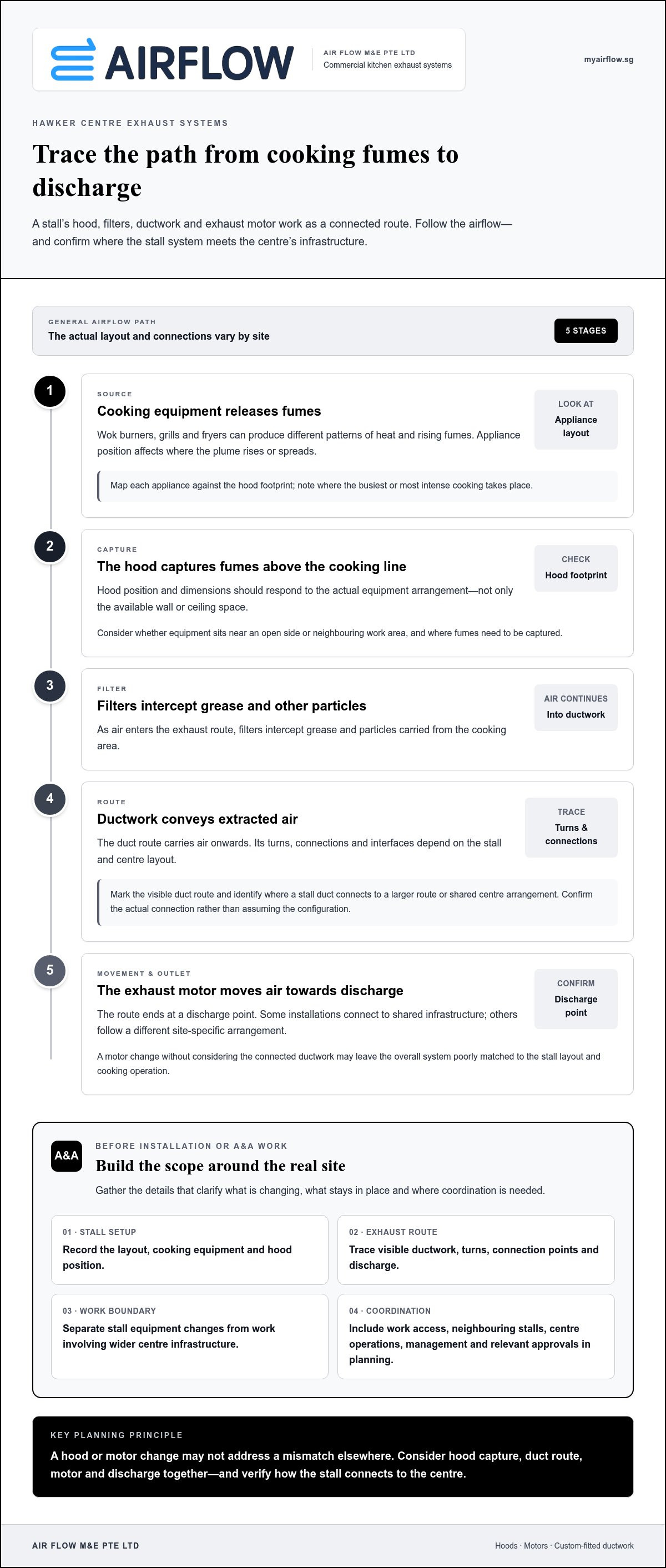
Air travels through a route that depends on the stall and the centre. In broad terms, cooking releases fumes that rise towards a hood. The hood captures part of that plume, filters intercept grease and particles, ductwork carries extracted air, and an exhaust motor moves it towards a discharge point. Some installations connect to shared infrastructure, while others follow a different site-specific arrangement.
The airflow path runs from the cooking equipment to hood capture, through filters and the connected duct route, with an exhaust motor moving air towards its discharge point. This describes the general sequence, not a standard layout for every hawker centre. The actual route, connections and project scope need to be established at the site.
How cooking equipment affects hood capture
Capture begins above the cooking line. A wok burner, grill and fryer can produce different patterns of heat and rising fumes. Equipment position matters too: a plume may rise beneath the hood or spread towards an edge, depending on how the station is arranged and used. The hood’s position and dimensions should respond to the actual equipment layout, not just the available wall or ceiling space.
For planning, map each appliance against the hood footprint. Note where the busiest or most intense cooking takes place and whether equipment sits near an open side or neighbouring work area. These observations help clarify where fumes need to be captured. They do not replace a project assessment, but they make the design discussion more specific than simply requesting a larger hood.
Why duct and exhaust motor coordination matters
Once air enters the hood, the duct route and motor must work together. Changing a duct connection or route can change the scope of the work and the conditions the motor needs to serve. Likewise, changing a motor without considering the connected ductwork may leave the overall system poorly matched to the stall layout and cooking operation.
Trace the proposed route from hood to discharge. Mark turns, changes in direction, connection points and any interface with centre infrastructure. This helps distinguish a hood-focused adjustment from work involving ductwork, motor installation or wider A&A coordination. For more detail on duct layout and fabrication considerations, consult this commercial kitchen ductwork guide.
For hawker centre kitchen exhaust solutions, the practical question is not only whether fumes reach the hood. It is whether hood capture, duct route, motor and discharge function as a coordinated path in the actual site arrangement. Air Flow M&E’s commercial exhaust installation work includes hoods, motors and custom-fitted ductwork for commercial kitchen layouts.
Will a hood or motor change solve the exhaust problem on its own?
Not necessarily. A hood or motor is only one part of the exhaust route, so replacing a visible component may not resolve a mismatch elsewhere. For example, a new hood may still connect to a duct route that does not suit the altered stall layout. A motor change may not address an issue with hood capture or duct connections. Define the scope from the installation and site conditions, rather than relying on symptoms alone.
Use this comparison as a starting point for planning, not as a remote diagnosis. Each option has a different scope and point of connection to the existing system.
| Scope | May be considered when | Interface to account for |
|---|---|---|
| Hood-focused installation | Cooking equipment or stall layout has changed | Hood position, cooking line and duct connection |
| Exhaust motor installation | The project involves changing the motor serving the exhaust route | Connected ductwork and the system arrangement |
| Coordinated A&A | Changes involve several components or shared-system interfaces | Stall scope, existing connections and centre infrastructure |
When might a hood-focused installation be relevant?
A hood-focused change may be relevant when cooking equipment moves, the cooking line changes, or a stall alteration affects where fumes rise. The hood needs to suit the equipment position and connect to the exhaust route. A hood alone may not resolve a separate issue in the ductwork or motor. For further context on sizing and installation, see this commercial hood installation guide.
When should the wider exhaust arrangement be considered?
Look beyond the hood when proposed work affects the motor, duct routing or connection between stall equipment and centre infrastructure. These components interact, so changing one can affect the scope and coordination needed for the others. Coordinated A&A may suit a project involving several interfaces, but that does not automatically mean the whole system needs replacing. Define the work around the site conditions.
Before settling on a scope, document the cooking layout, hood position, duct route and connection points. Note which parts are changing and whether the work touches infrastructure beyond the stall. This gives the project team a clearer basis for assessing options and coordinating installation. A focused hood or motor installation may suit a contained change; broader A&A may be appropriate when several components or interfaces are affected. Plan hawker centre kitchen exhaust solutions around the project details instead of assuming a fix in advance.
How to plan hawker centre exhaust installation or A&A works
Start with the stall’s cooking operation, then map the equipment to the existing exhaust arrangement. This sequence helps identify what is changing, where the work connects to centre infrastructure and what coordination is needed before installation. Include approvals and access planning from the outset, rather than leaving them until work is about to begin.
- Describe the cooking operation. List the equipment used, cooking methods and operating pattern. Note any planned changes to the menu or setup.
- Map the stall layout. Mark the cooking equipment, work areas and hood position. Note changes that may affect where fumes rise or how the stall is arranged.
- Record existing exhaust connections. Gather available plans or details for the hood, motor, duct route and connection points. Distinguish what serves the stall from any known centre-level interfaces.
- Identify site constraints. Note access routes, work areas, restrictions on moving equipment and interfaces near neighbouring stalls.
- Coordinate centre procedures. Establish the centre-management process for planning and carrying out work, including how access and operational impacts will be managed.
- Agree the installation scope. Use the information gathered to define whether the project involves a hood, motor, ductwork or coordinated exhaust A&A. Record which connections are affected.
What information helps define the project scope?
Useful preparation is specific. Record the cooking equipment and operating pattern, show the hood position on a stall layout, and note known site constraints. Include existing hood, motor and duct connection details where available. Flag access restrictions and nearby stall interfaces. These details help shape a project scope around the actual layout rather than a generic equipment request.
If plans are incomplete, a simple marked-up layout and clear notes can still frame the discussion. Separate known details from assumptions, especially around where a duct connects or whether infrastructure is shared.
How should compliance and operational coordination be handled?
Before work proceeds, check current requirements with the relevant authorities and centre management. Requirements can depend on the project and site, so use current official guidance rather than relying on general online summaries. The F&B kitchen exhaust requirements guide offers regulatory context, but project decisions should reflect applicable guidance and centre procedures.
Coordinate access and the sequence of work with the centre’s operating arrangements. Consider how work at the stall may interact with neighbouring operations, and include those interfaces in the project scope. This helps set practical expectations without assuming a fixed work duration.
These steps give hawker centre kitchen exhaust solutions a sound starting point: a defined cooking operation, a mapped existing arrangement and an agreed scope. To discuss commercial exhaust A&A and installation planning, prepare the stall layout and available connection details.
Air Flow M&E hawker centre kitchen exhaust solutions
Air Flow M&E Pte Ltd provides commercial kitchen exhaust A&A and installation services in Singapore. For hawker-centre projects, its services include commercial kitchen hood installation, exhaust motor installation and custom-fitted ductwork. The combination depends on the stall layout, existing connections and requested changes. This keeps the project scope tied to the commercial site rather than treating equipment as a one-size-fits-all package.
Hawker centre kitchen exhaust solutions need to account for both the cooking setup and the route connecting it to the exhaust system. A hood may be part of a stall alteration, and a motor or ductwork may also form part of the project. Where connections meet centre infrastructure, account for that relationship while defining the scope.
A&A and installation scope for commercial hawker kitchens
Air Flow M&E’s commercial exhaust A&A work can coordinate hood, motor and ductwork installation within a project scope. For example, a stall layout change may involve adjusting the hood position and duct connection, while another project may focus on motor installation. These are examples, not prescribed fixes. The required work depends on the site layout and the alteration.
Custom-fitted ductwork is tailored to commercial kitchen layouts and operational requirements. In hawker settings, available stall space and existing connection points shape how an installation can be arranged. Defining the ductwork alongside the hood and motor makes the relationship between components clear during project planning.
Prepare for a project discussion
Specific details help turn an initial request into a defined scope. Share available information about:
- The stall layout and position of the cooking line.
- The cooking equipment in use and any planned changes.
- Existing hood, exhaust motor and duct connections, including plans or photographs if available.
- Known site constraints, work access requirements and interfaces with centre infrastructure.
Describe what you want to change and what should remain in place. If a connection detail is unknown, label it as unknown rather than making an assumption. This gives the project discussion a clear starting point and helps align the proposed hood, motor or ductwork scope with the commercial site. Work involving several components can be planned as coordinated A&A, with the scope tailored to the layout and requested work.
For a hawker-centre commercial exhaust project, bring together the stall information and intended changes before discussing the installation. Discuss your commercial kitchen exhaust project with Air Flow M&E.
Set your exhaust project up for a clear next step
A practical upgrade starts with a useful project brief. Bring together the stall layout, cooking equipment, known exhaust connections and intended changes. This gives the discussion a clear starting point and helps shape a scope around the actual commercial site, including interfaces with centre infrastructure.
Air Flow M&E provides commercial kitchen exhaust A&A and installation, including hood installation, exhaust motor installation and custom-fitted ductwork. The work can be scoped around the project requirements, rather than assuming every stall needs the same combination. With the relevant information in hand, you can move from general concerns about smoke, heat or odour towards a focused discussion about the installation.
For hawker centre kitchen exhaust solutions tailored to your commercial kitchen project, discuss your hawker centre kitchen exhaust project with Air Flow M&E.
Frequently Asked Questions
Can an existing exhaust duct be reused when a hawker stall changes its cooking equipment?
Possibly. Reuse depends on the duct route and connection, its condition, and whether it suits the new cooking setup. For example, moving from a compact cooking line to equipment in a different position may change where fumes need to be captured and how they enter the duct. Gather available plans and details of the proposed equipment, then review the site arrangement and applicable centre requirements before defining the installation or A&A scope.
Does every hawker stall need its own exhaust motor?
No. Hawker centres can have different ventilation arrangements, including shared exhaust infrastructure. A stall may have a dedicated motor or connect to a wider system, depending on the centre’s design. Do not assume another stall’s arrangement applies to yours. Establish how the existing equipment connects and whether an alteration could affect a shared interface before defining the work.
How much does a hawker centre kitchen exhaust installation cost?
There is no single price for every hawker centre installation, and this guide does not provide a price estimate. The scope may involve a hood, motor, ductwork or A&A, depending on the project. Duct routing, site constraints and existing connections can also affect the work required. A useful project brief describes the stall layout, cooking equipment and intended changes so the scope can be defined.
How long does hawker kitchen exhaust installation take?
There is no single duration for every stall project. Scheduling depends on the agreed scope, site access, duct arrangement, centre operations and coordination requirements. Work involving an interface with centre infrastructure may need different planning from a contained installation within the stall. Discuss the sequence and operational arrangements for the specific site before relying on a timeline.
Do I need approval before changing a hawker stall exhaust system?
Requirements depend on the proposed work, applicable rules and centre arrangements. Before work begins, check current official guidance and coordinate with the relevant centre management. Do not assume that an existing installation or earlier approval automatically covers a new alteration, especially if equipment or connections are changing. Confirm the requirements for the specific project using current authority information rather than general advice.
What should I do if smoke escapes from the hood during cooking?
Note when smoke escapes, which equipment is operating and whether the issue occurs during a particular cooking task. Smoke outside the hood’s capture area can relate to the cooking setup, hood position, equipment layout or wider exhaust arrangement, so do not assume a motor change alone will solve it. Use these observations to inform a commercial system assessment and define an appropriate installation or A&A scope.


