

What if a bigger exhaust motor won’t solve the smoke, heat or cooking odours disrupting your kitchen? A kitchen exhaust upgrade for heavy cooking needs to address the full airflow path, not just the component that seems most obvious.
When cooking demands increase, it’s reasonable to suspect the hood or motor is underperforming. But ductwork, kitchen layout and equipment use also affect how well fumes are captured and removed. Replacing one part without assessing the wider system may leave the problem unresolved and disrupt service without addressing its cause.
This guide explains how to match an upgrade to your cooking patterns, existing equipment and operational needs. You’ll learn which parts of a commercial exhaust system to assess, how layout informs hood, motor and custom-fitted ductwork choices, and how coordinated addition and alteration work can define a practical project scope. For commercial F&B kitchens in Singapore, start by documenting how the system performs under current operating demands and what will change.
Key Takeaways
- Assess cooking methods, appliance use and operating patterns to understand how heavier demands affect exhaust performance.
- Trace airflow from hood capture through the ductwork to the exhaust motor. A limitation in one part of the path can affect the whole system.
- Compare hood, motor, ductwork and coordinated A&A options by the issue each is intended to address and how the work may affect the kitchen layout.
- Build a clear project brief around equipment, layout, observed symptoms and operational constraints to plan a practical kitchen exhaust upgrade for heavy cooking.
- Air Flow M&E provides commercial exhaust A&A, hood and motor installation, and custom-fitted ductwork tailored to kitchen layouts and operating needs.
When Does Heavy Cooking Call for a Kitchen Exhaust Upgrade?
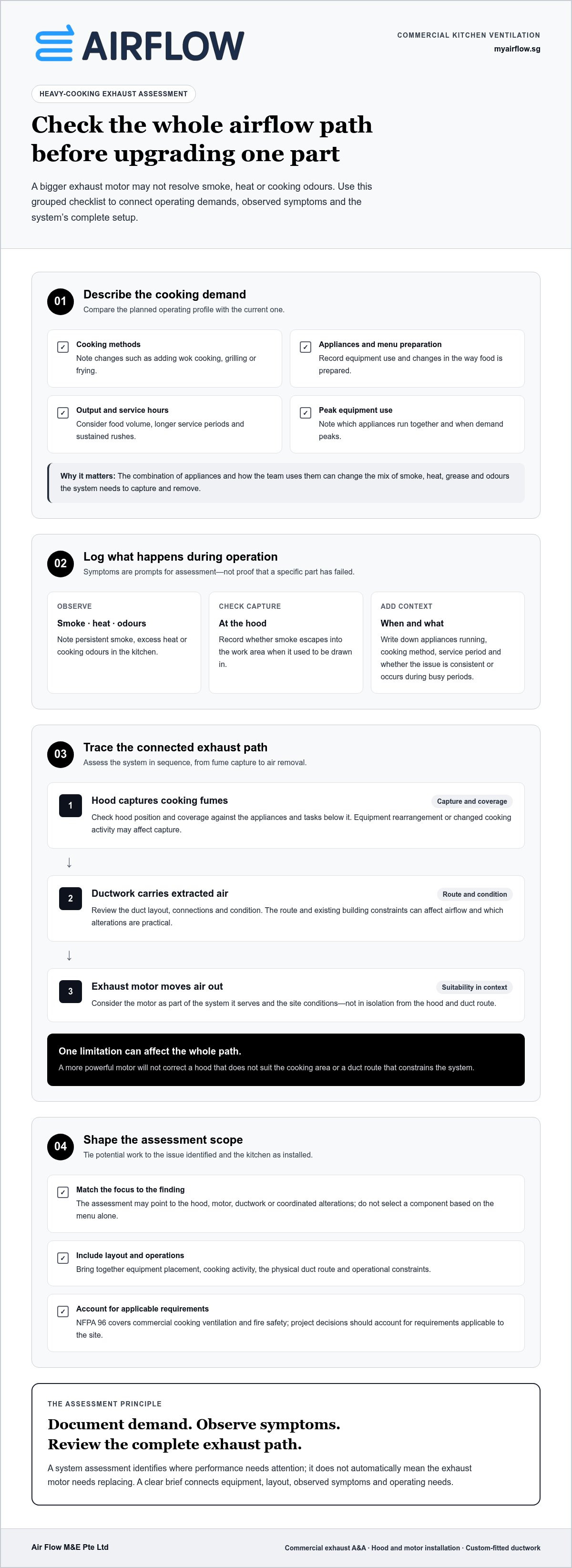
“Heavy cooking” isn’t defined by a single appliance or menu item. It describes the demands a kitchen’s cooking methods, equipment use, food volume and operating pattern place on the exhaust system. A kitchen that adds wok cooking, grilling or frying, for example, may produce a different mix of smoke, heat, grease and odours. Longer service periods or more appliances running together can also change the system’s workload.
That shift may call for a kitchen exhaust upgrade for heavy cooking, but it doesn’t automatically mean the fan needs replacing. Base the decision on how the current setup performs under the kitchen’s present and planned conditions. A kitchen exhaust hood is one part of a wider system, so assess the hood, duct route and exhaust motor in context.
Which operational changes can increase exhaust demand?
Compare the planned cooking profile with the current one. Note changes in cooking methods, appliance use, menu preparation, output volume and service hours. A shift from occasional cooking to a sustained rush, or the addition of equipment that produces more smoke or grease, can change what the system needs to capture and remove. The effect depends on the combination of appliances and how the team uses them.
Record which appliances operate together and when demand peaks. An assessment can consider these changes alongside the kitchen layout and existing exhaust setup. This helps define whether the project should focus on the hood, motor, ductwork or coordinated alterations, rather than selecting a component based on the menu alone.
What signs suggest the existing system needs assessment?
Look for persistent smoke, excess heat or cooking odours in the kitchen during normal operation. Note whether capture at the hood seems to have changed, such as smoke escaping into the work area when it used to be drawn in. These observations are prompts for assessment, not proof that a particular part has failed.
Record when symptoms occur, which appliances are running, the cooking method and service period, and whether the issue happens consistently or only during busy periods. This context makes the observations more useful. The cause may relate to one component or to how the system’s parts work together, so symptoms alone can’t identify it.
A system assessment identifies where performance needs attention; it doesn’t automatically lead to an exhaust motor replacement. For commercial F&B operators, documenting changes in workload and observed symptoms helps define a clearer upgrade scope and reduces the risk of changing a component without addressing the underlying issue.
How Hood, Exhaust Motor, and Ductwork Affect Heavy-Cooking Performance
Commercial kitchen exhaust works as a connected path. The hood captures cooking fumes above the appliances, ductwork carries extracted air through the building, and the exhaust motor moves it out. If one part limits airflow or capture, replacing another part alone may not resolve the issue. A more powerful motor, for example, won’t correct a hood that doesn’t suit the cooking area or a duct route that constrains the system.
That’s why a kitchen exhaust upgrade for heavy cooking should start with the whole setup, not a default package of new components. The hood, motor and ductwork are all assessment areas. The work may focus on one part or involve coordinated alterations, depending on the kitchen’s arrangement and operating needs. Applicable requirements also matter. The National Fire Protection Association’s NFPA 96 standards for commercial kitchen ventilation cover commercial cooking ventilation and fire safety. Project decisions should account for the requirements applicable to the site.
Assessing the hood against the cooking operation
Start at the cooking line. Consider whether the hood’s position and coverage correspond to the appliances beneath it and the tasks performed there. If equipment has been rearranged or cooking activity has changed, fumes may not be captured in the same way. Cooking practices and appliance use affect capture, so assess the hood against the work happening below it. A commercial kitchen hood guide can help clarify the hood’s role in an upgrade assessment.
Checking the exhaust motor and duct route as a system
The motor’s suitability depends on the system it serves and the site conditions, not just the cooking equipment in isolation. The duct route matters too: its layout, connections and condition shape the exhaust path. Existing building constraints may also affect which alterations are practical. Reviewing the motor and ductwork together helps prevent specifying a component without considering how it connects to the rest of the system. See how commercial kitchen ductwork relates to layout and fabrication choices.
Set the upgrade scope by reviewing the complete exhaust path, from hood capture to the motor, so each change addresses the system as installed. For commercial F&B kitchens, this keeps decisions tied to equipment placement, cooking activity and physical layout. Air Flow M&E carries out commercial exhaust A&A work tailored to project conditions, including hood installation, motor installation and custom-fitted ductwork. Explore commercial kitchen exhaust upgrade support when planning a coordinated scope.
How to Compare Kitchen Exhaust Upgrade Options for Heavy Cooking
The right scope depends on what the assessment identifies, not on an assumption that every component needs replacement. Use the comparison below to frame the decision. It outlines the issue each option may address, its possible effect on the kitchen and its operational objective. Final suitability depends on the existing exhaust setup, layout and operating requirements.
| Upgrade option | Condition it may address | Possible layout impact | Operational objective |
|---|---|---|---|
| Hood work | Capture area or position may not suit the appliances and cooking tasks beneath it. | May affect the arrangement above the cooking line. | Align hood coverage with the cooking operation. |
| Exhaust motor installation | The motor may not suit the connected system or site conditions. | May involve changes at the motor location and its connection to the exhaust path. | Address the motor as part of the system, not in isolation. |
| Ductwork changes | The existing duct route, configuration or condition may constrain the project. | Can be shaped around the kitchen’s physical layout. | Connect the hood and motor through ductwork suited to the site. |
| Coordinated A&A | Changes may involve multiple components or a revised kitchen arrangement. | Coordinates relevant alterations across the exhaust setup. | Define a joined-up scope around operating needs. |
Design decisions should reflect the appliances and actual cooking demands. ASHRAE guidelines for kitchen exhaust provide ventilation guidance, but a reference point alone can’t determine the right scope for a particular site. Existing connections and layout also affect which options are practical.
When might a targeted component upgrade be considered?
A targeted upgrade may suit a project when assessment identifies one component as the relevant focus. Hood work may be considered if its position or coverage doesn’t match the cooking line. Motor installation may be appropriate if the motor is identified as the focus. In either case, consider the change alongside the connected equipment and ductwork. Replacing one item isn’t a guaranteed fix for every airflow concern.
When should an operator consider coordinated exhaust A&A?
Consider coordinated A&A when heavier cooking coincides with changes to several components, or when equipment moves and the existing layout no longer fits the operation. Where relevant, the scope can bring hood installation, exhaust motor installation and custom-fitted ductwork into one project plan. Air Flow M&E’s kitchen ventilation A&A guide explains how addition and alteration work can be planned around a commercial kitchen.
Compare the condition being addressed with the layout impact and operational objective. For a kitchen exhaust upgrade for heavy cooking, Air Flow M&E tailors commercial exhaust A&A to the existing arrangement and operating needs. Explore commercial kitchen exhaust upgrade services as you define the project scope.
How to Plan a Heavy-Cooking Exhaust Upgrade Around Kitchen Operations
A well-scoped upgrade starts with the kitchen’s operating reality. Give the project team a clear picture of what has changed, what the kitchen needs to keep doing and what constraints could affect the work. That context helps shape a practical scope before deciding which exhaust components need attention.
Prepare a clear site and operating brief
Gather the details that connect cooking activity to the existing setup. Include appliance information, menu or production changes, service periods, symptoms and layout constraints. Available information about the hood, exhaust motor and ductwork can also help frame the project. Organise the brief with these steps:
- Document the cooking change. Describe new or changed methods, appliances, preparation tasks and the times equipment operates together.
- Record symptoms in context. Note where smoke, heat or odours occur, when they appear and which appliances are in use. Separate observations from assumptions about the cause.
- Describe the existing setup. Share available details about the hood, motor and duct route, along with the current kitchen layout and equipment positions.
- Flag operational constraints. Identify service periods, access limitations, busy production windows and areas that need to remain workable during project coordination.
Specific examples help. Explain whether symptoms occur only when several appliances run during peak service or also during quieter preparation periods. If equipment has moved, note its former and current positions. These details help clarify the scope without assuming a particular component is at fault.
Set acceptance priorities and compliance checks
Decide what the kitchen needs the upgrade plan to prioritise. That could include smoke capture, heat management, reducing the spread of cooking odours or maintaining workable movement around the cooking line. Clear priorities keep planning focused on operational needs, while the project scope accounts for the existing layout and relevant exhaust components.
Plan work coordination around service needs. Identify which areas may be affected, what access is needed and how the kitchen team will be informed about planned work. The sequence and timing depend on project conditions, so don’t assume a fixed duration or schedule before the scope is developed.
For a Singapore commercial kitchen, identify which current SFA, NEA and fire-safety considerations apply to the proposed work. Requirements can depend on the project and site. Verify applicable rules with the relevant authorities and project team rather than relying on assumptions or outdated information.
A clear brief gives a kitchen exhaust upgrade for heavy cooking a defined starting point. Once you’ve outlined the cooking changes, symptoms, layout and operating priorities, plan a commercial exhaust upgrade with Air Flow M&E. Its commercial exhaust A&A work can be tailored to the kitchen’s arrangement and operational requirements.
How Air Flow M&E Supports Commercial Kitchen Exhaust Upgrades
A commercial kitchen exhaust upgrade should reflect the equipment in place, the kitchen’s layout and the way the team operates. Air Flow M&E supports commercial food-service establishments in Singapore with exhaust system addition and alteration (A&A) work. The scope is tailored to the project rather than treated as a standard package of components.
For a kitchen planning a kitchen exhaust upgrade for heavy cooking, that means considering how each relevant change fits into the existing exhaust arrangement. Hood work, motor installation or ductwork alteration may form part of the project, depending on its requirements. The aim is to define work around the commercial kitchen’s needs and physical layout.
What commercial exhaust upgrade work can include
Commercial exhaust A&A gives an existing system a project-specific scope. Work can include commercial kitchen hood installation suited to the cooking area, exhaust motor installation as part of the connected setup, and custom-fitted ductwork shaped around the kitchen layout. These elements can be considered individually or coordinated when the project calls for changes across multiple parts of the system.
Custom-fitted ductwork is relevant when the route needs to work with the site’s arrangement. Hood and motor work can also be planned in relation to the appliances and existing connections. The appropriate scope depends on project conditions, so recommendations should reflect the actual commercial setup rather than assumptions about a single component.
Air Flow M&E focuses on commercial kitchen exhaust systems for F&B operations, including commercial hood and motor installation and custom-fitted ductwork. Its work is for commercial kitchens, not residential kitchen ventilation.
What information helps move an upgrade discussion forward?
A concise project brief connects the proposed work to the kitchen’s actual needs. Share what’s changing and what the team has observed. Useful details include:
- Cooking methods, menu changes and appliances in use
- Operating periods and when multiple appliances run together
- Observed smoke, heat or odour issues, including where and when they occur
- Existing hood, motor and ductwork information, where available
- Kitchen layout, equipment positions, access considerations and operational constraints
This information gives the project discussion a practical starting point. It helps clarify how the existing arrangement relates to the planned cooking operation and what the scope may need to address. For example, noting an appliance move alongside the location of smoke capture concerns keeps the discussion specific to the site. Air Flow M&E tailors commercial exhaust A&A, hood and motor installation, and custom-fitted ductwork to the project’s layout and operational requirements.
Ready to outline your kitchen’s needs? Discuss your commercial kitchen exhaust upgrade with Air Flow M&E.
Turn Your Upgrade Plan Into a Practical Next Step
A heavier cooking workload is a good reason to revisit whether your exhaust setup still fits the way your kitchen operates. A clear project brief turns that concern into a practical discussion about priorities, layout and scope. The goal isn’t to change components by default, but to plan an upgrade around your commercial kitchen’s actual needs.
Air Flow M&E specialises in commercial kitchen exhaust A&A and installation. Its work includes commercial hood and high-performance exhaust motor installation, alongside custom-fitted ductwork tailored to kitchen layouts and operational requirements. This provides a project-specific approach to a kitchen exhaust upgrade for heavy cooking.
Bring your cooking changes, observed symptoms, equipment details and operational constraints into the conversation. Discuss your commercial kitchen exhaust upgrade with Air Flow M&E and take the next step toward a scope that supports your kitchen’s work.
Frequently Asked Questions
How do I know if my kitchen exhaust is suitable for heavier cooking?
Compare how the system performs during the busiest cooking period with what your kitchen now requires. For a kitchen exhaust upgrade for heavy cooking, note whether smoke, heat or odours become more noticeable when particular appliances run together. Record the cooking tasks and equipment involved, then compare them with the previous menu and production pattern. This gives an assessment concrete operating examples rather than a general impression.
Is replacing the exhaust motor enough for a heavy-cooking kitchen?
Not necessarily. Motor installation may be relevant if assessment identifies the motor as the project focus, but a motor change alone won’t correct every constraint elsewhere in the system. If fumes aren’t captured effectively above a relocated appliance, for example, the hood’s position may also need attention. Consider the connected hood and duct route before treating motor replacement as a complete solution.
Can existing kitchen exhaust ductwork be adapted for heavier cooking?
In some projects, existing ductwork can form part of an adapted system, but its suitability depends on the route, condition, connections and proposed changes. A kitchen with relocated appliances may need a different connection or a duct route tailored to the new arrangement. Share available layout drawings or photographs during project planning to help assess the existing ductwork.
Does a commercial kitchen hood need to change when the menu changes?
No, a menu change doesn’t automatically mean the hood must be replaced. The relevant question is whether the current hood remains suited to the appliances, their positions and the cooking tasks planned beneath it. Adding an appliance to the existing line may affect capture differently from changing recipes on the same equipment. Assess the actual setup and operation before deciding whether hood work belongs in the upgrade scope.
How much does a commercial kitchen exhaust upgrade cost?
There isn’t one suitable cost for every commercial upgrade. The project scope may involve hood installation, exhaust motor installation, ductwork changes or coordinated A&A. The extent of work depends on the kitchen’s existing system and layout, and custom-fitted ductwork varies with the site arrangement. Define which components and alterations are involved before comparing project costs, since a component-only figure may not reflect a wider scope.
How can an exhaust upgrade be planned around kitchen operating hours?
Share service periods, preparation times and any planned periods of lower activity during project planning. Identify which work areas must remain accessible and which operations may be affected by access to the hood, motor or duct route. This helps the project team consider how work can be coordinated with kitchen needs. Agree on the work sequence and operational arrangements as the scope develops, without assuming a fixed duration.
Do SFA or NEA requirements apply to a kitchen exhaust upgrade?
Applicable requirements can depend on the premises and proposed work, so don’t assume the same checks cover every project. Identify the relevant SFA and NEA considerations for the commercial kitchen, and verify current requirements with the appropriate authorities and project team. Fire-safety considerations may also need review with the relevant authority. Addressing applicability early helps include compliance checks in the upgrade planning process.


