

You've spent months perfecting your menu and hiring a team, but a single non-compliant duct weld could delay your grand opening by weeks. It's a common frustration for Singaporean business owners who find themselves caught between conflicting contractor advice and strict regulatory deadlines. Failing an SFA inspection doesn't just hurt your pride; it drains your capital through expensive rectifications and lost operating days. We understand that you want a kitchen that works perfectly and meets every technical standard without the guesswork.
Staying on top of the latest F&B kitchen exhaust requirements is essential for a smooth launch. This guide provides a definitive roadmap to compliance under the new SS 553:2026 standards and the SFA SAFE framework. You'll learn the exact specifications for custom ductwork, motor performance, and air cleaning systems required to pass inspections on the first try. We cover everything from mandatory 1.2 mm mild steel thickness to NEA discharge setbacks to ensure your ventilation system is a silent, compliant partner in your success.
Key Takeaways
- Learn how to navigate the 2026 SFA SAFE framework and NEA air pollution standards to avoid costly demerit points or license delays.
- Discover why custom-fitted ductwork and precise CFM calculations are critical for managing smoke and odor in tight Singapore kitchen layouts.
- Understand the technical F&B kitchen exhaust requirements for hood sizing and air cleaning systems to ensure your setup meets SS 553:2026 standards.
- Get a step-by-step checklist to verify your M&E drawings against your physical installation before your SFA pre-licensing inspection.
- Find out how targeted Addition & Alteration (A&A) services can rectify non-compliant systems without the need for an expensive total replacement.
Understanding SFA and NEA Kitchen Exhaust Requirements in 2026
Compliance is the foundation of your F&B business. You can't legally serve a single plate without meeting F&B kitchen exhaust requirements. The Singapore Food Agency (SFA) manages the licensing of all food shops, ensuring that your layout is sanitary and safe. They won't issue a Food Shop Licence if your ventilation fails to meet the approved metric floor plans submitted during your application. It's a strict process that requires precision from day one.
The National Environment Agency (NEA) focuses on the external impact of your kitchen. Their Code of Practice on Environmental Health (COPEH) dictates how you handle smoke and odor. If your neighbors smell your cooking, you're likely in breach of NEA rules. Modern commercial kitchen exhaust hoods must be paired with effective air cleaning systems to prevent air pollution in high-density areas. This is especially true for shophouses or malls where residential units are nearby.
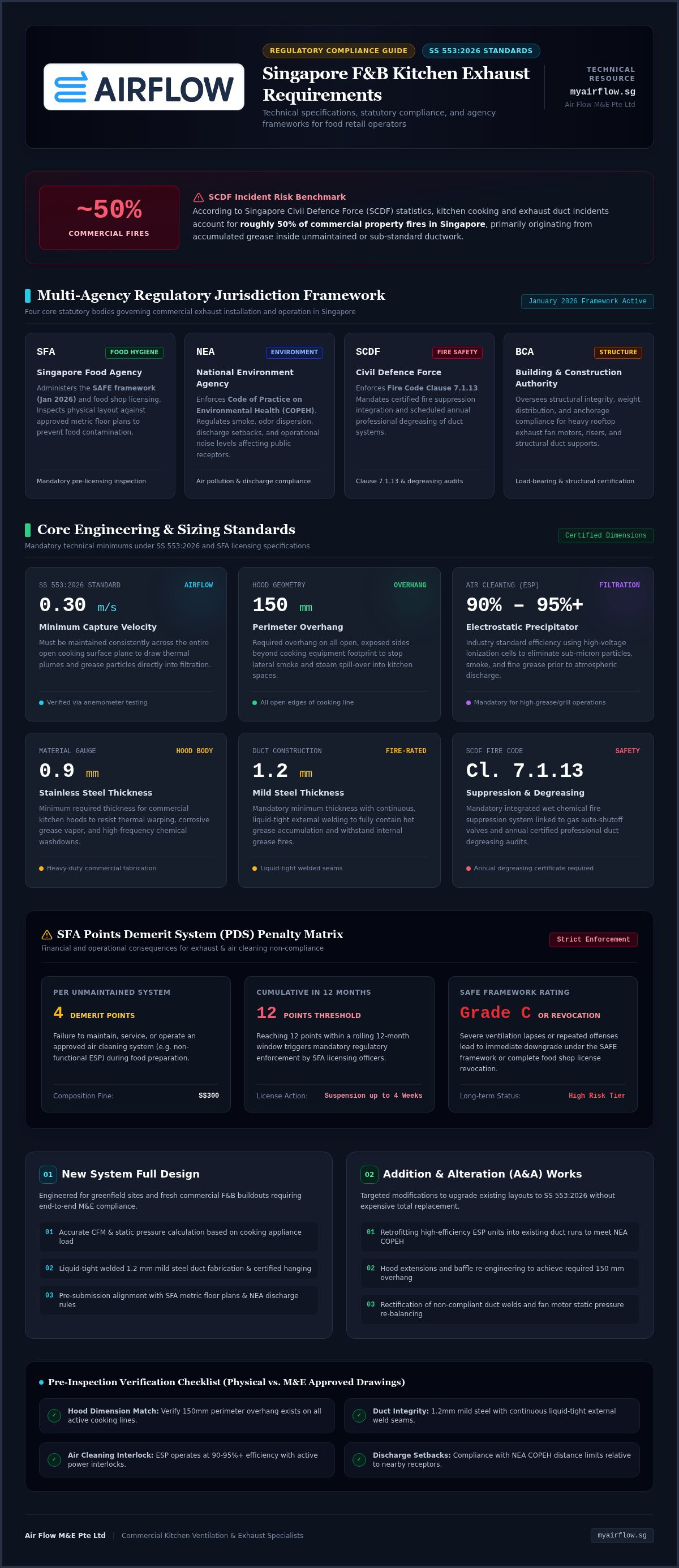
Fire safety is a critical driver for these regulations. SCDF statistics show that kitchen cooking and exhaust duct incidents account for roughly 50% of commercial property fires in Singapore. Most of these start from accumulated grease inside the ductwork. Whether you're planning a new installation or performing Addition & Alteration (A&A) works, your system must be engineered to mitigate this risk. New installations involve full system design for a fresh space. A&A works involve modifying existing setups to meet the updated SS 553:2026 standards without necessarily replacing every component.
Key Regulatory Bodies and Their Jurisdictions
SFA oversees food hygiene and the SAFE framework rolled out in January 2026. They ensure your kitchen environment doesn't contaminate food. NEA regulates pollution, focusing on smoke and noise levels that affect the public. The Building and Construction Authority (BCA) ensures structural integrity for heavy fans or duct supports. The Singapore Civil Defence Force (SCDF) enforces the Fire Code, specifically Clause 7.1.13, which mandates fire suppression and annual professional degreasing.
The Legal Consequences of Non-Compliance
Ignoring these standards leads to immediate financial and operational pain. Under the SFA Points Demerit System (PDS), failing to maintain an air cleaning system carries 4 demerit points and a S$300 composition fine. Accumulating 12 points in a year results in a mandatory license suspension of up to 4 weeks. Major lapses can lead to outright license revocation or a downgrade to Grade C under the SAFE framework. A compliant exhaust system for SFA standards is an engineered ventilation setup that effectively captures grease, smoke, and heat through liquid-tight welded ducting and high-efficiency filtration to maintain a sanitary food preparation environment.
Commercial Kitchen Hood Standards and Air Cleaning
Proper hood design is the first line of defense in meeting F&B kitchen exhaust requirements. It isn't just about catching smoke; it's about managing thermal plumes and grease particles before they enter your ductwork. Under SS 553:2026, hoods must maintain a minimum capture velocity of 0.30 m/s over the cooking surface. Your hood should overhang the equipment by at least 150mm on all open sides to prevent spill-over into the kitchen. This precision ensures that heat and contaminants are effectively drawn into the system, keeping your workspace compliant with SFA guidelines for licensed food retail premises.
Selecting the Right Commercial Kitchen Hood
Your choice of hood depends entirely on your kitchen layout and cooking volume. Wall-mounted hoods are efficient for linear line-ups, while island hoods are necessary for central cooking blocks. Island hoods typically require higher airflow rates because they lack a back wall to help direct the air. Regardless of the style, durability is non-negotiable. Industry standards require hoods to be constructed from stainless steel with a minimum thickness of 0.9 mm to withstand high temperatures and frequent cleaning. For a deeper look at selection criteria, see our 2026 Commercial Kitchen Hood Guide for Singapore F&B.
Air Cleaning Systems (ESP) Requirements
SFA and NEA regulations are particularly strict regarding air cleaning, especially for high-grease operations like charcoal grilling or deep frying. Electrostatic Precipitators (ESPs) are the industry standard for removing sub-micron particles. These units use high-voltage cells to ionize grease and smoke particles, achieving an efficiency rating of 90% to 95% or higher. This is critical for preventing visible smoke violations and reducing fire risk in your ductwork.
To manage odors, many modern systems integrate UV-C technology. According to SS 553:2026, UV-C systems must maintain an air velocity not exceeding 2.5 m/s across the lamps to ensure effective ozone production and odor neutralization. This multi-stage approach is often mandatory for low-level discharge setups where rooftop exhaust isn't possible. You can find detailed technical specifications in our 2026 Guide to SFA Compliant Kitchen Exhaust Air Cleaners in Singapore. If you're planning a new space, a professional commercial kitchen hood installation ensures your equipment is sized correctly from the start.
- Baffle Grease Filters: These are mandatory for capturing large grease droplets. They must be made of non-combustible material and be easily removable for cleaning.
- Fire Suppression Integration: Your hood must be compatible with an automatic wet chemical fire suppression system, as mandated by the SCDF Fire Code.
- Make-up Air: For large systems, you must supply at least 80% make-up air to maintain a negative pressure environment without starving the exhaust fan.
Engineering the Airflow: Ductwork and Exhaust Motors
Precision engineering determines whether your kitchen remains a productive workspace or a smoke-filled hazard. Calculating the correct Cubic Feet per Minute (CFM) is the first step in meeting F&B kitchen exhaust requirements. A heavy-duty Chinese kitchen with high-heat wok stations requires significantly more extraction power than a light-duty pastry cafe. Engineers aim for a duct velocity of approximately 10 m/s to ensure grease stays suspended until it reaches the filters. If your airflow is too slow, grease settles and creates a fire risk. If it's too fast, you'll face excessive noise and energy waste.
Custom Ductwork Fabrication and Routing
Singapore's unique urban landscape, ranging from historic shophouses to compact mall units, demands Expert Kitchen Ductwork Fabrication in Singapore: A Commercial Guide. Standard galvanized metal isn't permitted for grease ducts. You must use mild steel with a minimum thickness of 1.2 mm or stainless steel at 0.9 mm with liquid-tight welded seams. Horizontal runs must maintain a downward slope of at least 0.5% toward a drainage point. These technical details are non-negotiable under the NEA Building Plan guidelines for kitchen exhaust systems to ensure long-term safety and hygiene.
High-Performance Exhaust Motors
The exhaust motor is the heart of your ventilation. For most commercial F&B setups, centrifugal fans are preferred over axial fans. They better handle the higher static pressure of long duct runs and multi-stage filtration. If you notice smoke lingering or heat building up despite the fans being on, it's a clear sign your motor is underpowered. Upgrading to a high-performance unit usually requires an Addition & Alteration (A&A) permit. For technical specs on sizing, consult our Commercial Kitchen Exhaust Motor Replacement: The 2026 F&B Reference Guide.
NEA also enforces strict noise and discharge regulations. Your exhaust outlet must terminate at the roof level, extending at least 1.2 meters above the roofline. It must be positioned at least 5 meters away from any openable windows or fresh-air intakes. If your motor creates a noise nuisance for neighbors, NEA may mandate the installation of silencers or acoustic enclosures. Getting these F&B kitchen exhaust requirements right during the design phase prevents the high cost of post-installation rectifications.
The Compliance Checklist: Passing Your SFA Inspection
Passing an SFA inspection isn't just about surface cleanliness. It's about technical precision. Your F&B kitchen exhaust requirements must be met across four critical steps. First, verify that your as-built mechanical and electrical (M&E) drawings match the physical installation exactly. Inspectors check for deviations in duct routing and hood placement. Even a small shift from the approved plan can lead to a failed audit and a delay in your opening date.
Second, confirm your air cleaning systems are fully operational. Under the 2026 SAFE framework, SFA officers check if Electrostatic Precipitators (ESPs) are powered on and effectively capturing particulates. Third, inspect your ductwork for visible smoke or odor leakage. Liquid-tight welded seams are mandatory to prevent grease from dripping or smoke from escaping into the kitchen. Finally, you must maintain a rigorous maintenance logbook. This record proves you're managing your system proactively rather than waiting for a breakdown. If you're preparing for a launch, schedule a compliance audit to identify any hidden gaps.
Common Pitfalls During Inspections
Many business owners overlook the 150mm hood overhang rule for heavy-duty ranges. This leads to poor capture velocity and lingering smoke. Noise is another frequent issue. If your exhaust motor is poorly placed, neighbors may lodge complaints with NEA, triggering a mandatory noise assessment. Additionally, ensure your grease ducts have adequate access panels. SCDF and SS 553 standards require these for professional degreasing. If a specialist can't reach the interior of the duct, you won't receive the required cleaning certificate.
Preparing Your Documentation
Documentation is your evidence of compliance. You need valid maintenance contracts and current cleaning certificates ready for review. If you've modified your system, ensure you have Professional Engineer (PE) endorsement letters. These letters certify that your A&A works meet structural and safety codes. The single most important document SFA inspectors demand is the 12-month trailing service record for professional duct degreasing and air cleaning system maintenance. Providing this record shows you're operating a safe and professional kitchen environment.
A&A Services: Modifying Your System for Compliance
Addition & Alteration (A&A) works are often the most practical path to compliance for established businesses. You might need A&A if you're changing your cooking style from light to heavy grease, or if a recent audit flagged gaps in your current setup. It isn't always necessary to rip out the entire system. Targeted upgrades to exhaust motors or adding an Electrostatic Precipitator (ESP) can bring your kitchen up to current F&B kitchen exhaust requirements. These modifications allow you to meet the SS 553:2026 standards without the massive capital expenditure of a full replacement.
Integrating new hardware into older infrastructure requires precision. Older ductwork might not have the correct thickness or slope. A professional M&E contractor identifies these weak points and fabricates custom transitions to ensure airflow remains laminar and efficient. This focus on physical hardware modification is what separates a successful A&A project from a failed inspection. We focus on minimizing downtime by pre-fabricating components off-site, ensuring your kitchen stays operational for as long as possible during the transition.
The A&A Process for F&B Owners
The process begins with a detailed site assessment. We look for compliance gaps such as missing access panels or insufficient motor static pressure. Once identified, we design and fabricate custom components to bridge your existing infrastructure with new, high-performance equipment. This might include custom-fitted ductwork sections or upgraded motor housings. The final stage involves rigorous testing and commissioning. We verify capture velocities and filtration efficiency to ensure everything is ready for SFA approval. This methodical approach ensures that your system doesn't just look compliant on paper but performs reliably under heavy use.
Partnering with an M&E Specialist
Choosing a specialized M&E contractor over a general handyman is a matter of safety and accountability. General contractors often lack the technical knowledge to calculate CFM requirements or manage SCDF fire safety submissions. An expert acts as a "safe pair of hands," handling the technical complexities so you can focus on your business. Air Flow M&E Pte Ltd ensures that every modification is durable and compliant with Singapore's strict regulations. Proper engineering reduces long-term operational costs and prevents the risk of fire or neighbor complaints. For expert guidance, you should Contact Air Flow M&E Pte Ltd for a professional site assessment of your exhaust requirements.
Securing Your F&B License with Compliant Ventilation
Meeting F&B kitchen exhaust requirements doesn't have to be a source of stress for your business. By focusing on precise hood sizing, high-efficiency air cleaning, and custom-fitted ductwork, you ensure your kitchen passes every SFA and NEA inspection on the first attempt. Whether you're launching a new concept or modifying an existing setup through A&A works, the key is balancing technical standards with operational efficiency. A well-engineered system does more than just satisfy regulators; it protects your staff from heat and your property from the significant risk of grease-related fires.
As specialists in SFA and NEA compliance, we provide pragmatic M&E solutions tailored to the unique layouts of Singaporean kitchens. From custom ductwork fabrication to high-performance motor installations, we handle the technical complexities so you can focus on your culinary vision. Don't let a non-compliant exhaust system delay your grand opening or lead to costly demerit points. Get Professional M&E Support for Your Kitchen Exhaust Requirements and build your business on a foundation of safety and reliability. Your compliant, high-performance kitchen is within reach.
Frequently Asked Questions
What are the SFA requirements for kitchen exhaust air cleaners?
SFA mandates that air cleaning systems, typically Electrostatic Precipitators (ESP), must effectively capture grease and smoke to maintain hygiene. Under the 2026 SAFE framework, you must keep a 12-month trailing record of professional maintenance. These systems are essential for F&B kitchen exhaust requirements, especially in low-level discharge scenarios. Failure to maintain these units results in 4 demerit points and a S$300 fine. Professional servicing ensures the system achieves the necessary 90% to 95% efficiency.
Do I need a PE endorsement for a simple kitchen hood replacement?
Yes, you generally need a Professional Engineer (PE) endorsement if the replacement involves modifications to the building's mechanical systems or structural supports. SFA and SCDF require endorsed M&E drawings to verify that the new installation complies with fire safety and structural standards. Even a simple replacement is often classified as Addition & Alteration (A&A) work. This process ensures the hood is sized correctly for your equipment and that the building's envelope remains safe.
How often must a commercial kitchen exhaust system be cleaned for NEA compliance?
SCDF Fire Code Clause 7.1.13d requires a professional degreasing of the entire exhaust system at least once every 12 months. However, many mall landlords and high-grease operators, such as those doing wok-heavy cooking, now mandate quarterly or semi-annual cleaning intervals. You must keep all cleaning certificates in your Fire Safety Instruction Manual for inspection. SFA inspectors audit these logs during routine checks to ensure your system doesn't pose a fire hazard or environmental nuisance.
What is the required CFM for a commercial kitchen exhaust in Singapore?
The required Cubic Feet per Minute (CFM) depends on your cooking equipment, cuisine type, and hood dimensions. For example, a heavy-duty wok range requires a higher capture velocity than a light-duty electric oven. Engineers typically design for a duct velocity of 9 to 11 m/s to keep grease particles suspended. We calculate these F&B kitchen exhaust requirements based on SS 553:2026 standards to ensure your motor provides enough static pressure for your specific duct length.
Can I use a residential hood for my small F&B shop?
No, you cannot use a residential hood for any commercial F&B establishment in Singapore. Residential units lack the grease filtration capacity, fire suppression compatibility, and airflow power required by SFA and SCDF. Commercial kitchens produce significantly higher volumes of grease and heat that would quickly overwhelm a domestic fan. Installing a residential unit will lead to a failed SFA pre-licensing inspection and poses a major fire risk to your business premises.
What happens if my kitchen exhaust fails the NEA noise test?
If your system exceeds permissible noise levels, NEA will issue a notice requiring you to rectify the issue within a specific timeframe. Common solutions include installing acoustic silencers, enclosing the exhaust motor in a soundproof box, or using vibration isolators. Failing to resolve the noise nuisance can result in heavy fines or a stop-work order. It's often more cost-effective to include noise control measures during the initial M&E design phase to avoid these complications.
Do I need BCA approval for kitchen exhaust ductwork installation?
BCA approval via the CORENET system is required if your ductwork installation involves major structural openings or if the weight of the fans and supports exceeds 150 kg. You must also obtain written consent from the building owner or MCST. For external facade ducting, especially in URA-gazetted conservation districts, additional planning permission is mandatory. Ensuring your M&E contractor handles these submissions prevents legal complications and structural safety issues during your renovation project.
How do I resolve a smoke nuisance complaint from NEA?
To resolve a smoke complaint, you must first verify that your air cleaning system is functioning at peak efficiency. This often involves deep-cleaning the ESP cells or upgrading to a multi-stage system that includes UV-C or activated carbon for odor control. If your discharge point is too low, you might need to extend the ductwork to the roof level. NEA requires that all visible smoke be eliminated to prevent nuisance to neighboring residential or commercial units.


