

Did you know that approximately 50% of commercial property fires in Singapore originate in the kitchen, often fueled by grease buildup in exhaust ducts? For hotel operators, the stakes are even higher. You aren't just managing a kitchen; you're protecting guest sleep from vibrating motors and ensuring your SFA license remains secure. Finding the right hotel kitchen exhaust system specialist is the difference between seamless service and a costly operational shutdown. You likely already know that a standard contractor isn't enough for the complex, multi-story risers found in modern hospitality builds.
It's frustrating when system breakdowns disrupt dining or lead to noise complaints from the rooms above. This guide provides the technical clarity you need to hire an expert who truly understands Singapore's 2026 regulatory landscape. We'll explore the critical updates in SS 553:2026, SCDF fire safety requirements, and NEA boundary noise limits. You'll discover how specialized engineering and custom ductwork ensure long-term durability, quiet performance, and a smooth path to regulatory compliance for your hotel.
Key Takeaways
- Learn how the updated SS 553:2026 standards and SCDF fire safety codes impact your hotel's mandatory ventilation design and maintenance.
- Understand why a hotel kitchen exhaust system specialist is essential for managing the complex vertical risers and high static pressure found in hospitality buildings.
- Identify when Addition & Alteration (A&A) permits are mandatory for kitchen upgrades to ensure compliance with BCA and URA regulations.
- Discover how custom-fitted ductwork and high-performance motors prevent guest noise complaints and stop grease leaks in sensitive service corridors.
- Gain clarity on the specific documentation and engineering standards required to pass SFA licensing inspections and SCDF fire audits.
The Critical Role of a Hotel Kitchen Exhaust System Specialist
Managing a hotel kitchen requires more than just high-end appliances. It demands an invisible infrastructure that works perfectly 24 hours a day. A hotel kitchen exhaust system specialist understands that hotel ventilation isn't just a larger version of a restaurant setup. It's a complex engineering challenge involving multi-story vertical risers, high static pressure, and sensitive guest environments. While a standard F&B contractor might handle a single-story cafe, they often lack the specialized knowledge required for the high-stakes world of hospitality.
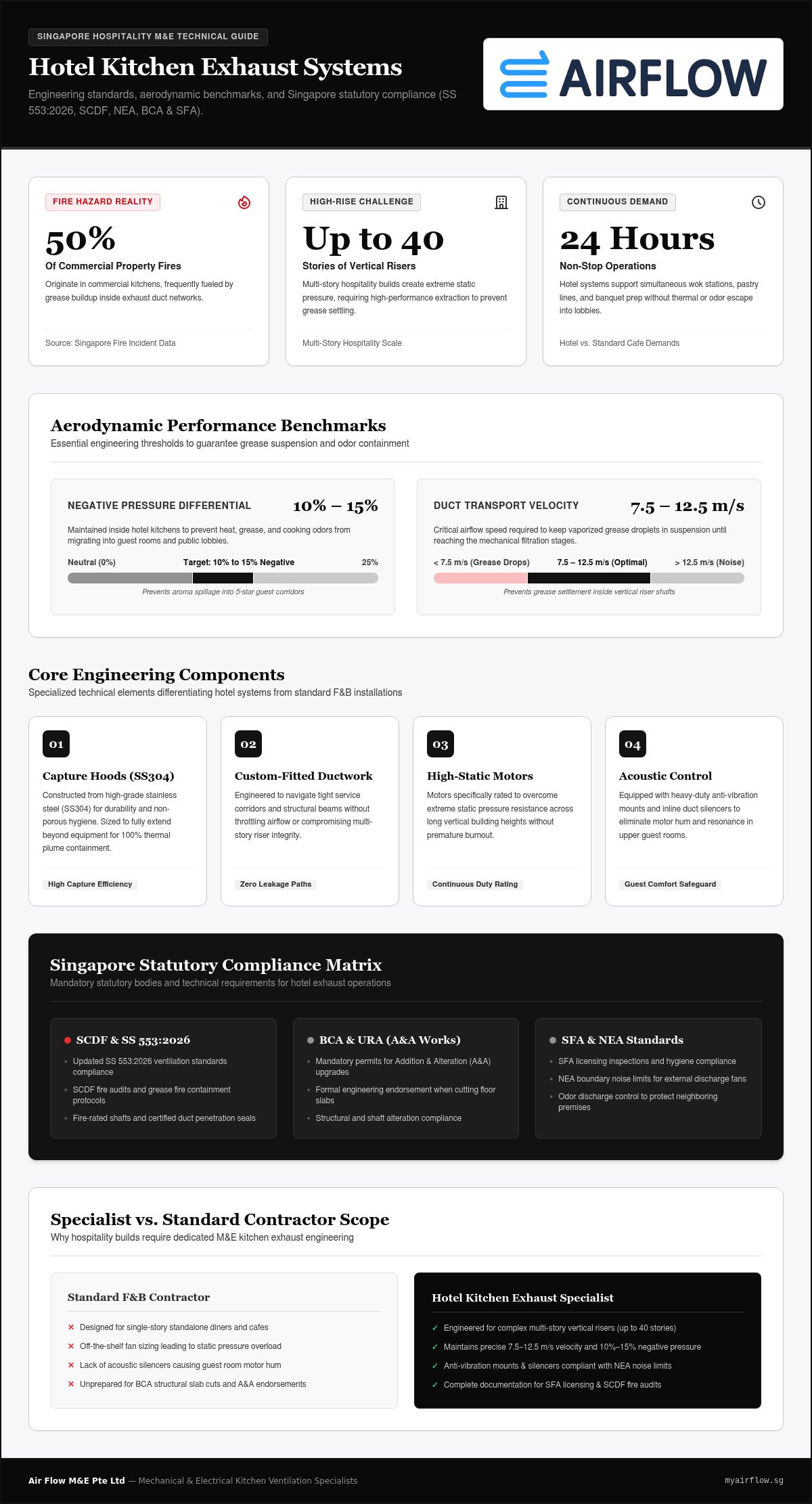
Standard exhaust solutions frequently fail in hotels because they don't account for the massive scale of operation. High-volume cooking produces constant grease vapor that can travel through 40 stories of ductwork. Without precise engineering, this grease settles, creating a significant fire hazard. Statistics show that 50% of commercial property fires originate in the kitchen, with grease-caked ducts acting as the primary fuel source. A specialist mitigates this risk through superior commercial kitchen ventilation systems designed for maximum capture and containment.
Hotel vs. Restaurant Ventilation Needs
Hotels operate on a different rhythm than standalone diners. Your ventilation must handle multiple cooking stations, from heavy-duty Asian woks to delicate pastry ovens, often simultaneously. Maintaining the right air pressure is a technical necessity. We aim for a 10% to 15% negative air pressure differential in the kitchen. This prevents heat, grease, and pungent cooking odors from escaping into guest corridors or the main lobby. In a 5-star environment, the smell of breakfast shouldn't greet a guest checking into a luxury suite.
The Specialist Advantage in M&E Engineering
When you undertake Addition & Alteration (A&A) works, you need more than a technician. You need a partner who understands Mechanical and Electrical (M&E) precision. Hotel upgrades often involve cutting into floor slabs or altering fire-rated shafts, which requires formal endorsement and compliance with BCA standards. A specialist provides several key advantages:
- Custom-fitted ductwork: We design solutions that navigate tight service corridors and existing structural beams without compromising airflow.
- Precision motor selection: We install high-performance exhaust motors specifically rated for the high static pressure of long vertical risers.
- Acoustic management: We prioritize guest comfort by using anti-vibration mounts and silencers to eliminate motor hum in guest rooms.
Choosing a dedicated hotel kitchen exhaust system specialist ensures your facility remains quiet, compliant, and safe. It's about protecting your property's reputation as much as its physical structure. Professional engineering provides the peace of mind that your back-of-house operations won't disrupt your front-of-house experience.
Essential Components of High-Performance Hotel Exhaust Systems
A high-performance hotel exhaust system is more than just a collection of fans and filters. It's a balanced mechanical ecosystem designed to handle the intense, 24-hour demands of a luxury kitchen. Every component must work in harmony to maintain a transport velocity between 7.5 m/s and 12.5 m/s. This precision ensures grease remains suspended in the airflow until it reaches the filtration stage, preventing dangerous buildup in the risers. Achieving this balance requires a hotel kitchen exhaust system specialist who prioritizes engineering over simple off-the-shelf installation.
Commercial Kitchen Hood Installation Standards
Capture efficiency starts at the hood. If the thermal plume escapes the hood's perimeter, your ventilation has already failed. We use high-grade stainless steel (SS304) for its durability and non-porous surface, which simplifies degreasing. Proper sizing is critical; the hood must extend beyond the cooking equipment to account for the expanding plume of heat and grease. For a detailed look at hardware selection and placement, refer to our 2026 commercial kitchen hood guide. A specialist ensures 100% capture through meticulous placement and airflow calculations.
Exhaust Motor and Fan Engineering
Hotels present a unique challenge: long vertical risers that create immense static pressure. Standard exhaust fans often burn out under these loads. You need specialized kitchen exhaust motor replacement strategies that account for building height and air volume. We integrate Variable Frequency Drives (VFD) to modulate fan speeds based on cooking activity. This demand-controlled approach can reduce energy consumption by up to 30%. To protect guest peace of mind, we employ spring isolators and acoustic silencers to stop motor vibrations from traveling through the building's structure.
Precision Ductwork Fabrication
Ductwork is the highway of your exhaust system. In a hotel, this highway often runs through tight service shafts alongside chilled water pipes and electrical trays. Precision is mandatory. We focus on kitchen ductwork fabrication Singapore standards to ensure every joint is airtight and grease-proof. Under SCDF Fire Code Clause 7.1 ventilation regulations, these ducts must be independent and fire-rated. We use heavy-gauge steel and specialized welding to prevent leaks in ceiling voids, which are a major fire risk. If you're planning a system upgrade, our team at Air Flow M&E can provide the custom-fitted solutions your kitchen requires.
Finally, environmental compliance requires the integration of air cleaners. We install Electrostatic Precipitators (ESP) and UV-C photolytic oxidation systems. These scrubbers remove up to 95% of particulates and odors before discharge. This keeps your hotel's exterior clean and ensures you meet NEA's strict emission standards for non-industrial buildings.
Singapore Compliance Standards: SFA, NEA, and BCA Requirements
Compliance in 2026 isn't just about passing a one-time check. It's an ongoing tripartite responsibility involving the Singapore Food Agency (SFA), the National Environment Agency (NEA), and the Building and Construction Authority (BCA). A professional hotel kitchen exhaust system specialist ensures your facility meets these evolving standards without costly rework. With the launch of SS 553:2026 on 10 March 2026, the design parameters for mechanical ventilation have become more stringent, focusing on resilience and indoor air health.
SFA Licensing and Inspection Readiness
The SFA requires every food establishment to maintain high hygiene standards, which starts with effective smoke and grease extraction. You'll find the technical specifics in our F&B kitchen exhaust requirements in Singapore. Beyond hardware, documentation is vital. You must keep a documented servicing log on-site, as SFA and SCDF conduct audits to verify that hoods and ducts are degreased at least once every 12 months. For heavy-duty wok stations common in hotel kitchens, we recommend cleaning every 1 to 3 months to prevent grease fuel loading. Failure to produce these records can result in demerit points or statutory notices during surprise inspections.
NEA Environmental Protection Standards
NEA focuses on how your kitchen affects the surrounding community. Discharge terminals must terminate at roof level, directed vertically upwards at least 3 metres above the highest building roofline. If your hotel is located near residential premises, you must adhere to strict nighttime noise limits of 55 dBA. This often requires a hotel kitchen exhaust system specialist to install certified acoustic silencers and anti-vibration spring isolators. Odor management is equally critical. Using SFA compliant kitchen exhaust air cleaners, such as Electrostatic Precipitators (ESP) with 90% to 95% efficiency, ensures you don't face penalties for public nuisance or air pollution.
Major modifications to hotel ventilation are classified as Addition & Alteration (A&A) works. From 1 October 2026, the BCA and URA mandate that major A&A projects for buildings with a Gross Floor Area (GFA) of 5,000 m² and above must use the CORENET X digital submission process. This requires model-based BIM coordination using the IFC+SG schema to prevent clashes with structural beams or fire compartmentation. We coordinate these technical submissions through registered Professional Engineers (PE), ensuring your structural modifications are safe, compliant, and legally endorsed. Precision in these early stages prevents the "fear of failing" that many operators experience during final inspections.
Addition & Alteration (A&A) Works for Hotel Kitchen Upgrades
Upgrading a hotel ventilation system is rarely as simple as swapping a fan. When your project involves cutting new floor penetrations, altering fire-rated shafts, or increasing the static mechanical load on the roof, the Building Control Act classifies this as Addition & Alteration (A&A) works. These modifications require a hotel kitchen exhaust system specialist who can coordinate with a registered Professional Engineer (PE) to endorse calculations and submit plans to the BCA and SCDF. For hotels with a Gross Floor Area of 5,000 m² or more, these submissions must now use the CORENET X digital gateway as of October 2026.
Heritage hotel buildings present unique engineering hurdles. Thick masonry walls and restricted service corridors often lack the space for modern, high-capacity ducts. We solve this through custom-fitted ductwork designed to navigate existing structural constraints without sacrificing airflow velocity. Our team focuses on maintaining the 7.5 m/s to 12.5 m/s transport velocity required to keep grease from settling in long, horizontal runs that are common in retrofitted layouts.
The A&A Project Lifecycle
Every successful upgrade begins with a comprehensive site survey. We assess your current airflow capacity and identify bottlenecks in the existing riser system. Once the design phase is complete, we handle the submission of mechanical drawings for regulatory approval. The final stage involves installation, testing, and commissioning. We ensure the system is balanced at the mandatory 10% to 15% negative air pressure differential before the kitchen resumes full operation. If you need expert guidance on your next retrofit, consult with our A&A specialists at Air Flow M&E today.
Modifying Existing Ductwork and Motors
Retrofitting often requires assessing the structural integrity of old duct shafts. We ensure that new installations maintain the required 500 mm clearance from unprotected combustible materials, as mandated by SCDF Fire Code Clause 7.1.13. Upgrading your exhaust motors is another critical step, especially if you're adding heavy-cooking appliances like high-pressure woks. We integrate these new components into your existing fire suppression systems, ensuring compliance with UL 300 and NFPA 17A standards.
Minimizing downtime is our priority. We employ phased installation strategies, often working during low-occupancy periods or overnight. This allows your 24-hour hotel operations to continue with minimal disruption to guest services. By coordinating every step of the A&A process, a hotel kitchen exhaust system specialist provides a "safe pair of hands" for even the most complex hospitality environments.
Air Flow M&E: Precision Engineering for Hotel Ventilation Systems
Choosing the right partner determines whether your kitchen is a liability or a high-performance asset. Air Flow M&E operates as a dedicated hotel kitchen exhaust system specialist, focusing exclusively on the rigorous demands of Singapore's commercial sector. We understand that in a hotel environment, technical failures aren't just inconveniences; they're threats to your guest ratings and regulatory standing. Our team brings a pragmatic, engineering-first mindset to every project. We ensure your ventilation remains a silent, compliant, and efficient backbone of your back-of-house operations.
We position ourselves as a "safe pair of hands" for hotel engineers who cannot afford downtime. Our focus is strictly commercial, meaning we understand the scale and complexity of industrial-grade systems. We don't just provide parts; we provide precision-engineered solutions that handle the high-stakes reality of 24-hour hospitality service. By prioritizing safety and long-term functionality, we help you avoid the frequent breakdowns and noise complaints that disrupt guest peace of mind.
Our Technical Expertise
We specialize in the full spectrum of Addition & Alteration (A&A) services. This includes everything from initial site surveys to the installation of high-performance exhaust motors and custom-fitted ductwork. Because we handle fabrication in-house, we create duct solutions that fit perfectly within the restricted service shafts of luxury or heritage hotels. This level of precision prevents grease leaks and vibration issues that often plague generic installations. Our expertise extends to navigating the complex 2026 standards set by SFA and NEA. We ensure your system meets the transport velocity requirements of SS 553:2026, giving you total confidence during every regulatory audit.
Partnering for Long-Term Success
We don't just install hardware; we build systems for long-term reliability. As a hotel kitchen exhaust system specialist, we provide direct access to experienced M&E specialists for troubleshooting. This ensures that technical complexities are resolved before they impact your guests or staff. Our proactive approach to system design focuses on reducing future maintenance costs and energy expenditure. We ensure your makeup air units are perfectly balanced with your exhaust load, preventing the energy penalties caused by drawing conditioned air out of your lobby. A well-engineered system from Air Flow M&E keeps your kitchen cool and your guest corridors completely odor-free. Contact Air Flow M&E today for a professional system assessment and experience the peace of mind that comes with expert engineering.
Secure Your Hotel's Operational Excellence for 2026
Maintaining a high-performance kitchen ventilation system protects your guests, your staff, and your property's reputation. Standard F&B solutions often fall short when faced with multi-story hotel risers and 24-hour operational loads. Navigating the 2026 regulatory landscape, from SS 553:2026 standards to mandatory SFA servicing logs, requires a meticulous engineering approach. Precision in these areas prevents the frequent breakdowns and noise complaints that disrupt the guest experience.
Partnering with a dedicated hotel kitchen exhaust system specialist ensures your facility remains quiet, efficient, and fully compliant. Air Flow M&E provides professional M&E engineering standards and specialized expertise in commercial A&A works. We handle the technical complexities of SFA and NEA compliance so you can focus on delivering exceptional service. Don't wait for a system breakdown or a failed inspection to evaluate your infrastructure. Proactive upgrades today prevent costly emergency repairs tomorrow.
Contact our hotel kitchen exhaust specialists for a professional assessment and secure the long-term durability of your ventilation systems. We look forward to providing the pragmatic, safety-first solutions your hotel needs to thrive.
Frequently Asked Questions
Why does my hotel kitchen need a specialized exhaust contractor instead of a general contractor?
Hotels feature complex multi-story risers and high static pressure requirements that general contractors aren't equipped to handle. A hotel kitchen exhaust system specialist possesses the M&E engineering expertise to manage these intricate layouts. They ensure your system meets SS 553:2026 standards while balancing air pressure across the building. This specialization prevents common issues like odor leaks into guest corridors and ensures total regulatory compliance.
What are the main causes of noise complaints in hotel kitchen exhaust systems?
Noise complaints typically stem from excessive aerodynamic boundary noise or motor vibrations. If duct velocities exceed 12.5 m/s, they create significant turbulence. Additionally, motors installed without anti-vibration spring isolators or acoustic silencers allow hum to travel through the building's structure. Professional engineering ensures your system stays below the NEA nighttime limit of 55 dBA for residential boundaries, protecting your guest sleep experience and room ratings.
How often should a hotel kitchen exhaust motor be replaced or serviced?
Motors should be inspected monthly and professionally serviced every quarter. While replacement cycles vary based on operational load, hotel motors running 24/7 face significant wear. SCDF mandates degreasing the entire system at least once every 12 months. However, heavy-use hotel kitchens often require cleaning every 1 to 3 months to prevent grease fuel loading and motor burnout. Regular maintenance ensures the system maintains its required static draw.
What are the specific SFA requirements for hotel kitchen exhaust systems in 2026?
SFA requires establish establishments to maintain documented servicing logs and certificates on-site for annual audits. Your system must effectively remove smoke and grease to maintain hygiene standards. In 2026, this includes adhering to the updated SS 553:2026 design parameters. You must also ensure that secondary particulate abatement systems, like Electrostatic Precipitators (ESP) with 90% to 95% efficiency, are fully functional and regularly degreased by a specialist.
Can custom ductwork be installed in old hotel buildings with limited ceiling space?
Yes, custom-fitted ductwork is essential for navigating the restricted ceiling voids and thick masonry common in heritage structures. A hotel kitchen exhaust system specialist uses precise measurements to design ducts that bypass structural beams while maintaining the mandatory 500 mm clearance from combustible materials. This tailored approach ensures optimal transport velocity (7.5 m/s to 12.5 m/s) without requiring major structural changes to the historical building.
How long does a typical kitchen exhaust A&A project take for a hotel?
A standard retrofit or upgrade typically takes between 4 to 8 weeks from start to finish. This timeline includes the initial site survey, PE endorsement, and the mandatory CORENET X digital submission for larger properties. We use phased installation strategies to minimize operational downtime. Major works are often performed during low-occupancy periods or overnight to ensure your kitchen remains functional and guest disruption is kept to a minimum.
What happens if my hotel kitchen exhaust system fails an NEA inspection?
Failing an NEA inspection results in statutory notices, fines, or demerit points against your license. NEA focuses on discharge point height (3 metres above the roof ridge) and boundary noise levels. If your emissions cause a public nuisance or exceed dBA limits, you'll be required to implement corrective actions immediately. This may include installing secondary scrubbers like UV-C oxidation, activated carbon filters, or high-efficiency acoustic attenuators.
Does Air Flow M&E provide residential kitchen ventilation services?
Air Flow M&E focuses strictly on commercial and industrial mechanical engineering in Singapore. We don't provide residential kitchen hood installations or home exhaust services. Our team's expertise is dedicated to high-stakes commercial environments like hotels, central kitchens, and large-scale F&B establishments. This specialization allows us to maintain professional M&E standards and handle the complex A&A requirements unique to commercial hospitality operations.


