

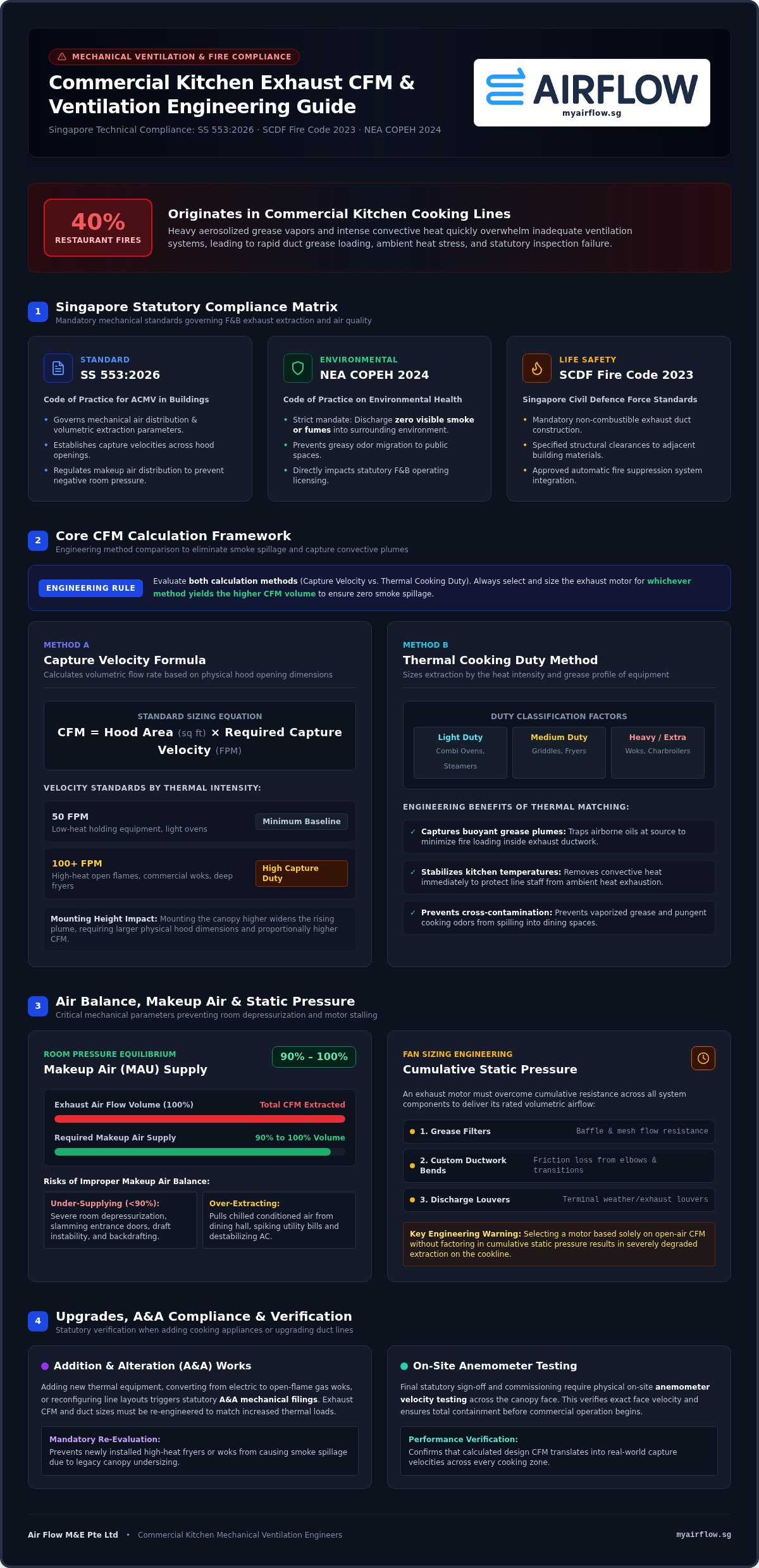
Approximately 40% of all restaurant fires originate in the kitchen, where heavy grease vapors and intense cooking heat quickly overwhelm an inadequate ventilation system. If you operate an F&B business, you already know the disruption caused by smoke spilling onto the line, uncomfortable ambient heat, and the lingering threat of failing a statutory inspection. Determining your commercial kitchen exhaust calculation CFM Singapore demands more than generic rules of thumb. It requires precise capture velocities and duty-specific engineering to keep your daily operations running smoothly.
You shouldn't have to guess whether your airflow meets Singapore Civil Defence Force (SCDF) or National Environment Agency (NEA) standards. This complete guide provides exact airflow calculation methods tailored to your actual cooking loads, helping you ensure full compliance with the Fire Code 2023, NEA COPEH guidelines, and the SS 553:2026 mechanical ventilation standard. From matching kitchen hood face velocity to balancing makeup air and selecting durable exhaust motors, here's everything you need to engineer a safe, high-performance commercial kitchen.
Key Takeaways
- Master the precise commercial kitchen exhaust calculation CFM Singapore framework to balance hood face velocity with thermal cooking equipment loads.
- Classify equipment duty correctly to eliminate smoke spillage, cut excessive ambient heat, and maintain steady capture velocity during peak food-service hours.
- Calculate cumulative static pressure across grease filters, custom ductwork bends, and discharge louvers to ensure your exhaust motor delivers its rated airflow.
- Maintain balanced makeup air supply at 90% to 100% of exhaust volume to prevent dangerous room depressurization and draft instability.
- Determine when equipment additions trigger Addition & Alteration (A&A) works and verify final extraction performance using on-site anemometer testing.
Understanding Kitchen Exhaust CFM and Why Precise Calculation Matters in Singapore
Cubic feet per minute (CFM) measures the volumetric flow rate of air moving through an extraction system. In a professional cookline, it defines how effectively your canopy pulls heat, aerosolized grease, smoke, and moisture away from cooking appliances. Establishing an accurate commercial kitchen exhaust calculation CFM Singapore framework ensures total containment of convective thermal plumes before they escape into prep lines and dining spaces.
Airflow engineering isn't a matter of rough estimates. Undersized extraction leads to rapid grease deposits across ceiling tiles, degraded air quality, and elevated ambient heat that wears down kitchen staff. Conversely, over-extracting air creates unnecessary operational expenses. Sucking out excessive air forces the exhaust motor to pull conditioned air from the dining room, spiking utility bills and destabilizing front-of-house cooling.
What CFM Means for Commercial Food Operations
Every commercial appliance generates an upward thermal plume of varying heat and velocity. Proper CFM sizing establishes the capture velocity required to pull these plumes into the hood reservoir without turbulent spillover. Modern kitchen ventilation principles require the extraction rate to match the appliance's thermal output, whether you're running light combi ovens or high-heat open-flame woks.
- Captures buoyant grease plumes: Traps airborne oils at the source to minimize fire loading inside the exhaust infrastructure.
- Stabilizes kitchen temperatures: Removes convective heat immediately, keeping working line temperatures manageable.
- Prevents cross-contamination: Stops vaporized grease and pungent food odors from drifting into customer dining areas.
Regulatory Compliance Under Singapore Ventilation Standards
Singapore strictly regulates commercial kitchen ventilation through performance-based and prescriptive mechanical standards. Your system design must comply with the Singapore Standard SS 553:2026 code of practice for air-conditioning and mechanical ventilation in buildings, which governs proper air distribution and mechanical extraction parameters.
Review The 2026 Guide to F&B Kitchen Exhaust Requirements in Singapore to understand how mechanical ventilation directly impacts statutory licensing. The National Environment Agency (NEA) enforces strict discharge standards under the Code of Practice on Environmental Health (COPEH) 2024 Edition, requiring systems to release zero visible smoke or fumes. Simultaneously, the Singapore Civil Defence Force (SCDF) inspects under the Fire Code 2023 to verify non-combustible duct construction, appropriate clearances, and approved fire suppression integration. Meeting these standards hinges entirely on performing an accurate commercial kitchen exhaust calculation CFM Singapore assessment before installing equipment.
Core Methods for Calculating Commercial Kitchen Exhaust CFM
Mechanical engineers rely on two established calculation frameworks: the capture velocity approach and the thermal cooking duty method. Relying on generic square-footage assumptions creates serious risks. Calculating airflow without evaluating your specific equipment lineup leads to severe under-extraction at the cookline. A rigorous commercial kitchen exhaust calculation CFM Singapore assessment evaluates both formulas, then uses whichever yields the higher volume to safeguard your line against smoke spillage.
The Capture Velocity Method (Hood Dimensions and Area)
The capture velocity formula calculates airflow based on the physical opening of the extraction hood. It ensures that air travels inward fast enough to entrain buoyant cooking plumes before room air currents disrupt them:
CFM = Hood Area (sq ft) × Required Capture Velocity (FPM)
Capture velocities typically range from 50 feet per minute (FPM) for low-heat holding equipment to 100 FPM or higher for high-heat cooking. Hood height directly alters this requirement. Mounting a canopy higher above the cookline widens the rising plume, requiring larger dimensions and higher airflow to capture it completely.
The Appliance Thermal Cooking Duty Rating Method
Appliance duty ratings size extraction by the heat intensity and grease profile of your cooking appliances. International guidelines classify cooking equipment into four operational tiers, each requiring specific volumetric flow per linear foot of hood:
- Light Duty (100 to 200 CFM/linear ft): Electric convection ovens, pasta cookers, steam tables, and holding cabinets.
- Medium Duty (200 to 300 CFM/linear ft): Countertop griddles, electric fryers, and flat-top ranges.
- Heavy Duty (300 to 400 CFM/linear ft): Gas open-burner ranges, deep fat fryers, and under-fired gas broilers.
- Extra-Heavy Duty (400+ CFM/linear ft): Solid-fuel equipment, charcoal grills, wood-fired ovens, and high-heat Asian wok burners.
For lines combining various types of gear, calculate each appliance zone independently based on its linear length. Summing these values gives you the baseline duty requirement.
Accounting for Canopy Style and Physical Hood Placement
Canopy style significantly alters your CFM requirements. Wall-mounted canopies benefit from a physical wall boundary, which naturally channels rising smoke upward and shields the plume from cross-drafts. Island canopies lack boundary walls. Exposed on all sides, they require 30% to 50% more airflow to counteract cross-drafts and ambient room turbulence. Consult the 2026 Commercial Kitchen Hood Guide for Singapore F&B to evaluate the precise front and end overhangs required for each canopy style. If you are retrofitting an existing space, consulting with specialists at myairflow.sg helps identify the most efficient canopy layout for your available floor plan.
Step-by-Step CFM Guide for Commercial Kitchen Layouts
Sizing extraction requires a methodical sequence. Skipping steps or guessing cooking loads causes smoke spillage and inspection delays. By executing a structured commercial kitchen exhaust calculation CFM Singapore assessment, you ensure your extraction system handles peak cooking volumes while meeting local statutory standards.
Step 1: Inventorying Kitchen Equipment and Thermal Duty
Create an exhaustive schedule of every cooking appliance positioned beneath the hood canopy. Document equipment dimensions, fuel sources (gas, electric, or solid fuel), and peak operating temperatures. Categorize each unit into light, medium, heavy, or extra-heavy duty.
Base your assessment on maximum simultaneous cooking loads rather than average output. For example, a cookline running two 24-inch gas deep fryers alongside a 36-inch open-burner range must be rated for continuous heavy-duty extraction, not intermittent light cooking.
Step 2: Measuring Hood Dimensions and Perimeter Overhang
Calculate physical canopy dimensions by measuring active hood length and width. Canopies must overhang the cooking equipment footprint to catch expanding thermal plumes before they curl into the kitchen workspace. Standard engineering practices call for a minimum 6-inch overhang on all open sides, with high-heat equipment often requiring 12 inches.
Next, determine your exposed perimeter. For a wall-mounted canopy, calculate the front length plus both exposed side edges. For an island canopy, sum all four open sides to establish your true capture boundary.
Step 3: Calculating Extraction Volume and Baseline Airflow
Execute both sizing formulas to establish your required mechanical baseline:
- Calculate thermal duty volume: Multiply total linear hood length by the CFM benchmark of your highest-rated appliance. For an 8-foot wall hood positioned over a heavy-duty gas cookline (using 350 CFM/linear ft):
8 ft × 350 CFM/linear ft = 2,800 CFM - Calculate face velocity volume: Multiply total hood opening area by your design face velocity (typically 75 to 100 FPM for commercial cooklines). For an 8-foot by 4-foot hood aperture (32 sq ft) at 90 FPM:
32 sq ft × 90 FPM = 2,880 CFM
Compare the two figures and adopt the higher volume. In this example, your baseline requirement is 2,880 CFM. Apply an engineering safety margin of 10% to accommodate ambient draft disruptions and filter loading, bringing total design capacity to roughly 3,168 CFM. This delivers robust containment while maintaining full compliance with statutory mechanical guidelines.
Beyond Airflow Volume: Static Pressure, Duct Routing, and Makeup Air
Airflow volume on paper means nothing if your blower cannot push air through the actual building infrastructure. Many operators calculate correct CFM figures yet suffer smoky kitchens because they overlooked system resistance. A complete commercial kitchen exhaust calculation CFM Singapore assessment must balance volumetric flow against total static pressure loss and incoming replacement air.
Duct layout directly dictates extraction velocity. If ductwork is oversized, air velocity drops below 1,500 feet per minute, causing vaporized grease to cool, liquefy, and pool inside horizontal runs. If ductwork is undersized, static pressure skyrockets, strangling fan performance and generating excessive mechanical noise.
Calculating Total External Static Pressure (ESP)
External static pressure measures the cumulative friction and mechanical resistance that the exhaust fan must overcome. Calculate pressure loss across every component in the air stream:
- Grease filters: Clean baffle filters typically contribute 0.25 to 0.50 inches water gauge (in. wg), increasing as grease accumulates.
- Air cleaning infrastructure: Electrostatic precipitators and secondary odor-control modules add between 0.50 and 1.20 in. wg of continuous resistance.
- Fittings and transitions: 90-degree elbows, fire dampers, and directional transitions introduce dynamic pressure losses.
- Linear duct runs: Straight duct friction losses accumulate over long vertical risers.
Check out Expert Kitchen Ductwork Fabrication in Singapore: A Commercial Guide to learn how customized duct sizing minimizes overall resistance across complex layouts.
Balancing Exhaust Air with Dedicated Makeup Air (MAU)
A kitchen cannot exhaust air that it does not replace. Operating without an engineered makeup air system creates severe negative pressure. That imbalance pulls treated air from dining spaces, causes doors to slam, and degrades hood capture velocity. Supply dedicated makeup air at 85% to 90% of total exhaust volume. The remaining 10% to 15% negative pressure margin ensures kitchen odors stay contained without compromising fan performance.
Selecting the Right Commercial Exhaust Motor
Never size an exhaust motor based on nominal free-air ratings. Match your calculated CFM against the manufacturer fan performance curve at your calculated ESP. Heavy commercial kitchens require belt-driven or direct-drive backward-inclined centrifugal blowers with motors isolated outside the hot grease stream.
Review the Commercial Kitchen Exhaust Motor Replacement: The 2026 F&B Reference Guide for in-depth motor drive specifications. If your existing fan struggles against duct resistance, explore how Air Flow M&E's exhaust motor installations and custom ductwork restore full capture performance to your kitchen.
Professional Mechanical Verification and Exhaust System Upgrades
Engineering plans establish the mathematical framework, but on-site mechanical verification determines whether your kitchen passes statutory licensing. Food-service operators frequently modify their cooklines over time without updating their ventilation systems. Executing a fresh commercial kitchen exhaust calculation CFM Singapore assessment ensures that your extraction infrastructure continues to safeguard staff, control grease loading, and satisfy national ventilation codes as your menu evolves.
When Kitchen Modifications Require System Recalculation
Whenever you alter cooking equipment beneath a canopy, your airflow requirements shift. Swapping an electric flat-top for a high-output open-burner gas range or an open-flame Asian wok burner dramatically increases thermal plume velocity. If you expand your equipment line beyond existing canopy dimensions, you trigger mandatory Addition & Alteration (A&A) works.
These modifications alter system dynamics. Adding canopy length increases required volumetric flow, while extending ductwork to a new tenant discharge point adds static friction. Both scenarios demand fan curve re-evaluation to determine if an exhaust motor upgrade or custom-fitted ductwork modifications are required.
Airflow Balancing and Testing Protocols
Certified mechanical technicians use precision diagnostic instruments to verify that theoretical CFM values match physical performance on the line:
- Vane anemometer traverse testing: Measures face velocity across each baffle filter section to confirm uniform extraction without dead zones.
- Differential pressure testing: Verifies that makeup air supply maintains an acceptable negative pressure margin without starving the hood.
- Chemical smoke pencil testing: Visualizes thermal capture along the hood perimeter to prove plumes are fully contained under simulated cooking drafts.
These empirical tests detect draft imbalances early, preventing hot air leakage and avoiding expensive re-inspection penalties from local authorities.
Partnering with Commercial M&E Ventilation Specialists
Commercial kitchen ventilation leaves zero margin for trial and error. Navigating spatial constraints in tight ceiling voids requires precision sheet-metal fabrication and code-compliant mechanical design. Air Flow M&E provides dedicated mechanical and electrical engineering expertise focused entirely on commercial F&B facilities across Singapore.
Whether you need commercial kitchen exhaust system Addition & Alteration (A&A) services, commercial kitchen hood installations, high-performance commercial exhaust motor installations, or custom-fitted ductwork, our engineering team ensures every component delivers exact aerodynamic performance. Connect with Air Flow M&E Pte Ltd to schedule an on-site airflow assessment and keep your extraction system fully compliant with statutory mechanical standards.
Engineer Your Kitchen Exhaust for Peak Performance and Total Compliance
A reliable ventilation system forms the backbone of any productive food-service operation. Getting your commercial kitchen exhaust calculation CFM Singapore right protects staff from dangerous heat, eliminates grease vapor spillage, and prevents costly statutory inspection delays. Success requires looking beyond raw air volume alone. You must balance appliance thermal loads against total external static pressure while maintaining continuous, dedicated makeup air.
When you plan cookline upgrades or face complex spatial constraints, rely on proven mechanical engineering expertise. Air Flow M&E Pte Ltd specializes strictly in commercial F&B ventilation systems across Singapore. Whether you need turnkey commercial kitchen exhaust system Addition & Alteration (A&A) works, custom-fitted ductwork fabrication, or new hood and exhaust motor installations, we engineer systems that satisfy national fire and mechanical ventilation codes. Consult Air Flow M&E Pte Ltd for precision commercial kitchen exhaust sizing and installation to secure total compliance and long-term operational peace of mind.
Frequently Asked Questions
How do you calculate kitchen exhaust CFM for commercial operations?
You calculate commercial kitchen exhaust CFM by determining the higher value between appliance thermal duty ratings and hood face velocity formulas. First, multiply the linear length of your hood canopy by the required CFM rating for your heaviest cooking appliance. Next, multiply the total hood aperture area in square feet by the required capture velocity, typically 75 to 100 feet per minute. Selecting the higher result ensures full capture of rising grease plumes.
What is the standard exhaust CFM requirement per linear foot of commercial hood?
Baseline CFM requirements range from 150 to over 400 CFM per linear foot depending on appliance thermal output. Light-duty equipment like electric ovens requires roughly 150 to 200 CFM per linear foot. Medium-duty fryers and griddles demand 200 to 300 CFM per linear foot. Heavy-duty gas ranges need 300 to 400 CFM, while high-heat Asian wok burners or solid-fuel charcoal grills exceed 400 CFM per linear foot.
Why is my commercial kitchen exhaust hood smoky even though the fan runs continuously?
Persistent smoke leakage usually stems from insufficient capture velocity, excessive external static pressure, or severe makeup air deficits. If supply air is inadequate, the exhaust motor chokes and fails to pull rated air volume. Alternatively, improper hood overhangs, localized cross-drafts from air conditioning diffusers, or grease-clogged baffle filters disrupt the thermal plume before it enters the ductwork, causing smoke to spill into the kitchen.
What happens if commercial kitchen exhaust CFM is higher than makeup air supply?
When exhaust airflow severely exceeds incoming fresh air, the room enters a high negative pressure state. This pressure imbalance starves the exhaust fan, pulling down actual extraction volume and allowing cooking fumes to linger. It also creates physical operational hazards. Heavy negative pressure forces exterior doors to slam shut, draws unconditioned humid air through ceiling cracks, and pulls cooking smells directly into customer dining areas.
Does commercial kitchen exhaust calculation in Singapore differ for open island hoods?
Yes, island canopies require significantly higher airflow volumes than wall-mounted hoods. Because island canopies lack side walls to contain expanding cooking plumes, cross-drafts pull smoke away from the capture zone. Completing a precise commercial kitchen exhaust calculation CFM Singapore layout for an island canopy requires increasing baseline airflow by 30% to 50% alongside wider overhangs on all four open sides to maintain proper capture velocity.
Can I increase exhaust CFM simply by installing a higher horsepower fan motor?
No, increasing motor horsepower without evaluating duct capacity often causes severe mechanical issues. If existing ductwork is too narrow, a larger motor simply generates excessive static pressure, violent air turbulence, and deafening operational noise without improving capture. Safe airflow expansion requires an engineered commercial kitchen exhaust calculation CFM Singapore assessment to verify duct dimensions, filter capacity, and makeup air balance before upgrading your motor.


