

Cooking equipment sparks nearly 61% of restaurant fires, yet too many operators treat ventilation safety as a simple surface-cleaning chore. Real kitchen exhaust fire safety compliance requires dedicated mechanical engineering, not cosmetic maintenance. When heavy grease vapor enters uncertified ductwork or poorly configured hoods, a single spark can shut down an entire commercial food operation in minutes.
Balancing fire safety requirements alongside daily kitchen demands during Addition and Alteration (A&A) works is challenging. You shouldn't have to guess whether your mechanical ventilation layout will pass regulatory inspections or risk catastrophic downtime from hidden hazards behind the ceiling line.
This guide helps you master commercial kitchen exhaust fire safety compliance under Singapore standards to protect your F&B business from hazards. You'll understand the statutory fire safety regulations governing commercial kitchen ventilation, learn to identify non-compliant exhaust components before licensing checks, and establish an engineering-led action plan for certified ductwork and hood safety.
Key Takeaways
- Understand how kitchen exhaust fire safety compliance under Singapore fire codes treats commercial ventilation as a critical grease-containment system rather than standard HVAC.
- Discover why heavy-gauge steel, certified extraction hoods, and custom-fitted ductwork form the mechanical foundation for high-temperature fire defense.
- Identify high-risk compliance errors before regulatory audits, including illegal fire damper placements and incorrect duct slopes that pool flammable grease.
- Establish a clear, engineering-led checklist for commercial Addition and Alteration (A&A) works to keep daily kitchen operations fully protected and inspection-ready.
What Is Kitchen Exhaust Fire Safety Compliance?
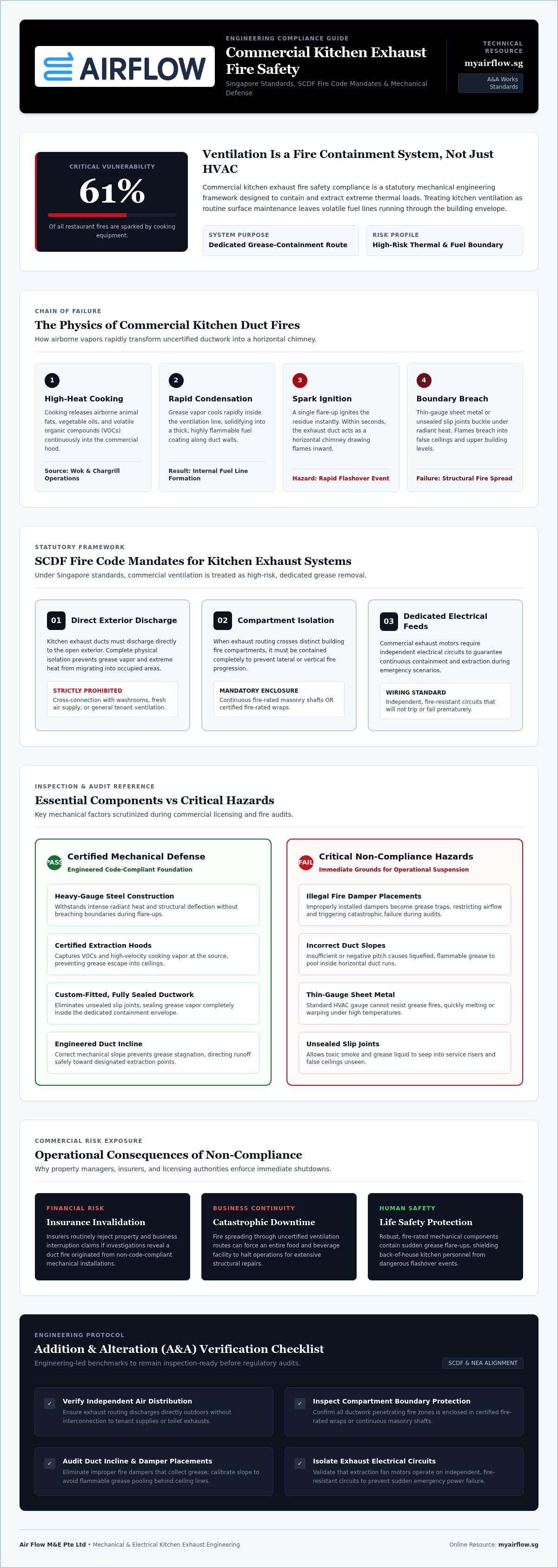
Commercial kitchen exhaust fire safety compliance isn't simply a housekeeping matter or routine filter wipe-down. It's a statutory mechanical engineering framework designed to contain and extract extreme thermal loads. In commercial food-service operations, cooking releases grease, vapor, and volatile organic compounds continuously. As these fumes enter the commercial kitchen hood, they form an uninterrupted fuel line running through the ventilation network. Meeting the mechanical benchmarks outlined in standard F&B kitchen exhaust requirements ensures this volatile mixture is contained passively and exhausted safely without endangering the building envelope.
The Physics of Commercial Kitchen Duct Fires
High-heat commercial cooking turns animal fats and vegetable oils into airborne vapor. Once drawn into the ventilation system, these vapors cool rapidly and condense into a thick, flammable grease lining along duct walls.
A single flare-up from a wok range or chargrill can ignite this residue instantly. Within seconds, the exhaust duct acts as a horizontal chimney. If the system uses thin-gauge sheet metal or unsealed slip joints, radiant heat rapidly compromises the duct boundary. Flames and superheated toxic smoke then breach the duct walls, spreading fire into false ceilings, service risers, and upper building levels.
Why Commercial Fire Compliance Protects Business Operations
Achieving rigorous kitchen exhaust fire safety compliance directly safeguards your daily commercial revenue. Property managers and commercial landlords enforce rigorous safety audits; failing these inspections often results in immediate operational suspension before statutory bodies even step in.
Beyond regulatory penalties, non-compliant exhaust systems introduce massive operational vulnerabilities:
- Insurance Invalidation: Insurers routinely reject property and business interruption claims if a duct fire stems from non-code-compliant mechanical installations.
- Catastrophic Downtime: Fire spreading through uncertified ventilation routes can force an entire food and beverage facility to halt operations for extensive structural repairs.
- Life Safety Protection: Robust, fire-rated mechanical components contain sudden grease flare-ups, shielding back-of-house personnel from dangerous flashover events.
Core Regulatory Framework for Commercial Kitchen Exhausts
Achieving total kitchen exhaust fire safety compliance in Singapore requires navigating strict, overlapping statutory rules. Commercial kitchen ventilation isn't treated as general building HVAC. The Singapore Civil Defence Force (SCDF) Fire Code classifies kitchen exhaust systems as high-risk, dedicated grease-removal routes. This classification demands complete physical isolation from general building air distribution, preventing grease vapor and heat from migrating into occupied guest spaces or common areas.
SCDF Fire Code Mandates for Kitchen Exhaust Systems
The SCDF Fire Code enforces strict engineering boundaries on commercial ventilation design:
- Direct Exterior Discharge: Kitchen exhaust ducts must discharge directly to the open exterior. They can't cross-connect with washroom exhausts, fresh air supplies, or general tenant ventilation.
- Compartment Isolation: When exhaust routing crosses distinct building fire compartments, it must be housed within a continuous, fire-rated masonry shaft or protected by certified fire-rated wraps.
- Dedicated Electrical Feeds: Commercial exhaust motors require independent, fire-resistant electrical circuits. This setup guarantees that power systems won't fail prematurely during an emergency, reflecting global safety criteria detailed in standard guides like the Commercial Cooking Operations Standard.
Coordinating Fire Protection with Commercial Operational Licences
Fire safety compliance can't be treated in isolation from everyday operational licensing. Before an F&B facility opens, regulatory bodies verify that the kitchen ventilation controls both fire risk and environmental emissions. To ensure your planned layout satisfies environmental baseline criteria alongside fire rules, review the official NEA kitchen ventilation standards before fabrication begins.
Any reconfiguration of cooking equipment or duct routes during tenancy upgrades constitutes an Addition and Alteration (A&A) project. A&A works require formal engineering reviews to confirm that modified hood capture velocities and duct configurations preserve original fire ratings. Working with experienced specialists at Air Flow M&E Pte Ltd ensures your mechanical layouts satisfy SCDF life-safety codes and local agency operational checks from day one.
Essential Mechanical Components for Fire Safety Compliance
Maintaining true kitchen exhaust fire safety compliance demands purpose-built mechanical hardware capable of handling immense thermal stress. Standard HVAC ductwork cannot withstand burning grease or direct flame impingement. A compliant commercial extraction setup relies on three interdependent mechanical barriers: durable structural ducting, certified capture hoods, and accessible maintenance points that conform to industrial risk practices outlined in this Commercial Kitchen Fire Safety guide.
Heavy-Gauge Steel Duct Construction
Ductwork carrying grease must be constructed from heavy-gauge steel. Regulations mandate a minimum thickness of 1.2 mm for mild steel or stainless steel to prevent thermal burn-through during sudden flash fires.
Fabrication methods matter just as much as metal thickness. Long horizontal runs must feature continuous external liquid-tight welds. Using ordinary slip joints or pop rivets creates micro-gaps where liquid oil leaks into false ceilings. When planning runs through complex commercial ceiling voids, refer to established engineering standards for kitchen ductwork fabrication Singapore to verify joint integrity and structural load ratings.
Commercial Kitchen Hoods and Grease Filters
Effective fire containment begins directly over the cooking line. Precision engineering principles for commercial kitchen hood installation focus on stopping grease before it enters the horizontal duct network.
- Stainless Steel Baffle Filters: These extract heavy grease droplets by forcing hot air through rapid direction changes. The condensed grease drains immediately into collector cups rather than entering the duct riser.
- Integrated Grease Gutters: Pitch-sloped perimeter gutters channel trapped oil away from the cooking surface into sealed, non-combustible collection trays, eliminating dangerous flashover points.
Strategically Placed Cleanout Access Panels
You can't clean or inspect what you can't reach. Mandatory fire codes require access panels installed along horizontal duct runs and beside sharp directional elbows.
These panels must match the duct's base fire resistance. Compliant cleanout doors utilize heavy-gauge steel plates fastened over high-temperature, grease-tight ceramic or silicone gaskets. When properly spaced, these hatches allow complete bare-metal physical inspections, keeping internal grease deposits below hazardous accumulation thresholds without compromising duct wall containment.
Critical Non-Compliance Hazards in Commercial Kitchens
Achieving true kitchen exhaust fire safety compliance involves avoiding dangerous installation shortcuts just as much as using heavy-gauge materials. In commercial food-service operations, minor fabrication mistakes quickly become massive fire hazards. When contractors treat grease extraction like general air-conditioning ductwork, they create latent hazards hidden within drop ceilings and riser shafts that can lead to failed regulatory inspections or severe facility damage.
The Prohibition of Fire Dampers in Grease Ducts
Standard mechanical ventilation systems rely on fusible-link fire dampers to seal off air routes during high heat events. In dedicated kitchen exhaust ducts, this practice is strictly prohibited. Cooking exhaust carries sticky oil droplets that coat damper blades, mechanical springs, and pivot pins.
Over time, this thick grease sludge binds the moving components. If a cooking flare-up occurs, the damper fails to snap shut. Even worse, the damper mechanism acts as an internal grease shelf, collecting flammable deposits that trap fire inside the duct run. Fire regulations mandate continuous, heavy-gauge steel runs rather than internal dampers to maintain duct integrity.
Poor Duct Slope and Flammable Grease Pooling
Horizontal grease ducts must slope continuously toward accessible drainage points or hood reservoirs. When exhaust runs are installed completely flat or supported with inadequate ceiling trapezes, trouble starts immediately:
- Low-Point Pooling: Unsloped duct sections trap cooling cooking oils, creating deep pockets of liquid grease inside your ceiling spaces.
- Sagging Duct Traps: Weak structural hangers allow sheet metal runs to sag under thermal cycling, turning small bends into hidden reservoirs of flammable cooking fat.
- Seam Compromise: Pooled grease eats through substandard joint seals, dripping rancid, flammable liquid onto false ceiling tiles directly over electrical wiring.
Mechanical stress also extends to extraction fans. When undersized or grease-choked blowers work against poor duct layouts, motors run excessively hot. Learn how to identify failing, fire-prone drive systems in our kitchen exhaust motor replacement breakdown. If you suspect your current setup harbors uncertified modifications, arrange a site evaluation with Air Flow M&E to upgrade your ducting to full commercial compliance.
Maintaining Exhaust Fire Safety and Compliance Audits
Sustaining long-term kitchen exhaust fire safety compliance is an active engineering commitment, not a one-off sign-off. Daily commercial cooking subjects ventilation components to severe mechanical and thermal wear. High cooking volumes degrade baffle filters, stress fan motors, and loosen structural duct joints. Protecting your F&B facility requires pairing routine operational degreasing with systematic mechanical integrity audits.
Step-by-Step Compliance Verification Protocol
A rigorous audit schedule prevents grease accumulation from breaching safety thresholds and ensures your venue stays inspection-ready:
- Weekly Filter Checks: Kitchen teams should remove and inspect stainless steel baffle filters every week. Check for thermal warping, physical rattling, or gaps that let raw grease vapor enter internal ductwork uninhibited.
- Scheduled Internal Duct Cleanouts: Contract professional cleaning specialists to mechanically strip ducts down to bare metal. Systems handling intense wok cooking or continuous charbroiling need quarterly servicing, whereas moderate-volume kitchens typically require semi-annual cleanouts.
- Digital Record Maintenance: Keep a comprehensive on-site maintenance logbook. Building managers and licensing inspectors check servicing dates, motor run-hour reports, and cleaning certificates during routine fire safety audits.
Executing Compliant Addition and Alteration (A&A) Works
Whenever you alter kitchen cooking lines, swap out deep fryers, or add heavy burners, your ventilation requirements change instantly. Increasing cooking heat loads without adjusting airflow capacity risks drawing uncontained grease plumes past the hood envelope.
Before modifying equipment lines, consult experienced mechanical specialists. Upgrading to higher-output cooking appliances often requires matching commercial exhaust motor replacements to sustain proper capture velocity across hoods. Replacement or rerouted duct sections must also preserve fire-compartment integrity, utilizing continuous heavy-gauge steel welds and certified fire enclosures that match the building's base structural specifications.
Navigating layout redesigns within strict building parameters requires specialized expertise. Partner with Air Flow M&E Pte Ltd for certified commercial kitchen exhaust Addition & Alteration works, custom-fitted ductwork, and compliant mechanical installations engineered for uninterrupted commercial operations.
Future-Proof Your Kitchen Ventilation and Compliance
Operating a thriving food and beverage business requires complete confidence in your back-of-house infrastructure. Commercial kitchen exhaust fire safety compliance is fundamentally an engineering discipline. Surface cleaning alone cannot fix compromised duct slopes, unsealed joints, or prohibited fire dampers that threaten daily operational uptime. True safety relies on robust mechanical systems built from the ground up: fully welded steel ducting, certified extraction hoods, and properly matched exhaust motors.
Whether you're fitting out a new commercial space or reconfiguring an existing cookline, precision engineering protects your business continuity. Upgrade your commercial ventilation with compliant A&A engineering solutions from Air Flow M&E Pte Ltd. Backed by specialized Addition & Alteration (A&A) commercial kitchen mechanical services and custom-fabricated heavy-gauge ductwork engineered to strict fire performance standards, you can run your kitchen with complete peace of mind, knowing your systems are safe and fully compliant every day.
Frequently Asked Questions
Is a fire damper allowed inside a commercial kitchen exhaust duct?
No, standard fire dampers are strictly prohibited inside dedicated commercial kitchen exhaust ducts. The moving blades collect sticky grease vapor over time, which jams the release mechanism and prevents the damper from shutting during a fire. The trapped grease also turns the damper into an internal fuel source. Instead of dampers, fire codes mandate continuous, heavy-gauge welded ductwork protected by certified fire-rated enclosures.
What minimum steel thickness is required for fire-compliant kitchen exhaust ductwork?
Fire codes generally require a minimum steel thickness of 1.2 mm for both mild steel and stainless steel commercial exhaust ducts. Thinner sheet metal cannot withstand the intense heat of an internal grease fire and will burn through, venting flames into ceiling spaces. Heavy-gauge steel provides the structural rigidity and thermal resistance needed to contain sudden flare-ups safely until fire suppression activates.
How often must commercial kitchen exhaust systems undergo professional fire safety cleaning?
Cleaning frequency depends directly on cooking style and volume. High-volume operations using open charbroilers, solid fuel, or heavy wok stations require professional cleaning every month to three months. Moderate-volume commercial operations generally schedule thorough bare-metal duct degreasing semi-annually. Regular servicing prevents grease coatings from exceeding hazardous accumulation thresholds, keeping your facility aligned with kitchen exhaust fire safety compliance standards.
Can commercial kitchen exhaust ducts connect to general building ventilation shafts?
No, commercial kitchen exhaust ducts must remain completely independent from general building ventilation systems. Cross-connecting cooking exhaust with restroom vents or general HVAC ducts introduces flammable oil vapors and toxic cooking smoke into shared building air pathways. Kitchen exhaust systems must route directly to the exterior atmosphere through dedicated, continuous risers to prevent smoke and flame migration across tenant spaces.
What happens if a commercial kitchen fails exhaust fire safety compliance checks?
Failing kitchen exhaust fire safety compliance checks can trigger immediate operational disruption. Building management may suspend your kitchen operations to protect neighboring commercial units. Statutory inspectors can delay operating licence approvals or issue rectification orders. In the event of a duct fire, commercial insurance carriers frequently reject property damage and business interruption claims if the ventilation layout violates fire codes.
Why do commercial kitchen hoods require certified baffle grease filters?
Certified stainless steel baffle grease filters act as the primary physical barrier against duct fires. Unlike mesh screens, baffle filters force airborne grease vapors through rapid directional shifts, slinging heavy oil droplets onto filter surfaces where they drain into collection troughs. This mechanical extraction minimizes the volume of flammable grease entering horizontal duct runs, directly reducing fuel loads if cooktop flames flare up.


