

A struggling kitchen exhaust doesn’t always need a whole new system. Weak extraction can point to a failing fan, but blocked filters, duct restrictions or a hood that no longer suits the kitchen may also be involved. Replacing the wrong component can leave the underlying problem unresolved. The key question in commercial kitchen exhaust fan replacement Singapore is whether the fan is actually the source of the problem.
If you’re considering commercial kitchen exhaust fan replacement Singapore, first establish what’s affecting performance and then plan the work around the kitchen’s layout and operations. This guide covers signs that fan replacement may be appropriate, what to assess across the fan, hood and ductwork, and how to define a practical scope. Air Flow M&E provides commercial exhaust system A&A and installation, including commercial kitchen hoods, exhaust motors and custom-fitted ductwork. The aim is to address the diagnosis and fit the work to the kitchen’s needs.
Key Takeaways
- Persistent smoke, unusual noise or reduced extraction can signal a problem, but the cause may not be the fan itself.
- Compare fan, motor and wider exhaust system work to define a replacement scope that fits the diagnosis.
- For commercial kitchen exhaust fan replacement Singapore, assess the connected hood, duct arrangement and kitchen operating needs, not fan labels alone.
- Plan access, work timing and operational checks with the project team to help manage disruption to kitchen operations.
- Air Flow M&E provides commercial exhaust A&A and installation, with scope that can include a hood, exhaust motor or custom-fitted ductwork.
Commercial Kitchen Exhaust Fan Replacement Singapore: Recognise the Signs
Weak extraction can make a commercial kitchen less comfortable and disrupt day-to-day work. Smoke or cooking odours lingering around the hood may affect staff as they prepare food, while inconsistent performance can make busy service periods harder to manage. These changes deserve attention, but they don’t automatically mean the exhaust fan has failed.
Look for patterns rather than relying on one brief episode. Note when symptoms occur, whether they worsen during heavier cooking, and whether they affect one area or the whole kitchen. Record any recent changes to the cooking equipment or layout as well. These observations help describe the problem during an assessment, but they don’t confirm its cause.
Which signs can point to an exhaust fan problem?
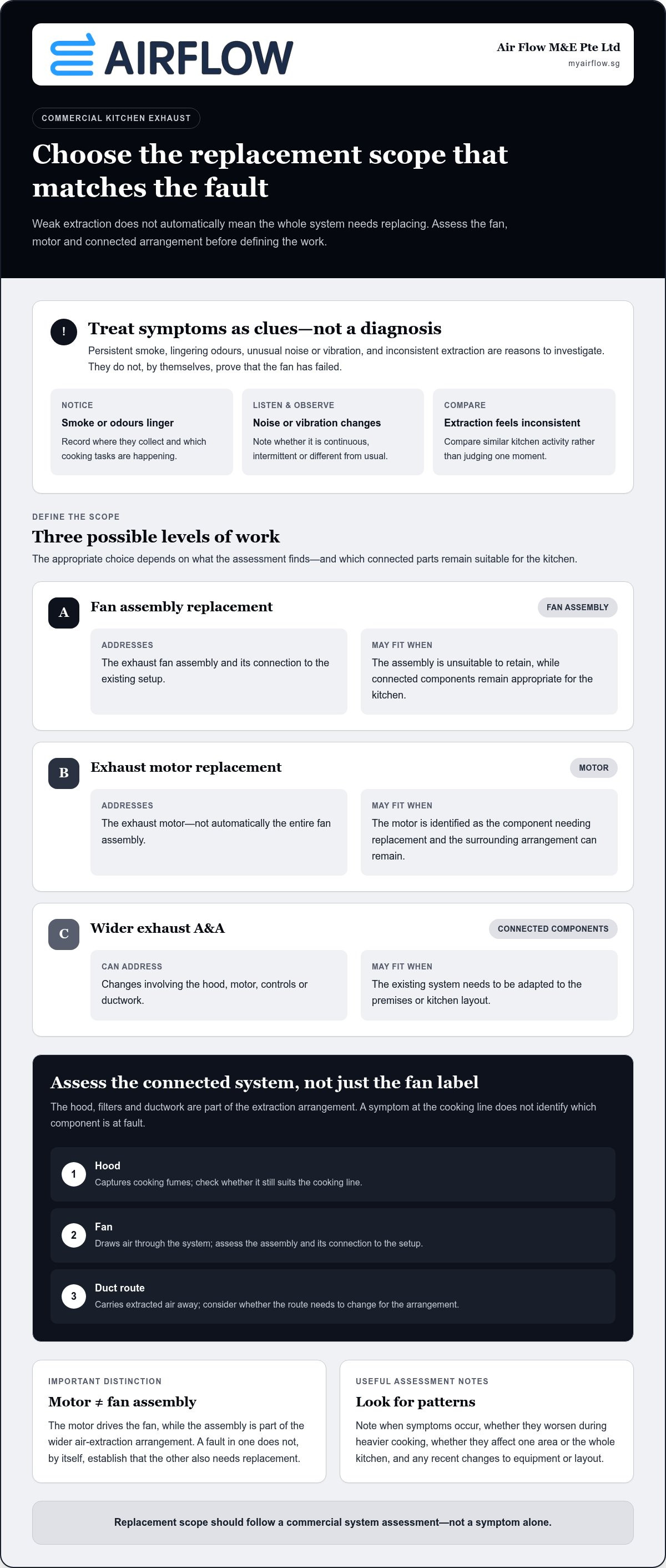
A noticeable drop in extraction is a reason to investigate. Persistent smoke around the cooking area, unusual operating noise, vibration or performance that varies from one service period to another can point to a fan or wider system issue. Treat them as warning signs, not a diagnosis.
- Smoke or odours linger: Record where they collect and whether this happens during particular cooking tasks.
- Noise or vibration changes: Note whether the sound is continuous, intermittent or different from the fan’s usual operation.
- Extraction feels inconsistent: Compare performance during similar kitchen activity instead of judging from a single moment.
The hood, filters and ductwork form part of the extraction arrangement, so symptoms at the cooking line don’t necessarily identify the faulty component. The overview of Kitchen Hoods and Exhaust Systems explains how hoods capture cooking fumes and work with exhaust components. In practice, consider the connected system before deciding what to replace.
Does a weak exhaust fan mean replacing the whole system?
Not necessarily. The cause of weak extraction and the condition of connected components determine the appropriate scope. The work may involve replacing the fan assembly, addressing the exhaust motor, or carrying out broader addition and alteration (A&A) work if other parts of the arrangement also need changes. A motor fault and a fan assembly issue are related, but they aren’t interchangeable descriptions of the same work.
Replacement scope should follow a commercial system assessment. Consider the reported symptoms alongside the hood and duct arrangement rather than treating every drop in extraction as proof that the whole system needs replacing. This distinction helps define a practical scope before work is planned.
For a broader change involving connected exhaust components, the commercial kitchen exhaust system replacement guide covers wider system scope. For commercial kitchen exhaust fan replacement Singapore, first establish what the signs indicate. A clear assessment helps separate a component-level replacement from a wider A&A project, so the proposed work can match the kitchen’s needs.
Fan, Motor or Full System: Define the Commercial Replacement Scope
Once an exhaust issue has been identified, the next decision is how much of the system needs attention. A fan assembly, its motor and the wider exhaust arrangement are connected, but they are not the same replacement scope. Distinguishing between them helps match the work to the problem instead of assuming every fault calls for a complete system change.
| Scope | What the work addresses | When it may fit |
|---|---|---|
| Fan replacement | The exhaust fan assembly and its connection to the existing setup | Assessment finds the assembly unsuitable to retain, while connected components remain appropriate for the kitchen |
| Motor replacement | The exhaust motor, rather than automatically the entire fan assembly | The motor is identified as the component requiring replacement and the surrounding arrangement can remain |
| Wider exhaust A&A | Changes involving connected components such as the hood, motor, controls or ductwork | The existing system needs to be adapted to the premises or kitchen layout |
A motor fault and a fan assembly issue are related, but not interchangeable. The motor drives the fan, while the assembly forms part of the wider air-extraction arrangement. Replacing one component doesn’t, by itself, establish that the other also needs replacement. For motor-specific considerations, see the commercial exhaust motor replacement guide.
When might the fan assembly need replacement?
Fan replacement becomes a consideration when an assessment finds the existing assembly unsuitable to retain. The decision should account for the current installation and how the kitchen operates, rather than rely on the fan’s label or a symptom alone. Without project details, there’s no sound basis for prescribing a particular capacity or specification. The aim is to define a suitable scope for the premises.
When is the work broader than the fan itself?
The hood captures cooking fumes, the fan draws air through the system, and the duct route carries extracted air away. Controls and the kitchen layout also influence how these elements work together. If the hood no longer suits the cooking line, or the ductwork needs to change to fit a revised arrangement, replacing only the fan may not address the wider requirement.
Commercial kitchen exhaust A&A can adapt connected parts to a premises layout. For example, a change to the position or arrangement of cooking equipment may call for adjustments to the hood or custom-fitted ductwork alongside exhaust motor installation. Hood-specific planning is covered in this commercial kitchen hood installation guide.
For commercial kitchen exhaust fan replacement Singapore, base the scope on the relationship between the fan, motor, hood and duct route. Air Flow M&E provides commercial exhaust installation and A&A work tailored to the kitchen layout. Explore commercial kitchen exhaust A&A and installation to plan the project scope.
How to Assess a Replacement Fan for a Singapore Commercial Kitchen
A replacement fan should suit the work the kitchen needs it to do and the system it will connect to. Before selecting equipment, gather information about the existing installation, cooking operations and premises layout. This gives the assessment a practical starting point and helps determine whether the change can stay focused on the fan or needs to include connected components.
Replacement compatibility depends on the whole exhaust path, from the hood and duct route to the fan and its connection.
What should the site assessment consider?
Build a clear picture of the current arrangement. Record what is known, note any changes to the kitchen, and identify practical constraints at the premises. These details help assess the proposed scope against the actual installation rather than a fan label alone.
- Existing fan configuration: Note its location, visible arrangement and connection to the exhaust ductwork.
- Hood arrangement: Describe which cooking areas the hood serves and whether the cooking line or equipment layout has changed.
- Kitchen use: Outline the type of cooking and the periods when extraction demand is most important to daily operations.
- Operating priorities: Identify practical concerns such as maintaining kitchen workflow and coordinating access for the work.
- Site access: Record how the installation area can be reached and whether space around the fan affects installation or future maintenance.
Photos of the fan, hood and visible duct route can help document the current setup. Pair them with a short description of when performance concerns occur. Photographs and labels are useful context, but they don’t replace an assessment of the connected system.
How do hood and ductwork affect fan replacement?
The fan doesn’t operate in isolation. The hood captures cooking fumes, while the ductwork forms the route through which extracted air travels. Their configuration affects what a replacement needs to connect to. A fan chosen from its label alone may not reflect the arrangement it must serve, so assess the hood and duct route alongside the existing fan.
Consider the full route through the premises. A change to the cooking line may alter the hood arrangement. Renovation or a revised layout may also change how ductwork connects to the exhaust fan. In such cases, custom-fitted ductwork can form part of a wider A&A scope instead of treating fan replacement as a standalone component swap.
The commercial kitchen ductwork guide explains duct-specific considerations. For commercial kitchen exhaust fan replacement Singapore, consider operating needs, existing equipment, access and the connected hood-and-duct arrangement to shape a scope that fits the commercial premises.
Plan Commercial Kitchen Exhaust Fan Replacement with Less Disruption
Replacement work is easier to coordinate when the scope, site access and kitchen schedule are considered together. A clear sequence helps the project team understand what needs to happen and gives F&B operators time to plan around affected work areas and service periods. For commercial kitchen exhaust fan replacement Singapore, base the plan on the premises and agreed scope, rather than assuming every project follows the same timetable.
What should happen before replacement work begins?
Start with a record of the symptoms, the operating conditions when they occur and relevant details of the existing installation. Use this information to frame a site assessment and define whether the work is fan-only or involves wider exhaust system A&A. Then coordinate access and timing with the project team around kitchen operations, including which areas may be affected and when they can be made available.
- Document the issue. Note when extraction concerns arise, what cooking activity is underway and whether the pattern changes during service. Include available details about the existing fan, hood and duct arrangement.
- Assess the premises. Review the installation, connected equipment, work area and practical access. This helps establish the project scope against the kitchen’s actual layout.
- Agree on the work boundary. Set out whether the project covers the fan alone or includes related motor, hood, controls or ductwork changes. A defined scope helps the operator understand which parts of the kitchen may be affected.
- Coordinate the schedule. Discuss suitable work timing, access arrangements and operational adjustments with the project team. For example, if access to the cooking line is needed, plan how kitchen tasks will be managed while that area is unavailable.
- Review project requirements. Regulatory and approval requirements depend on the work and site. Verify applicable requirements with the relevant official Singapore sources before work proceeds, rather than assuming one set of requirements applies to every replacement.
What should commissioning and handover cover?
After installation, review the completed connections and observe operating behaviour in the context of the agreed scope. The handover should explain what work was completed and provide relevant operating guidance. This gives the kitchen operator a practical reference as staff return to normal use and helps them understand the changes made to the exhaust arrangement.
Before closing out the work, align on who will review the system’s operation and how any observations will be communicated. Keep project information with the premises’ relevant maintenance records. Checks and documentation should reflect the actual installation and project requirements. Verify site-specific testing or approval requirements instead of assuming they apply.
A coordinated plan helps the kitchen team prepare for access, work timing and operational checks while keeping the technical scope clear. Discuss your commercial exhaust project with Air Flow M&E.
Commercial Kitchen Exhaust Fan Replacement with Air Flow M&E
A fan replacement is a practical M&E project, not just a matter of selecting a new component. Air Flow M&E provides commercial kitchen exhaust installation and addition and alteration (A&A) work in Singapore. The scope can be tailored to the assessed kitchen layout and may involve an exhaust motor, commercial kitchen hood or custom-fitted ductwork alongside the fan.
This approach keeps the proposed work relevant to the commercial premises. If only one component needs replacement, the scope can stay focused. If the existing arrangement also needs modification, the related work can be included in the project plan.
How can tailored A&A support a fan replacement?
A&A can address a fan replacement alongside relevant system modifications. For example, a revised cooking-line arrangement may affect the hood position or the duct route connecting it to the exhaust fan. Considering these components together helps align the work with the actual commercial kitchen, rather than treating the fan as an isolated item.
The appropriate scope depends on the assessed layout and exhaust requirements. Air Flow M&E provides commercial hoods, exhaust motor installation and custom-fitted ductwork as part of commercial exhaust work. For broader modification context, the kitchen ventilation A&A guide explains how changes can extend beyond a single component.
What information helps start a replacement discussion?
A concise project summary gives the team useful context about the kitchen and its current arrangement. Share what you know, even if you’re still unsure whether the issue is limited to the fan or involves connected equipment. Site details and photographs can help describe the existing setup and focus the discussion on next steps.
- Kitchen type and use: Describe the commercial F&B operation and the cooking areas served by the exhaust system.
- Current symptoms: Note what has changed and the operating conditions when it happens.
- Existing equipment: Include available details about the fan, exhaust motor and hood.
- Site context: Share photographs or layout information showing the equipment, access and visible duct route.
These details help frame the conversation, but they don’t predetermine the replacement scope. Air Flow M&E provides commercial kitchen exhaust A&A and installation tailored to the premises, with components and modifications selected to suit the project requirements. For commercial kitchen exhaust fan replacement Singapore, the aim is a defined scope that fits the kitchen, not a fixed solution applied to every site.
Plan your commercial kitchen exhaust replacement.
Set the Scope for Your Next Kitchen Upgrade
Use the assessment as a starting point for a clear project brief. Note what the kitchen needs to maintain, any planned layout changes and practical constraints that may shape access or scheduling. This keeps decisions grounded in how the premises operate, rather than defaulting to a like-for-like component swap. For commercial kitchen exhaust fan replacement Singapore, a well-defined scope also gives your team a clearer basis for coordinating the work with other kitchen plans.
Air Flow M&E provides commercial kitchen exhaust A&A and installation for projects that need a considered, site-specific approach. The scope can bring together a commercial hood, exhaust motor and custom-fitted ductwork where the project requires them. Each element is considered in relation to the commercial kitchen layout and operational needs.
Start with the details you have, including the kitchen’s current setup and the changes you’re planning. Discuss your commercial kitchen exhaust fan replacement with Air Flow M&E and take the next step towards a clearly scoped project.
Frequently Asked Questions
How do I know if a commercial kitchen exhaust fan needs replacing?
A persistent change in extraction, recurring smoke around cooking areas, unusual noise or vibration warrants investigation, but none proves the fan must be replaced. Compare performance during similar cooking tasks and note whether the issue affects one station or the whole kitchen. Also record any recent changes to equipment or layout. This information helps distinguish a fan concern from an issue elsewhere in the connected system.
Can I replace a kitchen exhaust fan without replacing the ductwork?
Yes, a fan can be replaced while retaining the ductwork if the existing duct arrangement is suitable for the proposed work. The assessment should consider its connection to the fan and whether the kitchen layout or equipment has changed. For example, a moved cooking line may affect the route or hood connection even if the ductwork appears intact. The replacement scope should reflect the actual installation, not an assumption that every component must change.
Is a commercial exhaust fan replacement the same as replacing its motor?
No. The motor is a component that drives the fan, while fan replacement refers to work on the fan assembly. A motor-only replacement may be appropriate when the assessment identifies the motor as the issue and the rest of the assembly remains suitable. If the fan assembly itself is unsuitable to retain, replacing only the motor may not address the requirement. The project scope depends on which component needs work.
How much does commercial kitchen exhaust fan replacement cost in Singapore?
There isn’t one fixed price for commercial kitchen exhaust fan replacement in Singapore. The project scope can differ depending on whether the work involves the fan alone or includes the motor, hood, ductwork or other system modifications. Site access and the existing installation also affect what needs to be planned. A useful project brief includes the kitchen layout, equipment details and the work being considered, rather than relying on a generic estimate.
How long does it take to replace a commercial kitchen exhaust fan?
The duration depends on the site and the agreed work scope, so it can’t be stated accurately without project details. A straightforward component replacement may involve different work from a project that also changes the hood or duct route. Access to the installation area and coordination with kitchen operations also matter. Include the premises’ operating constraints in the project plan so timing reflects the work required.
What happens if the kitchen exhaust fan is not extracting smoke effectively?
Smoke may linger around the cooking area, making it harder for staff to work comfortably and see their immediate workspace clearly. Don’t assume that the fan is the only possible cause. Note when the problem occurs, which cooking stations are affected and whether extraction changes with kitchen activity. This record gives an assessment useful context and helps identify whether the issue is local to an area or affects the wider exhaust arrangement.
Do commercial kitchen exhaust fan replacement works in Singapore need approval?
Approval requirements depend on the project scope and the premises, so there isn’t a universal yes-or-no answer for every replacement. A like-for-like component change may raise different considerations from work that alters the wider exhaust arrangement or building systems. Before work proceeds, verify applicable requirements with the relevant official Singapore authorities for the specific project. Don’t rely on assumptions based solely on how similar work was handled at another premises.


