

A more restrictive filter isn’t automatically the better choice for a commercial kitchen. The right kitchen grease filtration system in Singapore must capture grease effectively while working with the hood, exhaust motor and ductwork. If the filtration stages are poorly matched to the exhaust setup, airflow and day-to-day kitchen performance can suffer.
Before planning an installation, clarify what each filter stage is meant to do, what it can capture and how it may affect extraction. Filtration helps limit grease entering the exhaust duct, but it doesn’t remove the need for suitable system design and regular cleaning. The filter is one part of a larger arrangement.
This guide explains the role and limits of common grease filtration stages, the project details that shape system selection, and how to plan filtration alongside a commercial hood, motor and custom-fitted ductwork. It also covers maintenance and compliance planning in Singapore. Considering the full exhaust route helps F&B operators make informed decisions about a coordinated commercial kitchen exhaust project.
Key Takeaways
- Match filtration choices to cooking equipment, operating intensity, hood layout and the wider exhaust arrangement.
- Consider how filter form and placement affect the path of cooking exhaust, and assess airflow alongside capture.
- Gather the details needed to assess a kitchen grease filtration system Singapore project before selecting a filter type.
- Plan site information, system design and cleaning around the kitchen’s actual use and observed grease build-up.
- Coordinate filtration planning with the commercial hood, exhaust motor and ductwork as part of the wider exhaust project.
What a commercial kitchen grease filtration system does
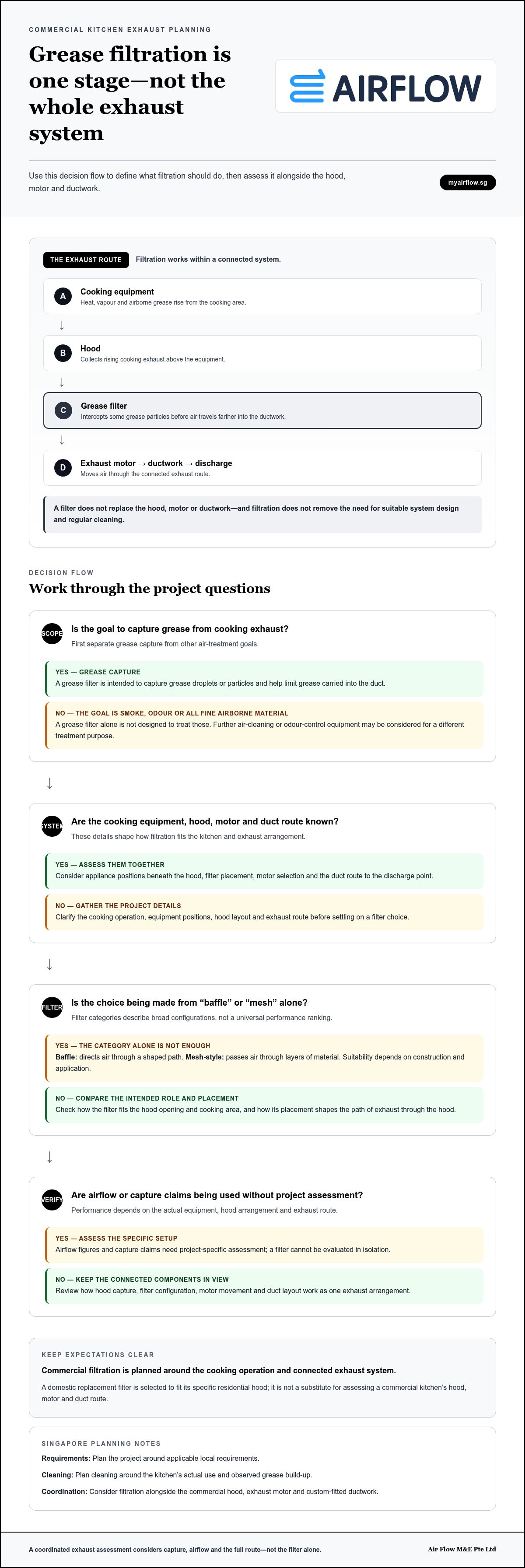
In a commercial kitchen, grease filtration is one stage in the exhaust system. It captures some grease particles carried in cooking exhaust before that air travels farther through the ductwork. The filter works with the hood that collects rising fumes and the exhaust motor that moves air through the system. It isn’t a standalone solution: its role depends on how the full arrangement is designed for the kitchen.
In brief: A grease filter captures grease from cooking exhaust. By itself, it does not treat smoke, odour or every airborne contaminant.
Where grease filtration sits in a commercial exhaust system
The general route starts at the cooking equipment. The hood captures rising heat, vapour and airborne grease, which pass through a filter before continuing into the ductwork and towards the exhaust discharge. The filter helps intercept grease before it travels farther into the system, but it doesn’t replace the hood, motor or ductwork.
The exact arrangement depends on the kitchen layout and equipment. Appliances may sit beneath different hood configurations, and the exhaust route varies by site. That’s why a kitchen grease filtration system Singapore project should be considered alongside the whole exhaust setup, rather than as a filter choice in isolation. The overview of Kitchen ventilation systems and grease filters provides broader context on how ventilation components work together.
Grease filters, air cleaners, and odour control are different
Grease filters are intended to capture grease droplets or particles from the airstream. They help limit grease carried into the duct, where deposits can build up, but their performance depends on the filter and the operating system. Don’t assume they remove visible smoke, cooking smells or all fine airborne material.
Further air-cleaning or odour-control equipment has a different purpose. It may be considered when a project needs treatment beyond grease capture, but it doesn’t change what the grease filter is designed to do. Separating these functions helps operators set realistic expectations and plan each stage for its intended role. For related equipment context, see the Singapore kitchen exhaust air cleaner guide.
Domestic replacement filters serve a narrower purpose: they replace the filter component in a residential hood. A commercial kitchen exhaust system must account for the cooking operation and the connected hood, motor and duct route. The distinction isn’t that one type of filter is universally better. Commercial filtration needs to be planned as part of a larger air-management arrangement, while a domestic replacement filter is selected to fit its specific hood.
How commercial grease filters work with airflow and exhaust components
A grease filter changes how cooking exhaust moves through a hood. Its shape, position and construction guide air through or around filter surfaces, where some grease particles can be intercepted. The filter must work with the hood’s ability to capture rising exhaust and the system’s ability to move it along the duct route. Choosing a filter without considering those connected components leaves important design questions unanswered.
Filter configuration and grease capture
Baffle and mesh-style filters are two broad categories, not universal recommendations. Baffle designs direct air through a shaped path, while mesh-style designs pass air through layers of material. How either handles grease-laden exhaust depends on its construction and application. The category alone does not establish capture performance or suitability for a particular kitchen.
Placement also affects the route exhaust takes as it enters the hood and passes through the filter. The filter needs to fit a configuration that works with the hood opening and the cooking area below it. For commercial projects, compare the filter’s intended role with the hood layout and operating conditions. NFPA 96 Standards for Commercial Kitchens offers a reference on commercial kitchen ventilation and fire protection. Singapore projects must also be planned around applicable local requirements.
Why the hood, motor, and ductwork matter
The hood’s position relative to the cooking equipment affects how it collects rising heat, vapour and grease-laden air. For example, a hood serving a line of appliances should be considered in relation to appliance positions and the way the kitchen operates. Filter choice is only one part of that capture arrangement.
The exhaust motor moves air through the hood, filter and ductwork. The duct route through the premises is part of the same design discussion. A filter, hood, motor or duct route can’t be evaluated in isolation, because each component contributes to how the system operates.
Airflow figures and claims about capture or system performance need project-specific assessment. They depend on the actual equipment, hood arrangement and exhaust route. A useful design review considers:
- Cooking equipment and its position beneath the hood.
- Filter configuration and placement within the hood.
- Motor selection in relation to the complete exhaust system.
- Ductwork layout and the route to the discharge point.
For additional context on how hood configuration relates to cooking equipment, the commercial kitchen hood guide for Singapore F&B can help frame the planning discussion. A kitchen grease filtration system Singapore project is best assessed as part of a coordinated commercial exhaust design, with the hood, motor and custom-fitted ductwork planned together. Air Flow M&E’s commercial kitchen exhaust planning brings those components into the wider project conversation.
How to assess a grease filtration system for your commercial kitchen
Start with the cooking operation, not a filter’s material, appearance or label. Different appliances and operating patterns can place different demands on an exhaust arrangement. Consider filter selection alongside the hood dimensions, equipment positions, motor and duct route. A component that looks suitable on its own may not suit the complete installation.
System suitability depends on the cooking process and the complete exhaust design. Use the points below to organise the assessment. They identify what needs review rather than treating a filter category as a ready-made answer.
Match filtration to cooking activity and kitchen layout
Record the cooking processes and appliances beneath the hood, then note how often and how intensely the kitchen operates. Compare that information with the hood’s dimensions and the position of each appliance. A change to the menu, equipment placement or operating pattern can alter the conditions the exhaust system must handle, so review filtration in that context.
Use this table as a starting framework, not a product recommendation. The filter form alone doesn’t establish performance or suitability.
| Filter form | Practical role | Information needed before selection |
|---|---|---|
| Baffle-style | Uses shaped passages to direct exhaust through the filter area as grease particles are intercepted. | Cooking processes, hood dimensions, filter placement and the wider exhaust arrangement. |
| Mesh-style | Uses a mesh structure through which cooking exhaust passes. Its application depends on construction and system design. | Equipment beneath the hood, operating pattern, airflow considerations and compatibility with the hood layout. |
Two filters made from similar-looking materials can still differ in construction and application. Don’t choose by appearance alone or assume one form suits every commercial kitchen. Treat the table as a prompt for project review, then assess the filter together with the hood, exhaust motor and ductwork.
Questions the project design should resolve
Before making decisions, gather a clear picture of both the cooking operation and the existing system. This information gives the design process a useful starting point and helps identify issues that need investigation.
- What food is prepared, which cooking equipment is used, and when does the kitchen operate?
- Where are the appliances positioned, and what are the hood’s dimensions and layout?
- What hood, exhaust motor and duct route are already in place?
- Are there known airflow concerns, planned kitchen layout changes or menu changes?
- Which project requirements and applicable Singapore rules need qualified verification?
For a new installation or alteration, these details help frame a coordinated exhaust design rather than a filter-only decision. Air Flow M&E plans commercial kitchen exhaust A&A work around project requirements, including kitchen hood and exhaust motor installation and custom-fitted ductwork. Resolve the kitchen grease filtration system Singapore selection as part of that wider design discussion.
Plan installation, cleaning, and compliance checks in Singapore
A commercial exhaust project is easier to plan when site details, design decisions and maintenance needs are considered together. Use a clear sequence to prepare for installation or alteration, then build a cleaning routine around the way the kitchen operates. Keep general maintenance practice separate from legal or inspection obligations, which should be checked against current Singapore requirements.
Prepare for a commercial exhaust project
A site-specific review helps align filtration planning with the hood, motor and ductwork. Before design begins, document the cooking operation and existing arrangement. Note practical site constraints too, such as access limitations or operating periods that could affect installation planning.
- Record the kitchen operation. List the cooking processes, equipment, expected operating patterns and any planned menu or equipment changes.
- Map the current layout. Note appliance positions, hood location and dimensions, the exhaust motor, and the duct route through the premises.
- Describe known issues. Record airflow concerns, visible grease build-up, access challenges and any changes already made to the exhaust system.
- Review the proposed arrangement. Consider how the hood, motor, ductwork and filtration fit the kitchen layout and intended use.
- Plan commissioning and handover. Document the completed arrangement and establish who will monitor its condition and maintain records.
For a new installation or alteration, this information gives the project team a practical basis for coordinating the exhaust components. Air Flow M&E provides commercial kitchen exhaust A&A services, including hood and motor installation and custom-fitted ductwork. The F&B kitchen exhaust requirements guide also offers related Singapore context for project planning.
Set a practical cleaning and compliance routine
Commercial cleaning intervals should reflect the cooking equipment, intensity of use and grease build-up observed during inspections. A kitchen running frequent frying or grilling may need closer monitoring than one with a different operating profile. Don’t apply a domestic filter-cleaning schedule as a universal rule for a commercial exhaust system.
Set routine checks for accessible filters and visible areas of the hood and exhaust system. Record inspection dates, observations, cleaning completed and any issues that need follow-up. A consistent log helps teams spot changes over time and plan maintenance.
Keep legal duties distinct from routine guidance. Suggested day-to-day cleaning intervals are not a substitute for exact regulatory requirements. Before setting a compliance schedule, verify current rules and inspection expectations with relevant official Singapore sources, including SCDF and SFA guidance. Confirm which requirements apply to the premises and system, and retain the records required for the operation.
For project-specific coordination of a commercial hood, exhaust motor and ductwork, plan your commercial kitchen exhaust project with Air Flow M&E.
Coordinate commercial grease filtration with Air Flow M&E
Grease filtration planning is most useful when considered alongside the commercial kitchen exhaust arrangement. Air Flow M&E provides commercial kitchen exhaust addition and alteration (A&A) services, including kitchen hood installation, exhaust motor installation and custom-fitted ductwork. These components can be planned together around the premises, cooking operation and intended layout, so filtration is considered in context rather than as an isolated purchase.
This is especially relevant for Singapore F&B businesses fitting out a new kitchen or changing an existing one. The project scope depends on what is changing and how the exhaust system is arranged. A coordinated review can help identify which parts of the hood, motor and ductwork need consideration as the design develops.
When exhaust A&A may be part of the project
Changes to cooking equipment, appliance positions or kitchen layout can affect how the exhaust arrangement needs to be reviewed. For example, adding equipment beneath a hood or reorganising a cooking line may prompt a closer look at hood coverage and the existing motor and duct route. The kitchen ventilation A&A guide for Singapore F&B provides more context on planning alterations for commercial food-service premises.
Air Flow M&E’s commercial exhaust A&A work connects project requirements with the relevant installation scope. A new hood, motor or custom-fitted ductwork may form part of a coordinated project, depending on the site and planned changes. Consider filtration as part of the wider exhaust design, alongside the components being installed or altered.
What to prepare before discussing your project
Useful project details make it easier to describe the kitchen’s needs and existing conditions. Before starting a discussion, gather:
- The cooking processes, equipment types and planned operating patterns.
- A layout or sketch showing appliance positions and the hood location.
- Available details about the existing hood, exhaust motor and duct route.
- Known airflow concerns, access constraints or other site considerations.
- The intended changes, such as a new fit-out, equipment addition or kitchen alteration.
These details help frame a project-specific conversation about the commercial exhaust arrangement. They also give the team a clearer basis for considering how hood, motor and ductwork planning can support the kitchen’s layout and operations. If you’re planning a kitchen grease filtration system Singapore project, include filtration in the broader discussion so it can be considered alongside the exhaust design.
For a commercial kitchen fit-out or alteration, discuss your commercial kitchen exhaust project with Air Flow M&E.
Make filtration part of your next exhaust decision
Before finalising a kitchen layout or changing cooking equipment, treat filtration as a design consideration, not a last-minute add-on. A well-planned kitchen grease filtration system Singapore project starts with the way your commercial kitchen operates and the exhaust arrangement it needs. Reviewing those details early helps you make informed decisions as the project takes shape.
Air Flow M&E supports commercial kitchen exhaust A&A projects, with hood and motor installation and custom-fitted ductwork planned around commercial kitchen layouts. Bring your equipment details, current setup and intended changes into the discussion. These practical inputs give the project a clearer starting point.
Ready to plan the next step? Discuss your commercial kitchen exhaust project with Air Flow M&E.
Frequently Asked Questions
What is a kitchen grease filtration system?
A kitchen grease filtration system captures some grease carried in cooking exhaust before the air continues through the exhaust arrangement. In a commercial kitchen, assess it alongside the hood, motor and ductwork, not as an isolated component. For a kitchen grease filtration system Singapore project, distinguish grease capture from odour control or broader air cleaning, which may require different equipment and design considerations.
How does a commercial kitchen grease filter work?
A commercial grease filter sits within or at the hood. As cooking exhaust passes through, the filter is intended to intercept some grease particles. Its function depends on the filter configuration and the kitchen’s airflow and layout. For example, equipment placed differently beneath the hood can change the arrangement that needs assessment. Don’t assume a filter alone captures all grease or removes all smoke and odour.
Are grease filters and kitchen air cleaners the same thing?
No. A grease filter is intended to capture grease from cooking exhaust. An air cleaner may address additional treatment objectives, depending on its design and the system it serves. The terms shouldn’t be used interchangeably. If a kitchen has concerns beyond grease, such as persistent cooking odour, assess that need separately and review technical documentation for the equipment’s stated purpose and performance.
How often should a commercial kitchen grease filter be cleaned?
There isn’t one cleaning interval that suits every commercial kitchen. The appropriate routine depends on the cooking methods, operating hours, grease accumulation and filter arrangement. Inspect filters regularly, note visible build-up and record cleaning so the schedule can respond to actual conditions. Don’t use a domestic filter’s washing guidance as a universal commercial rule. Follow applicable manufacturer instructions and verify current Singapore requirements with official sources.
Can a grease filter affect kitchen exhaust airflow?
Yes. A filter is part of the exhaust path, so its configuration and condition should be considered in airflow planning. The actual effect depends on system details and shouldn’t be assumed without relevant data. If extraction seems different after a kitchen change or maintenance issue, review the complete arrangement, including hood, motor, filter and ductwork, rather than treating airflow as a filter-only concern.
How do I choose a grease filtration system for a commercial kitchen in Singapore?
Start by documenting the cooking equipment, processes and operating patterns, then note the hood layout and existing exhaust arrangement. These details help frame a project-specific assessment of filtration alongside the motor and ductwork. For example, planned appliance changes may affect the system review. Verify applicable Singapore requirements against current official sources instead of relying on generic product descriptions or assumptions about a filter type.
Does a grease filtration system remove cooking odours?
Not necessarily. A grease filter’s primary role is grease capture, so don’t assume it provides complete odour control or removes smoke. Odour treatment may involve other equipment and needs to be considered in the context of the wider exhaust design. If cooking smells are a concern, describe when and where they occur and assess that objective separately from grease filtration.


