

A powerful exhaust fan can still leave a kitchen ventilation system out of balance. Correcting kitchen ventilation compliance issues starts with checking whether the canopy captures cooking fumes, grease buildup is restricting airflow, make-up air can replace extracted air, and the fan is performing as intended. In Singapore, occupied-space ACMV systems should provide at least the outdoor-air supply rates specified in Singapore Standard SS553:2026.
When ventilation problems persist, the cause may be more than a weak fan. Canopy coverage, dirty filters or ducts, and poorly balanced replacement air can all affect how effectively smoke and fumes are captured and removed.
This article explains what to inspect across the canopy, grease-laden exhaust path, make-up air supply, and exhaust fan. You’ll learn how these components work together, which warning signs may indicate an underlying issue, and when alterations to the system may be needed to address correcting kitchen ventilation compliance issues.
Key Takeaways
- Canopy coverage and airflow work together to capture cooking fumes; poor capture can point to a fit or system-balance issue.
- Grease on filters and inside ducts can restrict airflow, so cleaning needs to reflect how heavily the kitchen is used.
- Make-up air helps replace extracted air and maintain pressure balance; its direction and volume can affect canopy performance.
- Fan, motor, and ductwork problems may call for targeted alterations, including a commercial exhaust motor installation or custom-fitted ductwork.
Canopy and ceiling ventilation systems
Start an inspection at the canopy: it should cover cooking appliances and extend beyond their edges to capture rising heat, smoke, and grease. A commonly cited layout uses at least 300 mm of overhang at the front and open sides. Specialist appliances, such as steamers and combination ovens, may need a 600 mm overhang. These are practical design checks, not a substitute for confirming the requirements that apply to a specific Singapore premises.
How do you identify common kitchen ventilation compliance issues? Look for cooking fumes escaping the canopy, uneven capture across the cooking line, grease around filters, or air currents pushing smoke away. Then inspect the canopy coverage, filters, duct path, exhaust fan, and make-up air as one ventilation system. Singapore’s SS553:2026 specifies minimum outdoor-air supply rates for ACMV systems in occupied spaces, so airflow balance matters beyond the hood itself.
Ceiling diffusers can disrupt capture if they blow across the canopy or cooking surface. An unbalanced HVAC system may also create pressure differences that draw fumes into dining or adjoining areas. During a mechanical inspection, assess how supply air, exhaust, and room pressure interact while the kitchen is operating. Adjusting diffuser direction or correcting system balance may resolve capture problems without changing the canopy.
Fire suppression equipment must work with the hood layout. Keep appliance positions and canopy coverage aligned with the suppression system so protected cooking areas remain within its intended coverage. Commercial kitchen fire suppression systems are commonly serviced every six months. Coordinate this service with a canopy inspection so grease deposits, access, and system condition can be reviewed together.
Who can inspect and certify a kitchen ventilation system in Singapore? A mechanical ventilation professional can inspect canopy capture, airflow, fans, and ductwork. Certification depends on the specific approval required. Include any gas interlock in the inspection of ventilation and gas-appliance controls, so its operation is considered alongside the exhaust system. Record findings and identify whether the issue calls for adjustment, repair, or installation changes.
Grease buildup and fire risk
Grease travels from cooking surfaces into filters, the canopy plenum, and exhaust ductwork. As residue accumulates, it narrows the air path and increases resistance. The exhaust fan then moves less air, even if its motor still runs. Reduced airflow can allow smoke and fumes to escape capture, while combustible deposits inside ducts add fire risk. A clean-looking canopy does not prove that the full exhaust route is free from grease.
Cleaning frequency depends on cooking volume, menu, and operating intensity. TR/19 recommends cleaning commercial kitchen ducts every 3 to 12 months, depending on cooking volume. High-volume frying or grilling can load filters and ducts faster than lighter cooking. Inspect filters, duct access points, and fan areas for sticky deposits, pooling grease, or restricted passages. If cleaning no longer restores airflow, the underlying duct condition or system design may also need attention.
Grease control starts where cooking vapour enters the ventilation system. Filters capture larger droplets, but they need regular cleaning and correct seating. Some systems use centrifugal separation: airflow spins grease-laden air, causing heavier particles to separate and drain. This can reduce the amount of grease entering downstream ductwork, but it does not remove the need to inspect and clean the rest of the exhaust path.
During a maintenance inspection, assess the whole route, not just the removable filters. Check the canopy, duct joints, bends, access points, and fan for deposits or signs of leakage. Document the areas cleaned and any sections that remain difficult to reach. Adequate access supports thorough cleaning, while a poorly fitted or damaged duct section can collect residue and undermine airflow.
If recurring deposits point to an awkward duct route, a redesigned layout may help address access and airflow together. Custom-fitted ductwork can be considered when the existing arrangement does not suit the kitchen or its exhaust path. Pair any alteration with a cleaning plan based on cooking volume, so grease accumulation is managed before it restricts ventilation performance.
Make-up air and pressure balance
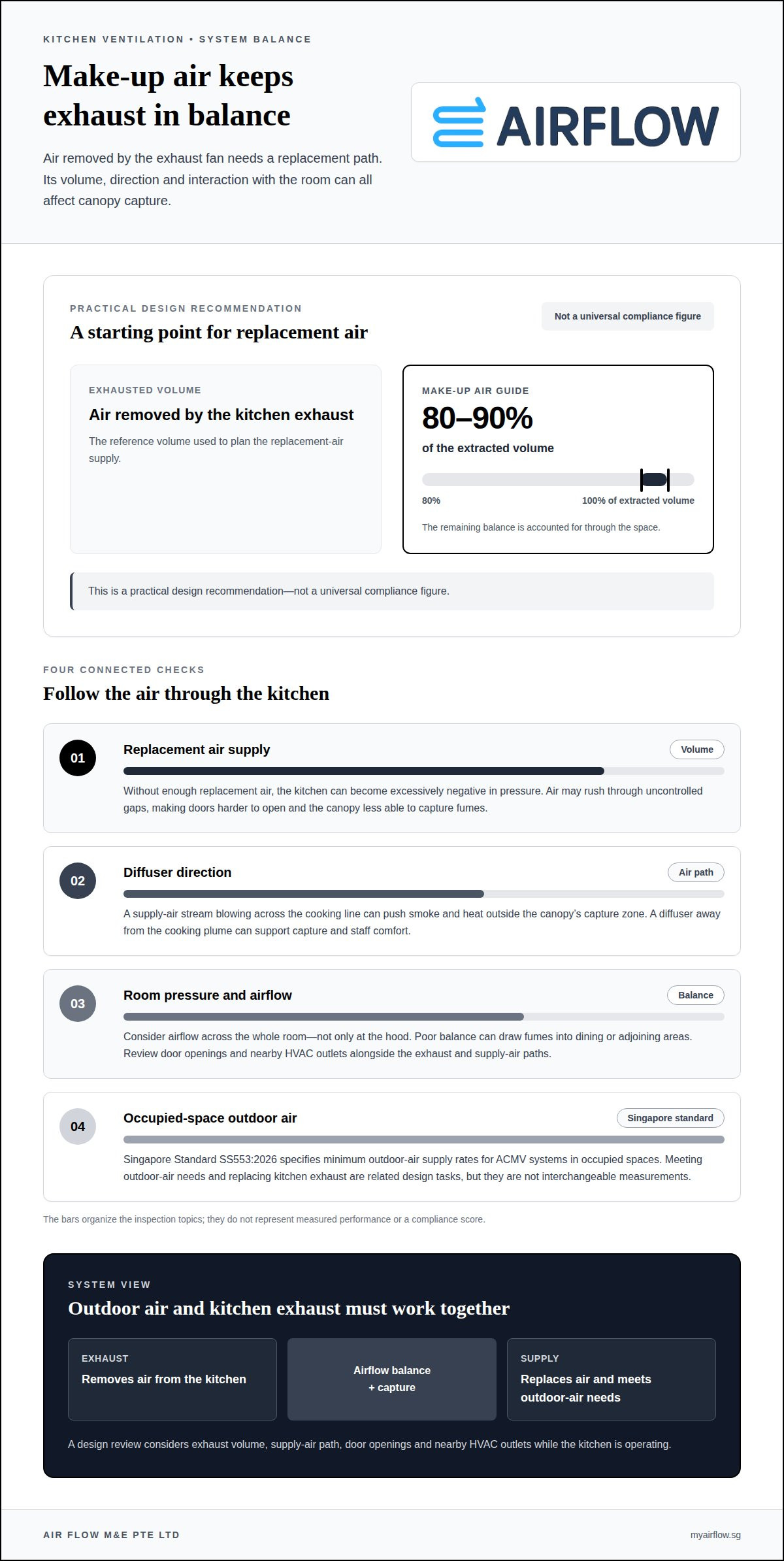
An exhaust fan removes air, so kitchen ventilation systems need replacement air to maintain airflow. Without it, the kitchen can become excessively negative in pressure. Doors may become harder to open, and the canopy may struggle to capture fumes as air rushes through uncontrolled gaps. A practical design recommendation is to supply make-up air at around 80–90% of the extracted volume, then account for the remaining balance through the space. This is a design guide, not a universal compliance figure.
Position matters. If a supply-air diffuser blows directly across a cooking line, its air stream can push smoke and heat outside the canopy’s capture zone. A diffuser placed away from the cooking plume can help preserve capture while supporting staff comfort. Consider airflow across the room, not just at the hood. Poor balance can also affect air quality in adjoining dining areas.
In Singapore, SS553:2026 specifies minimum outdoor-air supply rates for ACMV systems in occupied spaces. Meeting outdoor-air needs and replacing kitchen exhaust are related design tasks, but they are not interchangeable measurements. The system must deliver the required outdoor air while allowing the canopy to capture cooking emissions. A design review should consider the kitchen’s exhaust volume, supply-air path, door openings, and the position of nearby HVAC outlets.
HVAC testing, adjusting, and balancing helps identify where actual airflow differs from intended operation. A professional assessment can measure canopy capture velocity and system static pressure, then compare supply and exhaust performance under operating conditions. If the fan extracts more air than the room can replace, balancing may involve changing fan speed, adjusting supply outlets, or modifying the system arrangement. Variable frequency drives can help tune exhaust fan speed to changing cooking demand.
After adjustment, reassess capture at the cooking line and check for drafts around workstations. SS554:2026 provides Singapore’s code of practice for indoor air quality in air-conditioned buildings. Considering both airflow balance and indoor air quality helps distinguish a hood problem from a wider HVAC issue. This measured approach supports comfort and operational performance without treating one airflow ratio as suitable for every kitchen.
Exhaust fans and kitchen ventilation
In a commercial kitchen, the exhaust fan moves contaminated air through the canopy and ductwork to discharge. Its condition and airflow affect whether the whole system removes cooking fumes effectively.
Exhaust Fans in Kitchen Ventilation
An exhaust fan creates the airflow that carries heat, smoke, and grease-laden air out of the kitchen. A running motor alone doesn’t show that extraction is adequate: clogged filters, a slipping belt, or a damaged fan can reduce performance. Fan capacity must suit the appliances and cooking style. A medium commercial kitchen extractor may have an airflow rate of 2,000–5,000 m³/h, but that range isn’t a universal target; design specialists such as commercialcanopyfanpro.co.uk illustrate how canopy dimensions and fan performance must be balanced to suit specific catering demands.
Assess performance while the kitchen is operating. Inspect fan blades, belts, bearings, and motor function; quarterly checks can identify wear before it disrupts extraction. Clean filters weekly, depending on cooking intensity, and keep maintenance records. These checks help distinguish a fan fault from resistance elsewhere in the exhaust route.
Consequences of Ventilation Non-Compliance
There is no single penalty that applies to every ventilation defect in Singapore. Practical consequences depend on the finding and any applicable approval conditions. A fault may require corrective work and disrupt kitchen operations while the system is addressed. Poorly maintained equipment can also create safety concerns, so treat reduced extraction, persistent smoke, or a failed fan as issues requiring prompt attention.
Insurance reviews may require evidence of maintenance, and accurate ventilation records can support insurance and safety compliance. Keep dated inspection and repair details, including fan checks and cleaning work. Records make it easier to show what was maintained and when, rather than relying on memory after an incident.
If the fan runs but extraction remains poor, a system assessment can help locate the cause. Arrange a kitchen exhaust system assessment to identify whether fan performance or another part of the exhaust path needs attention.
Air Flow M&E Pte
Air Flow M&E Pte Ltd can address commercial kitchen ventilation issues when inspection points to equipment, layout, or system alterations. The right fix depends on where performance falls short: poor canopy capture may call for a hood solution, while a failing motor or unsuitable duct route may require different work.
Its commercial services include kitchen hood installation, exhaust motor installation, custom-fitted ductwork, and commercial kitchen exhaust system additions and alterations. These options support targeted changes to the exhaust path rather than treating every airflow problem as a fan fault. Clear inspection findings help define the work needed and keep proposed changes focused on the issue affecting the kitchen.
If your commercial kitchen needs ventilation system work, contact Air Flow M&E Pte Ltd to discuss the problem and possible next steps.
Plan the Next Ventilation Improvement
Use inspection findings to define a practical next step. A clear scope helps distinguish adjustments from equipment or layout changes, so work can focus on the issue affecting your kitchen. This is a useful starting point for correcting kitchen ventilation compliance issues without treating every fault as a reason to replace the entire system.
Air Flow M&E Pte Ltd supports commercial kitchen changes through Commercial Kitchen Exhaust System Addition & Alteration (A&A) Services, Commercial Kitchen Hood Installation, and Commercial Exhaust Motor Installation. The suitable work depends on the findings and the changes needed to address them.
Bring the ventilation concern and relevant inspection findings into the discussion. Contact Air Flow M&E Pte Ltd for help with planning the next step. A focused conversation can help you move forward with greater clarity and keep your kitchen operating with care.
Frequently Asked Questions
Need Help with Your Kitchen Ventilation?
Yes. If smoke escapes during service, odours linger, or staff notice drafts, record when the issue occurs and which appliances are running. Those details can help distinguish a local capture problem from a broader system fault. When correcting kitchen ventilation compliance issues, start with the specific symptom and its operating conditions rather than assuming the exhaust fan alone is responsible.
What Are the Commercial Kitchen Extraction Regulations?
Commercial kitchen extraction requirements in Singapore depend on the premises, approved building plans, fire-safety provisions, and ventilation design. There is no single airflow figure that applies to every kitchen. The cooking appliances, menu, canopy arrangement, and exhaust route all affect system design. Treat overseas standards as references only, not as automatic substitutes for requirements that apply to a Singapore project.
What ventilation rules apply to commercial kitchens in Singapore under SCDF and NEA regulations?
SCDF fire-safety provisions and NEA requirements may be relevant to a commercial kitchen, but applicable conditions depend on the premises and system arrangement. Assess a proposed change to a hood, duct route, or exhaust discharge against the project’s applicable approvals. Keep design and maintenance records together so system changes and completed work can be understood during later reviews.
What are the required exhaust hood, duct, and fan specifications for a commercial kitchen in Singapore?
Specifications depend on appliance heat load, cooking method, canopy coverage, duct route, and the fan performance needed to capture and remove fumes. For example, a grill line and a steamer can produce different plume patterns, so one hood configuration may not suit both. Design the hood, ductwork, and fan as a connected system, not as unrelated equipment selections.
Does a kitchen exhaust system need to discharge above the roof or meet minimum separation distances in Singapore?
Determine discharge location and separation from the applicable Singapore project requirements and building conditions. The outlet’s direction, nearby air intakes, openings, and surrounding structures all affect where exhaust can be released. Avoid applying roof-height or separation figures from overseas codes as though they automatically govern locally. The approved design and site layout are the practical reference points.
What fire-safety requirements apply to kitchen exhaust ducts, grease filters, and dampers in Singapore?
Fire-safety provisions depend on the approved design and the relationship between cooking equipment, grease filters, exhaust ducts, and fire-suppression coverage. Grease filters need to capture residue without obstructing the exhaust path, while ducts must suit the required fire-safety design. Damper suitability also depends on the system arrangement. Review these components together when planning changes, rather than treating each as an isolated part.


