

A hood can be running and still fail to clear smoke. When smoke is not clearing from a commercial kitchen, the cause may be restricted airflow, grease build-up, an extraction fan problem or insufficient replacement air. In Singapore, kitchen fumes from cooking ranges must be treated by an air-cleaning system, with no visible smoke or fumes exhausting, under clause 3.3(a) of COPEH 2025.
It’s easy to suspect the hood when smoke hangs over the cooking line. But the hood, filters, fan and ductwork operate as one system, so a blockage or airflow imbalance elsewhere can affect the whole kitchen.
This article explains how exhaust air moves through the hood and ducts, why smoke can linger, and how high-heat cooking challenges extraction. It also covers cleaning in Singapore, common airflow problems and signs that the system’s layout or components need attention.
Key Takeaways
- Trace smoke movement from the hood filters through the plenum and ducts to the fan; grease build-up along this path can restrict extraction.
- A fan can run while extracting poorly, including when a three-phase connection makes a centrifugal fan rotate backwards.
- High-heat cooking puts greater demands on hood capture and airflow balance, so ventilation design must account for cooking equipment and make-up air.
- In Singapore, the SCDF Fire Code 2023 requires specialist degreasing and cleaning of the entire kitchen exhaust duct and hood at least once every 12 months, with records kept.
How Does Ductwork Transport Smoke Out of the Building?
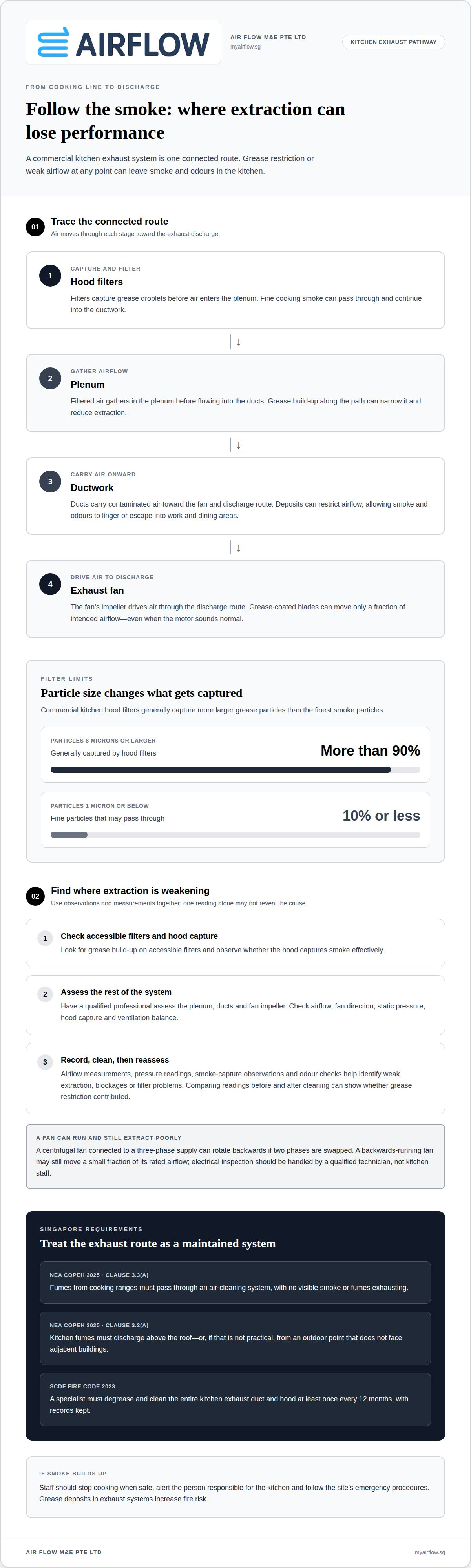
A commercial kitchen exhaust system moves contaminated air along a connected route through the hood filters, plenum, ductwork and exhaust fan. Filters capture grease droplets before air enters the plenum, where it gathers and flows into the ducts. The fan’s impeller drives air through the discharge route. Grease deposits anywhere along this path can narrow it, reduce airflow and leave smoke and odours in the kitchen.
Filters have limits. Commercial kitchen hood filters generally capture more than 90% of grease particles that are 8 microns or larger, but may capture 10% or less of particles measuring 1 micron or below. Fine cooking smoke can therefore pass through filters and continue into the ductwork. Grease-coated fan blades can also move only a fraction of their intended airflow, even when the motor sounds normal. Grease build-up in hoods, ducts and filters can cause smoke and unpleasant odours in the kitchen or nearby areas.
Start by checking accessible filters for grease build-up and observing whether the hood captures smoke effectively. Have a qualified professional assess the plenum, ducts and fan impeller. Airflow measurements, smoke-capture observations and odour checks can help identify weak extraction, blockages or filter problems, and show whether exhaust is being collected and discharged rather than escaping into work or dining areas.
If smoke builds up, staff should stop cooking when safe, alert the person responsible for the kitchen and follow the site’s emergency procedures. If there is a fire, a wet-chemical suppression system is designed to detect and extinguish it at its source; activation can shut off cooking equipment’s fuel or gas supply. Grease is highly flammable, so accumulated deposits in exhaust systems increase fire risk. Singapore kitchens need regular cleaning of hoods, filters, ducts and fans to remove grease and other contaminants.
Can a kitchen exhaust fan run in the wrong direction?
Yes. A centrifugal exhaust fan connected to a three-phase supply can rotate backwards if two phases are swapped, reducing extraction even while the motor runs. Troubleshooting involves assessing airflow, fan direction, static pressure, hood capture and ventilation balance, then recording the findings before deciding on corrective work.
Airflow and Extraction Capacity
Airflow is the volume of air the exhaust system moves through the hood and ducts. If the fan extracts too little, smoke can escape the hood instead of entering the exhaust route. Grease build-up can restrict airflow and reduce system efficiency, pressure and performance. A backwards-running fan may still move a small fraction of its rated airflow, so noise alone doesn’t show that it is working properly.
Insufficient extraction capacity can leave smoke lingering during cooking. Too much supply air relative to extraction may push kitchen air into adjacent or front-of-house areas. These symptoms point to problems with hood capture and may mean the fan’s capacity, direction or system resistance needs assessment.
Measuring Airflow and Static Pressure
Airflow measurements show how much air the exhaust fan moves, while static-pressure readings indicate resistance within the system. Together, they help assess whether the fan is operating under the conditions its design requires. A reading considered on its own may not reveal the cause of weak extraction.
A technician can measure airflow and pressure at relevant points, then record the results alongside observations of fan condition and hood capture. Comparing measurements before and after cleaning can help show whether grease restriction contributed to the problem. This provides a clearer basis for distinguishing a blocked system from a fan-direction or capacity issue.
Troubleshooting Fan Direction and Ventilation
Troubleshooting includes checking whether the fan rotates in the intended direction and air travels from the hood through the ductwork to discharge. In a three-phase fan, swapped phases can reverse rotation. A qualified technician should handle electrical inspection, not kitchen staff.
Assess the filters, hood capture, fan and ventilation balance as connected parts. Remove grease through appropriate cleaning, then reassess airflow and pressure; a reading should be recorded for comparison. If performance remains poor, commercial exhaust motor installation may address a faulty or unsuitable motor.
How Does a Commercial Kitchen Exhaust System Handle Smoke From High-Heat Cooking?
High-heat cooking creates a stronger demand on hood capture, airflow and replacement air. In Singapore, smoke control also depends on the exhaust system’s design, discharge point and maintenance.
Ventilation Design and Sizing
Kitchen ventilation design matches exhaust airflow and make-up air to the appliances, cooking method and kitchen layout. This matters because wok cooking, frying and grilling produce different heat and smoke loads from steaming.
Extraction rates should reflect appliance firepower and cooking style. A Type I hood captures grease-laden vapours from fryers and grills; a Type II hood handles heat and steam from equipment that doesn’t produce grease. Make-up air should be sized to match exhaust capacity. If supply and extraction are out of balance, hood capture and kitchen comfort can suffer.
Exhaust and Smoke Control Requirements
Singapore’s NEA COPEH 2025 clause 3.3(a) requires cooking-range fumes to pass through an air-cleaning system, with no visible smoke or fumes exhausting. Under clause 3.2(a), kitchen fumes must discharge above the roof or, if that isn’t practical, from an outdoor point that doesn’t face adjacent buildings. These requirements shape where treated exhaust can leave the building.
SCDF Fire Code 2023 requires the entire kitchen exhaust duct and hood to be degreased and cleaned by a specialist at least once every 12 months, with records kept. This annual cleaning supports fire safety and helps prevent grease restriction from undermining airflow.
Contact an exhaust ventilation professional when smoke persists after cleaning, hood capture weakens during high-heat cooking or airflow changes. If grease accumulation or a fault raises concerns about fire protection or suppression systems, contact a fire safety professional.
Ductwork design also affects performance and inspections. Access points let specialists inspect and clean grease-prone sections, including bends and concealed runs. A commercial kitchen exhaust system needs a route that supports effective discharge and practical maintenance. If cooking equipment or the kitchen layout changes, the ventilation design may need reassessment to maintain capture and compliance.
Commercial kitchen exhaust hood and ductwork
A hood must capture the rising plume above the cooking line before exhaust airflow carries it into the ductwork. If the canopy doesn’t extend beyond the equipment, smoke can spill into the kitchen instead. An extract canopy should overhang equipment by at least 300 mm at the front and on all open sides. Some specialist appliances, such as steamers and combination ovens, require a 600 mm overhang.
Ductwork carries contaminated air to its discharge point. Commercial kitchen ducts are typically made from welded black iron or stainless steel, materials suited to high temperatures and grease exposure. Bends, joints and concealed runs can collect deposits or develop damage, corrosion and leaks. These faults can restrict extraction or let smoke escape. Inspection access helps specialists assess and maintain the route, including sections hidden above ceilings.
Singapore’s SCDF Fire Code 2023 requires at least 500 mm clearance between kitchen exhaust ducts and unprotected combustible materials. For ducts outside a building, it requires at least 3 m from an unprotected opening, or 1.5 m when the opening is on the same plane as the duct. Kitchen exhaust outlets must also be at least 5 m from air intakes. These clearances affect where a duct route can safely run.
Air balance matters too. Without proper make-up air, a kitchen can develop negative pressure, draw in exhaust fumes and become difficult to ventilate. Too much supply air relative to extraction can instead push kitchen air into adjacent or front-of-house areas. A smoke problem may involve hood position, duct resistance, outlet placement or replacement-air supply, not just the fan.
If smoke escapes the canopy or airflow changes after kitchen alterations, address the hood and duct route as one system. Discuss hood and ductwork changes to support effective capture and extraction.
Air Flow M&E Pte
Air Flow M&E Pte Ltd helps commercial kitchens address smoke problems related to exhaust system layout or components. When extraction remains poor after routine cleaning, an Addition & Alteration (A&A) project can address changes to the existing system. Hood installation, exhaust motor installation and custom-fitted ductwork can also be part of a commercial kitchen system upgrade.
The right scope depends on where airflow is being lost, whether at hood capture, the fan or along the duct route. Air Flow M&E Pte Ltd installs and modifies commercial kitchen exhaust systems, with hood, motor and custom-fitted ductwork solutions tailored to the kitchen’s layout and operational needs. Contact Air Flow M&E Pte Ltd to discuss your commercial kitchen exhaust concerns and project requirements.
Make a Clear Plan for Your Kitchen
Recurring smoke can become part of daily operations if staff adapt around it. Treat it as a problem to address, not one to work around. Effective staff training and clear operational standards—such as professional development programs offered by Trainetics Academy—can help teams identify issues early rather than normalizing workplace hazards. If smoke is not clearing from a commercial kitchen, note when it occurs, which cooking activity is underway and whether it affects one hood or the wider space. These observations provide a focused starting point for discussing the issue and its operational impact.
Before changing equipment or kitchen use, consider how the exhaust system serves the current layout and workflow. Changes to cooking equipment, work areas or operating patterns can affect what the ventilation system needs to handle. A clear account of those changes helps focus the next discussion without guessing at the cause.
Contact Air Flow M&E Pte Ltd to discuss your commercial kitchen exhaust concerns and possible next steps. A considered plan can help your team move forward with confidence.
Frequently Asked Questions
How often must a commercial kitchen exhaust be cleaned in Singapore?
Singapore’s SCDF Fire Code 2023 requires the entire kitchen exhaust duct and hood to be degreased and cleaned by a specialist at least once every 12 months, with records kept. That is the minimum interval for these components, not a universal schedule for every part. Filter cleaning frequency depends on cooking volume and method, so high-heat frying may require more frequent attention.
What happens if a commercial kitchen doesn’t have proper ventilation?
Poor ventilation can leave smoke, heat and cooking fumes inside the kitchen, affecting staff and nearby areas. It can also allow hazardous carbon monoxide and carbon dioxide to build up. For example, weak extraction may struggle to clear fumes during busy cooking periods. Persistent ventilation problems call for attention to airflow and system design, not just changes to cooking practices.
How Does the Exhaust Hood Capture Smoke at the Source?
The hood sits above cooking equipment and draws the rising thermal plume into its filters and exhaust path. Capture depends on the hood covering the equipment and airflow being sufficient for the cooking activity. For example, smoke escaping from one edge may point to poor coverage or disturbed airflow near that part of the cooking line. A hood captures fumes; it doesn’t remove them from the building by itself.
How can I tell if the problem is make-up air?
Inadequate make-up air can make a kitchen difficult to ventilate. During troubleshooting, opening a door or window can show whether replacement air may be contributing to the problem. If smoke movement changes, the air balance needs professional assessment. This is a diagnostic clue, not a lasting fix: supply air must work with the exhaust system.
What Components Work Together to Remove Smoke and Grease?
The hood captures rising fumes, filters collect some grease, and the plenum channels air into the ductwork. The exhaust fan moves that air through the ducts and out of the building. Make-up air replenishes extracted air, helping the system operate as a balanced whole. A fault or restriction in one component can affect the performance of the others.
Why is smoke not clearing from a commercial kitchen?
Smoke may linger because extraction is restricted, the fan moves too little air or the hood fails to capture fumes at the cooking line. Possible causes include grease accumulation, a fan rotating backwards, poor duct routing and insufficient make-up air. Note whether the problem occurs with a particular appliance or cooking method. That pattern can help narrow down which part of the ventilation system needs assessment.


