

Lower fan speed when cooking demand falls, but keep exhaust matched to the heat and smoke the kitchen produces. That’s the practical answer to how to reduce kitchen ventilation energy costs: demand-controlled ventilation can reduce commercial kitchen exhaust fan energy use by 30% to 60%, while regular maintenance helps preserve performance. Cutting airflow indiscriminately can compromise capture, so efficiency depends on control and balance, not simply running fans less.
It’s reasonable to focus first on equipment investment. But savings can erode when sensors, filters, belts, motors or controls are neglected, or when fans run at full speed during quiet periods. Capital decisions and operating routines need to work together.
This article explains how demand-controlled ventilation responds to cooking activity, why efficient exhaust design matters, and how maintenance protects energy savings. It also outlines the capital and operating costs to consider, including equipment changes, ongoing upkeep and the energy needed to move and condition replacement air in Singapore’s commercial kitchens.
Key Takeaways
- Match fan output to cooking activity with demand-based controls, while preserving the airflow needed to capture heat, smoke and grease.
- Assess hood sizing, fan performance and duct layout together; restrictions and excess airflow can undermine efficiency.
- Build filter, sensor, belt, motor and control upkeep into operating plans to help protect ventilation performance over time.
- Compare upgrade costs with ongoing electricity and maintenance needs, then weigh how kitchen use and system design affect the value of changes.
What is demand-controlled kitchen ventilation?
Demand-controlled kitchen ventilation uses sensors and variable-speed controls to adjust exhaust and makeup air to cooking activity. In Singapore, heat recovery can transfer some exhaust heat to water, reducing water-heating demand without replacing the need for proper exhaust airflow.
Sensor-Based Fan Control
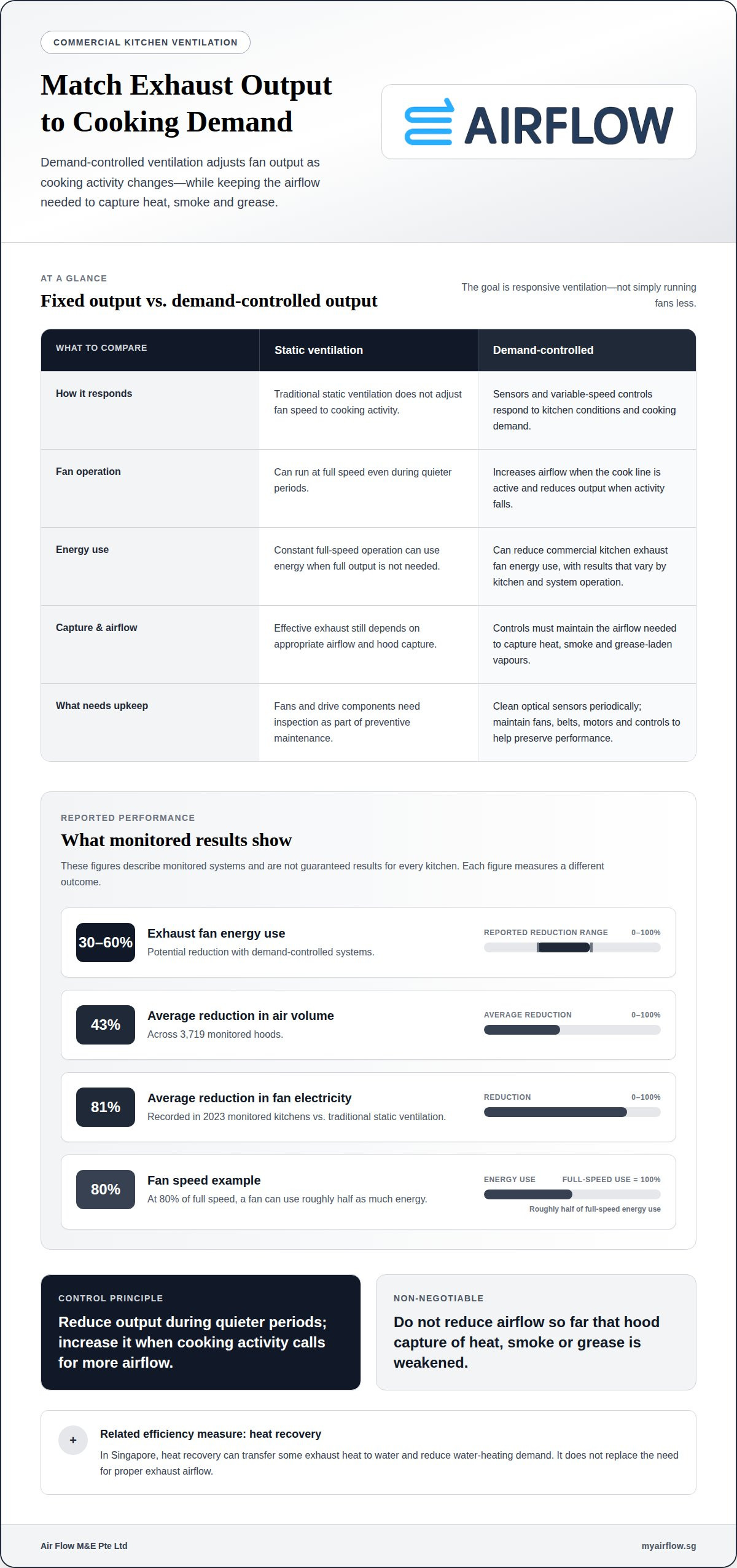
Sensor-based fan controls detect cooking activity and adjust ventilation rates to match kitchen conditions. Optical sensors can respond to heat or cooking emissions, prompting fans to increase airflow when the cook line is active and reduce it during quieter periods. This avoids running ventilation continuously at full output while maintaining capture when cooking creates more fumes. Clean optical sensors periodically to keep their readings useful.
Variable-Speed Exhaust Energy Savings
Variable-speed exhaust control changes fan speed as cooking demand rises or falls, instead of relying on constant full-speed operation. Demand-controlled systems can reduce commercial kitchen exhaust fan energy use by 30% to 60%. A fan running at 80% of full speed can use roughly half as much energy, illustrating why adjusting output can deliver energy savings during low activity. The control must still provide proper exhaust when cooking equipment is in use.
Results vary with kitchen use and system operation. Across 3,719 monitored hoods, demand-based ventilation reduced air volumes by an average of 43%. In 2023, monitored kitchens also recorded an average 81% reduction in fan electricity consumption compared with traditional static ventilation. These figures describe monitored systems, not a guaranteed result for every kitchen.
Controls need regular upkeep to preserve performance. Include exhaust fans, belts, motors and controls in a preventive maintenance programme. Clean optical sensors periodically, and inspect fans and drive components for wear or faults. A poorly maintained sensor may respond incorrectly, while worn belts or motor issues can affect fan operation. Proper maintenance helps keep ventilation dependable and the kitchen comfortable as cooking demand changes.
Why does commercial kitchen exhaust efficiency matter?
Efficient exhaust depends on suitable fan output, clear ductwork and balanced makeup air. In Singapore, consider applicable building and fire-safety provisions alongside how the hood captures cooking emissions.
High-Efficiency Fans and Variable-Frequency Drives
High-efficiency exhaust fans move the required airflow while using less electricity, and variable-frequency drives adjust motor speed to match demand. This matters because ventilation can account for 75% to 95% of a food service facility’s HVAC energy use in some cases. A drive can reduce fan speed during lower cooking loads, but settings must still support effective hood capture and air quality.
Balancing Exhaust and Makeup Air
Balancing means coordinating the air exhausted from the kitchen with the makeup air supplied to replace it. If the supply is poorly matched, doors may be harder to open, drafts may disrupt cooking, and the hood may capture fumes less effectively. Assess exhaust fans, ductwork and makeup-air delivery as one system. This helps maintain appropriate airflow without conditioning more replacement air than operations require.
Running Exhaust Fans Only When Needed
Run fans only when cooking equipment needs ventilation to avoid unnecessary energy use during idle periods. Exhaust fans should operate when cooking requires capture, but need not continue for hours after the cook line stops. Sensors or schedules can help align fan operation with kitchen activity. Savings come from reducing avoidable run time, not from switching off ventilation while heat, smoke or grease-laden vapours still need to be removed.
Risks of Reducing Exhaust Airflow
Reducing airflow too far can weaken capture, allowing smoke, heat and grease-laden vapours to spread through the kitchen. Grease can settle on surfaces or restrict filters, while poor capture can affect visibility and indoor air quality. Inadequate exhaust may also compromise the system’s intended fire-safety performance. Match airflow to cooking equipment and hood requirements. Efficiency must not come at the expense of effective capture.
For layout or airflow changes, commercial kitchen exhaust system alterations can address the hood, fan and ductwork as connected parts of the system.
Energy-efficient commercial kitchen ventilation
Energy efficiency depends on coordinating hood position, duct design, lighting and ventilation demand. In Singapore’s warm, humid conditions, excess exhaust can also increase the air-conditioning load.
Energy-Efficient Kitchen Design
Energy-efficient design places the exhaust hood over the cooking equipment and keeps duct routes smooth, direct and free from unnecessary bends. This reduces airflow resistance, helping the fan move air without working against avoidable pressure losses. The hood must still capture cooking emissions. For example, a kitchen ventilating 3 cubic metres per second for 12 hours daily moves almost 130,000 cubic metres of air per day, so unnecessary airflow can add up over each operating period.
The hood should suit the cooking equipment’s heat output and type. An oversized exhaust hood can extract more air than the cook line needs, increasing the volume of replacement air that may require conditioning. Good design weighs capture, temperature control and air quality together, rather than treating fan energy as the only measure of performance.
Grants, Incentives, and Energy Audits
For a Singapore kitchen, grant or incentive support depends on whether a current programme covers the business, equipment and proposed work. An energy audit can show where ventilation energy is used and help compare potential upgrades with actual operating patterns. Treat incentives as a possible contribution, not the basis of the investment case. Assess operating value using the equipment, run hours and energy use.
An audit is most useful when it records fan operation during busy and quiet periods, alongside makeup-air and cooling demand. This provides a practical baseline for assessing an upgrade. Review programme criteria before including funding in projections, since eligibility and covered measures determine whether support applies.
Lighting is another design consideration. LED canopy lights use less electricity than traditional incandescent bulbs and generally last longer. Proper canopy lighting can improve visibility over the cook line while reducing lighting consumption. Positioning light over food preparation also avoids relying on general room lighting alone.
Keep grease filters clean, and replace damaged or heavily worn filters rather than returning them to service. Grease buildup can restrict airflow, strain exhaust equipment and affect capture. Reviewing hood placement, duct resistance, fan operation and lighting together gives operators a clearer view of energy use across each operating period.
Commercial kitchen ventilation capital and operating costs
Compare the upfront investment with the operating costs an upgrade may affect. For a Singapore restaurant, include fan electricity, conditioned replacement air, maintenance and the exhaust volume required for proper capture. This whole-system view helps prevent a lower fan-energy estimate from obscuring added cooling demand or ongoing upkeep.
Capital spending may cover controls, fan or motor changes, hood adjustments and ductwork modifications. The scope depends on the existing commercial kitchen exhaust system, its layout and the airflow required by the cooking equipment. These components interact, so changing controls alone may not resolve a poorly matched hood or restrictive duct route. Define the operating issue first, then identify which system components the proposed work should address.
Operating costs continue after installation. Exhaust fans use electricity, while makeup air may add air-conditioning demand in Singapore’s warm, humid climate. Filters, sensors, belts, motors and controls also need maintenance. Include these recurring needs in the comparison rather than treating the initial equipment investment as the full cost of ownership.
Estimate potential savings from the kitchen’s actual schedule and demand. A restaurant with long quiet periods may have more opportunity to reduce unnecessary fan operation than one with a steadily operating cook line. Compare fan run time, cooking patterns and exhaust volume while preserving the airflow needed to capture smoke, heat and grease. Lower energy consumption can also reduce environmental impact, but operational performance remains essential.
Build a payback estimate around the project scope and savings the kitchen can sustain. Account for electricity, conditioned makeup air and maintenance over the same period. The calculation depends on factors such as operating hours, existing system performance and the changes required. Use kitchen-specific operating information rather than assuming results from another site will apply.
A sound decision weighs capital scope, ongoing electricity, maintenance and conditioned makeup air against expected operating changes. To discuss a project that addresses connected system components, discuss a commercial kitchen exhaust upgrade.
Air Flow M&E Pte: Commercial Kitchen Exhaust System Addition & Alteration (A&A) Services
Air Flow M&E Pte Ltd provides Commercial Kitchen Exhaust System Addition & Alteration (A&A) Services for commercial kitchens planning ventilation changes. Consider this service when an existing system needs alterations, or when hood, motor or ductwork changes form part of an upgrade.
Commercial Kitchen Hood Installation and Commercial Exhaust Motor Installation address key exhaust-system components. Custom-fitted ductwork can suit the kitchen’s layout. Coordinating these elements helps align the hood, fan and airflow with cooking operations rather than treating each change in isolation.
For energy-efficiency improvements, consider an A&A project when the current layout, equipment or exhaust performance needs to change. The scope can focus on the relevant system components and the commercial kitchen’s requirements.
Contact Air Flow M&E Pte Ltd or visit myairflow.sg to discuss your commercial kitchen exhaust project.
Turn Ventilation Findings Into a Practical Plan
Make the next step a clear decision about what needs attention first. Separate changes that affect airflow capture from those intended to reduce avoidable energy use. This keeps kitchen performance central and gives upgrade planning a defined purpose. A practical plan for how to reduce kitchen ventilation energy costs should fit the way your kitchen operates, not rely on a generic equipment change.
Before setting the project scope, identify the operational issue you want to address. Is the system difficult to adapt to changing cooking demand, or does the current hood, motor or layout need alteration? A precise scope makes it easier to assess the work against kitchen needs and consider its effect on day-to-day operations.
Air Flow M&E Pte Ltd can be part of that next conversation for a commercial kitchen exhaust project. Contact Air Flow M&E Pte Ltd to discuss the system changes you’re considering. A well-defined starting point can help your team move forward with confidence.
Frequently Asked Questions
How does maintenance protect your efficiency gains?
Maintenance helps prevent faults from increasing fan demand or weakening capture. Compare operating behaviour before and after servicing, and investigate unusual noise, vibration or inconsistent airflow. For sensor-controlled systems, clean sensors so they respond to cooking activity. A preventive maintenance programme can double a system’s life cycle, making upkeep important for sustained operation and replacement planning. It also helps identify deterioration before it affects daily kitchen performance.
How much can exhaust upgrades save on energy costs?
Commercial kitchen exhaust upgrades can cut energy use by up to 30%, but that describes energy, not a fixed dollar saving. A Singapore restaurant’s savings depend on operating hours, current fan consumption, cooking demand and the energy used to condition replacement air. Track these separately before estimating savings, then compare the change in consumption with the upgrade’s capital and ongoing operating costs.
Real-World ROI: How Quickly Can You Recover Costs?
Payback depends on the upgrade cost and the savings the kitchen can sustain. Estimate it by comparing the project’s capital cost with expected annual net savings, including electricity, conditioned makeup air and maintenance. A restaurant with long quiet periods may have different savings potential from one with steady cooking activity. Use the kitchen’s actual operating patterns and project scope to build a realistic investment comparison.
Which exhaust upgrade offers the fastest payback?
Demand-controlled ventilation is generally considered to offer its best return on investment in kitchens with exhaust flow rates of 5,000 CFM or higher. Below 3,000 CFM, investment typically doesn’t justify itself. These thresholds help screen options, but airflow alone doesn’t determine payback. Cooking schedules, fan use, conditioning load and retrofit scope also shape how quickly capital costs may be recovered.
What are the most effective ways to reduce commercial kitchen ventilation energy use?
Start by targeting energy use that doesn’t support active cooking or effective capture. Demand-based controls can align fan operation with kitchen activity, while clean filters and clear duct routes help avoid unnecessary resistance. When assessing how to reduce kitchen ventilation energy costs, include makeup-air conditioning. Excessive exhaust can increase the energy needed to treat replacement air, so preserve the airflow required to remove cooking emissions.
How much energy can demand-controlled kitchen ventilation save, and what does it cost in Singapore?
Demand-controlled kitchen ventilation can reduce commercial kitchen exhaust fan energy use by 30% to 60%. To assess how to reduce kitchen ventilation energy costs, compare potential savings with the project’s capital and operating costs. In Singapore, project costs depend on existing fan and control compatibility, sensor requirements, installation scope and airflow adjustments. Maintenance and makeup-air conditioning also affect the overall calculation.


